Can You Use US Dollars in Mexico? Understanding Where USD is Accepted
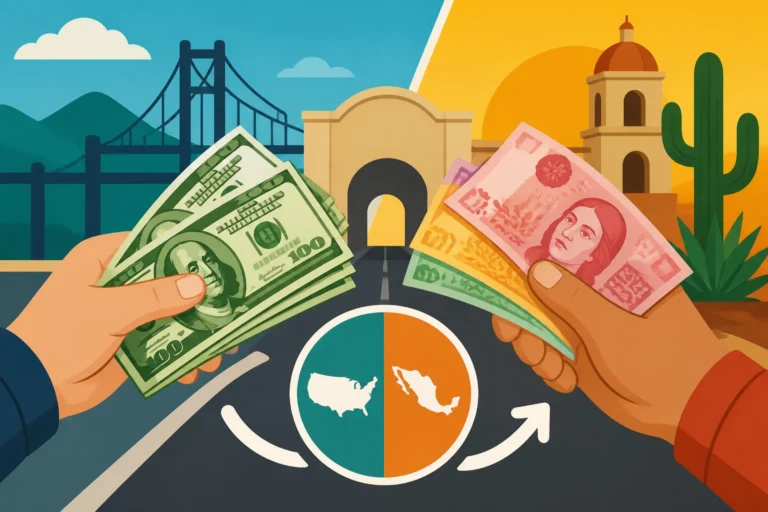
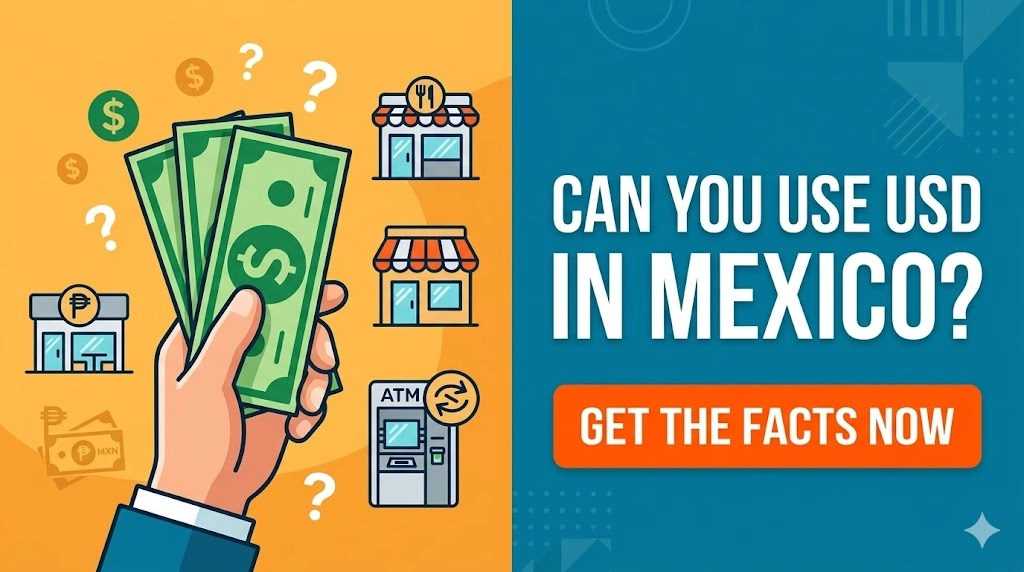
It is the most common question asked by tourists, newly minted remote workers, and prospective expats: Can you use US Dollars in Mexico? The short, highly simplified answer is: Yes, in certain areas, you can. The factual, financially responsible answer is: Yes, but doing so will cost you a fortune. This comprehensive guide completely strips away the tourist myths surrounding the US Dollar in Mexico. We are going to explore the strict legalities of foreign currency, map out exactly where the dollar is accepted (and where it is useless), break down the predatory exchange rates merchants use, and provide you with a bulletproof financial strategy to ensure you never lose your hard-earned money to the “convenience tax” of spending dollars abroad.
Disclosure: This post may contain affiliate links. We may earn a commission at no extra cost to you if you make a purchase through these links. Read full disclosure.
1. The Legal Reality: Legal Tender vs. Accepted Currency
The Mexican Peso is the Only Legal Tender
To understand how money works in Mexico, you must first understand the law. The Mexican Peso (MXN) is the official and only legal tender of the United Mexican States. Under Mexican federal law, no business, landlord, or government agency is legally obligated to accept United States Dollars, Canadian Dollars, or Euros.
When a restaurant in Playa del Carmen or a taxi driver in Los Cabos accepts your US Dollar, they are doing so entirely as a courtesy—and as a highly lucrative business strategy. Because the dollar is not legal tender, there is no federally mandated exchange rate that a private merchant must offer you. They are acting as an unregulated, independent currency exchange.
The Anti-Money Laundering Laws (Ley Antilavado)
Many Americans assume that “Cash is King” and that flashing a thick roll of US hundred-dollar bills will open any door in Mexico. In reality, the Mexican government severely restricts US cash transactions.
In an effort to combat cartel money laundering, Mexico introduced strict federal banking laws (often referred to as the Ley Antilavado) that placed hard caps on how many physical US Dollars businesses and banks can process.
- For Businesses: Many businesses simply cannot accept large US cash payments for high-value items (like jewelry, cars, or real estate) because they cannot legally deposit that cash into their corporate bank accounts without triggering massive federal audits.
- For Individuals: If you walk into a Mexican bank with $5,000 in physical US cash and attempt to deposit it or exchange it, you will be turned away. Mexican banks generally limit foreign cash exchanges for non-account holders to $300 USD per day, and strictly cap monthly deposits for account holders.
This legal friction is why your physical US Dollars are increasingly viewed as a liability by local Mexican businesses operating outside the immediate tourist zones.
2. The Geography of the US Dollar
Where you are standing in Mexico entirely dictates whether your US Dollar is viewed as a welcome payment method or a piece of useless foreign paper. The country’s economy is highly segmented.
The Heavily Dollarized Zones: Borders and Resorts
If you are in a massive, internationally recognized tourist hub, the US Dollar flows freely. In places like Cancún, Playa del Carmen, Tulum, Puerto Vallarta, and Los Cabos, almost every hotel, restaurant, and tour operator will gladly accept physical US Dollars. In these specific zones, menus and price tags are often dual-listed in both MXN and USD.
Similarly, in immediate border cities like Tijuana, Mexicali, and Nogales, the local economy is deeply binational. Because hundreds of thousands of people cross the border daily, the US Dollar acts as a parallel currency. Landlords price rent in dollars, and grocery stores have specific cash registers designed to accept them.
The Peso-Only Zones: The Interior and True Mexico
The moment you leave the immediate coastal resorts or the border wall, the US Dollar loses all its power. If you travel to the majestic capital of Mexico City (CDMX), the colonial highlands of San Miguel de Allende or Guanajuato, the culinary epicenter of Oaxaca, or the industrial powerhouse of Monterrey, your US cash is virtually useless for daily life.
If you attempt to pay for a coffee in a trendy Roma Norte cafe in Mexico City or buy fresh produce at the Mercado de Abastos in Oaxaca with a $20 US bill, you will be met with polite confusion or a firm “no.” These are thriving, massive domestic economies that operate exclusively on the Mexican Peso. Attempting to force the dollar in these regions marks you not just as a tourist, but as someone who is unprepared for reality.
3. The Exchange Rate Trap: The “Convenience Tax”
If you are in a tourist zone that does accept US Dollars, you must understand the brutal financial mathematics of what happens when you hand over that cash.
How Merchants Skim Your Wealth
When a merchant accepts your US Dollars, they are taking on a burden. They must eventually take that foreign physical cash to a local Casa de Cambio (exchange booth) or a bank, stand in line, and convert it to pesos to pay their suppliers and employees. To compensate for this hassle and the risk of the exchange rate dropping before they get to the bank, they apply a “convenience tax” by offering you a terrible exchange rate.
Let’s look at the math: Imagine you are at a restaurant in Cancún. Your meal costs 1,000 Mexican Pesos.
- The official mid-market interbank exchange rate that day is 18.00 MXN to 1 USD.
- If you pay with a card that has no foreign transaction fees, the meal costs you exactly $55.55 USD.
- However, if you want to pay in physical US cash, the restaurant will use their own “house rate,” which is often posted on a sign near the register. The house rate might be 15.00 MXN to 1 USD.
- At 15.00 MXN per dollar, the restaurant demands $66.66 USD to settle the 1,000 peso bill.
By choosing to pay in physical US Dollars, you just paid an invisible 20% markup on your meal. You lost $11 USD in purchasing power simply because you refused to use the local currency. Over a two-week vacation, or a first month of living abroad, relying on US cash will drain hundreds of dollars from your budget.
Getting Change in Pesos
Furthermore, even if you pay in US Dollars, you will almost never receive your change in US Dollars. The merchant will calculate the change owed using their terrible house rate, and hand you back Mexican Pesos. You have effectively been forced into one of the worst currency exchange transactions possible.
4. The Rules of Tipping in USD
Paper Bills are Appreciated, Coins are Useless
One of the few areas where using US Dollars is culturally acceptable and widely practiced is tipping—specifically in the heavy resort zones. If you leave a $5 or $10 US bill on the table for your waiter, or hand a $1 bill to the bellhop, they will gladly accept it.
However, there is a massive, unspoken rule that tourists constantly violate: Never, under any circumstances, tip with foreign coins. Mexican banks and exchange kiosks completely refuse to exchange foreign coins. If you leave four US quarters on the table as a tip, you have essentially left the waiter worthless pieces of metal. They cannot buy groceries or pay their electricity bill with a handful of American nickels and dimes. If you are going to tip in USD, it must be in clean, untorn paper bills.
Why Tipping in Pesos is Still Superior
Even though paper US Dollars are accepted as tips, tipping in Mexican Pesos is always superior and infinitely more respectful. When you tip in pesos, the service worker can use that money immediately on their commute home to buy dinner for their family. When you tip in US Dollars, you are forcing that worker to spend their time off standing in line at an exchange booth, where they will lose a percentage of their tip to the exchange spread.
If you want to be a financially savvy and culturally respectful traveler or expat, you must transition your mindset to the local currency as quickly as possible.
5. ATMs and Dynamic Currency Conversion (DCC)
If spending physical US Dollars is a terrible idea, the logical solution is to withdraw Mexican Pesos from a local ATM. However, this introduces you to the single most lucrative banking scam in the international travel industry: Dynamic Currency Conversion (DCC).
The ATM Trap Explained
When you land at the airport in Mexico City or Guadalajara, you should skip the brightly colored Casas de Cambio (exchange kiosks) with their terrible rates and walk directly to a formal bank ATM (such as BBVA, Santander, Banorte, or Citibanamex).
When you insert your US or Canadian debit card and request to withdraw 5,000 Pesos, the ATM recognizes your card is foreign. Before dispensing the cash, the screen will flash a highly deceptive prompt.
The prompt will say something like: “Would you like us to convert this transaction to US Dollars for your convenience? The total will be $315.00 USD.” It will feature a massive, glowing green ACCEPT button and a smaller, ominous red DECLINE button.
You must always hit DECLINE.
The Math Behind the Trap
If you hit ACCEPT, you are authorizing the Mexican bank to execute the currency exchange using their own inflated, predatory retail rate. They will typically bake a 5% to 10% markup into that rate.
If you hit DECLINE CONVERSION (or Rechazar Conversión), the ATM will still dispense your 5,000 Mexican Pesos. However, because you declined their conversion, the transaction is sent back to your home bank to be processed at the wholesale Visa or Mastercard interbank rate. By simply hitting the red decline button, you instantly save yourself $15 to $30 USD on a single withdrawal.
We break down the exact, step-by-step protocols for safely securing physical cash in our dedicated guide: Using ATMs in Mexico: Avoiding Fees and Staying Secure.
6. Credit Cards vs. Cash: When to Use What
The Power of the Right Credit Card
In modern Mexican cities, credit card acceptance is phenomenal. From mid-range restaurants and modern supermarkets to ride-sharing apps like Uber and DiDi, you can live a largely cashless lifestyle.
Using a credit card is the absolute best way to protect your purchasing power, provided you follow two strict rules:
- You must use a card with Zero Foreign Transaction Fees. If you use a basic, legacy debit or credit card, your home bank will slap a 3% fee on every single purchase you make abroad. Over a month of living or traveling, this is a massive drain.
- Always choose to pay in Local Currency. Much like the ATM trap, sometimes a restaurant’s physical credit card terminal will ask if you want to be charged in USD or MXN. Always select MXN. Let your premium credit card network handle the exchange rate, not the local restaurant’s bank.
The Necessity of Physical Pesos
Despite the rise of digital payments, Mexico retains a massive informal, cash-based economy. You absolutely must carry physical Mexican Pesos with you every single day.
You will need physical pesos for:
- Street food stalls (tacos, tamales, elotes).
- Neighborhood mercados and tianguis (open-air markets).
- Taxis (especially in areas where Uber is restricted, like Cancún or Oaxaca).
- Tipping grocery store baggers (who are exclusively volunteers and rely 100% on coin tips).
- Small purchases at local convenience stores (abarrotes).
- Public restrooms, which often charge 5 or 10 pesos for entry and toilet paper.
If you attempt to navigate these hyper-local environments with a $20 US bill or an American Express card, you will be turned away.
7. The Ultimate Expat Strategy: Bypassing Legacy Banking
If you are transitioning from a tourist to a long-term remote worker or expat, relying on your home-country debit card for daily ATM withdrawals becomes exhausting and financially inefficient. You need a systemic bridge between your US Dollar income and your Mexican Peso life.
The Problem with SWIFT Wires
If you open a local Mexican bank account to pay your rent and utilities, you must fund it. If you walk into a Bank of America or an RBC branch and ask to wire $2,000 USD to your new Mexican account, you are falling into the legacy banking trap.
Traditional banks use the archaic SWIFT network. They will charge you a $30 to $50 flat wire fee, the transfer will take three to five business days to clear, and worst of all, they will apply a terrible retail exchange rate spread, skimming 3% to 5% off your money before it crosses the border.
Leveraging the Fintech Revolution
To completely bypass this predatory system, the entire financially savvy expat community routes their cross-border capital through Wise. Utilizing Wise fundamentally changes the economics of living abroad.
By linking your home-country checking account to the Wise platform, you guarantee that your dollars are converted at the transparent, true mid-market exchange rate—the exact rate you see on Google. The platform clearly displays a microscopic, flat service fee before you hit send; there are zero hidden margins.
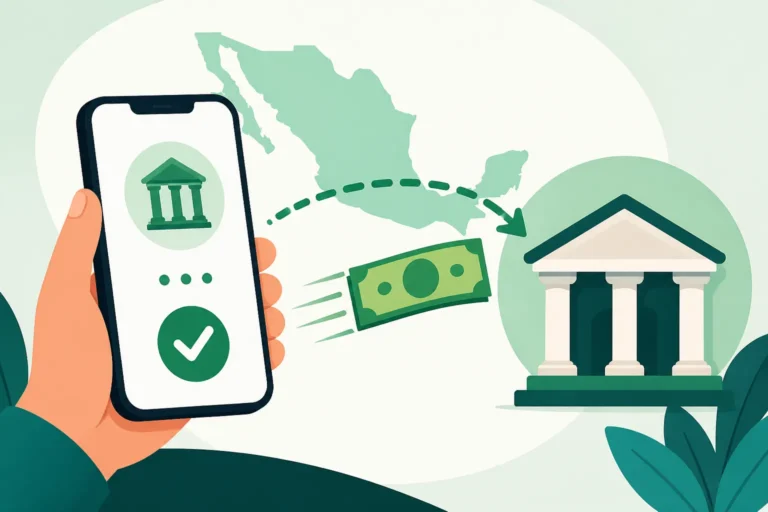
Furthermore, Wise completely bypasses the sluggish SWIFT network. They hold localized liquidity in Mexico. When you initiate a transfer, they simply instruct their Mexican accounts to push the equivalent pesos directly into your local Mexican bank account via the instantaneous domestic SPEI network. Your funds usually arrive in seconds.
By using Wise as the bridge between your two lives, you ensure that every single US dollar you earn stretches to its absolute mathematical maximum in the Mexican economy. We break down the exact logistics of these transfers in Transferring Money Internationally: Best Ways to Send Money to/from Mexico.
8. Managing Large Sums: Real Estate and Global Wealth
While Wise is the undisputed champion for your monthly living expenses, managing massive capital transfers—such as buying property or protecting a massive retirement portfolio—requires an entirely different level of financial architecture.
Buying Property: The Ban on Cash
If you are moving to Mexico to buy a beachfront condo in Puerto Vallarta or a colonial home in San Miguel de Allende, you might assume you can simply wire US dollars directly to the seller.
Under the aforementioned Ley Antilavado, real estate transactions in Mexico are heavily scrutinized. You cannot show up with a briefcase of US cash. Furthermore, while real estate prices in heavily expat-populated areas are often listed in USD as a marketing tactic, the actual, legal closing transaction executed by the Notario Público must be recorded and settled in Mexican Pesos at the official exchange rate of the day.
The Compliance Freeze Threat
If you attempt to wire $400,000 USD from your legacy retail brokerage account (like Vanguard or Charles Schwab) to a Mexican notary, you trigger massive compliance flags. If your US brokerage discovers that you have severed your US residential ties and established a permanent foreign address in Mexico, they will often forcefully restrict or close your accounts due to strict Patriot Act compliance laws. Being forced to liquidate your retirement portfolio simply because you relocated is a devastating, taxable disaster.
The Institutional Solution
To permanently neutralize this massive compliance threat and execute massive real estate transfers efficiently, proactive expats migrate their core wealth to Interactive Brokers before making major moves.
Because Interactive Brokers caters explicitly to a global, international clientele, you can legally and transparently maintain your global investment portfolio using your physical Mexican residential address. This ensures your wealth continues compounding securely in the US market, safely insulated from Mexican inflation.
More importantly, for massive purchases, Interactive Brokers provides direct access to institutional-grade spot-market foreign exchange. You can convert massive tranches of capital from USD to MXN directly inside your brokerage account at the raw interbank rate for commissions that amount to mere pocket change. You can then wire those converted pesos directly to the Mexican notary’s escrow account, retaining tens of thousands of dollars in equity that would have otherwise been stolen by retail banking spreads. We explore these advanced wealth preservation strategies deeply in Banking in Mexico: Complete Guide for Foreigners.
Conclusion: Stop Subsidizing Your Own Inconvenience
Can you use US Dollars in Mexico? In the immediate orbit of an all-inclusive resort or a border crossing, yes. But doing so is a voluntary choice to surrender your purchasing power. Every time you hand a merchant a US bill, you are subsidizing their exchange rate risk and paying an invisible convenience tax.
Living or traveling successfully in Mexico requires shedding the assumption that your home currency rules the world. By embracing the Mexican Peso, utilizing ATMs correctly to defeat dynamic currency conversion, and leveraging modern financial platforms like Wise for your daily cash flow and Interactive Brokers for your global wealth, you transition from a vulnerable tourist to a financially bulletproof expat. You stop giving your money away to predatory exchange kiosks and start keeping your hard-earned wealth exactly where it belongs: in your own pocket, funding the incredible lifestyle you have chosen south of the border.
References
Primary sources (official)
- Banco de México (Banxico): Official central bank portal detailing the legal tender status of the Mexican Peso, daily interbank exchange rates, and monetary policy. https://www.banxico.org.mx/
Other helpful sources
- Interactive Brokers: Institutional-grade global brokerage protecting expat wealth from domestic compliance freezes and facilitating spot-market currency exchange for major international purchases. https://www.interactivebrokers.com/
- Wise: Transparent cross-border transfer platform providing true mid-market exchange rates and executing instant domestic SPEI transfers to Mexican accounts. https://wise.com/
Disclaimer
The information provided in this article is for educational and informational purposes only and does not constitute financial, investment, legal, or tax advice. Mexican banking regulations, anti-money laundering limits on physical cash, and currency exchange markets are highly volatile and subject to frequent legislative changes by federal authorities. Attempting to time foreign exchange markets carries significant risk of financial loss. Always consult with a certified cross-border financial planner, a qualified tax professional, and legal counsel before opening foreign financial accounts, restructuring your retirement assets, or making significant international capital transfers. Ensure that any financial platforms or services mentioned meet your specific individual legal residency and compliance requirements.