ATM Withdrawal Limits in Mexico: How Much Cash Can You Get?
The immediate panic of being unable to access your own money in a foreign country is deeply valid. While Mexico has rapidly modernized its digital payment infrastructure in recent years, the reality is that the country still operates a massive, parallel cash economy. You cannot fully integrate into the local culture relying strictly on foreign credit cards. If you are trying to figure out exactly how much cash you can extract from a Mexican ATM in 2026, the answer is complex. This comprehensive guide demystifies the Mexican ATM network, detailing exact bank limits, exposing the hidden traps, and providing you with a bulletproof strategy to access your capital efficiently.
Disclosure: This post may contain affiliate links. We may earn a commission at no extra cost to you if you make a purchase through these links. Read full disclosure.
1. Why Cash is Still Mandatory in Modern Mexico
Before diving into the withdrawal limits, it is important to understand why you need to master the ATM network in the first place. Many newly minted expats assume that because they can use Apple Pay at a Starbucks in Roma Norte or a luxury beach club in Tulum, they can live a completely cashless lifestyle.
While digital wallets are gaining massive traction—a shift we explore thoroughly in Digital Payments in Mexico: Using Mobile Apps and Wallets (CoDi, etc.)—abandoning cash entirely severely limits your expat experience. You will absolutely need physical Mexican Pesos (MXN) for:
- Traditional Markets: If you want to buy fresh produce at the tianguis (open-air market) or local neighborhood mercados, cash is the only accepted currency.
- Street Food: The best culinary experiences in Mexico—from a corner taquería to a local tamale vendor—operate strictly on coins and small bills.
- Domestic Help: Weekly housekeepers, gardeners, and pool cleaners are almost universally paid in physical cash.
- Tipping Baggers: At major grocery stores like Walmart, Chedraui, or Soriana, the individuals bagging your groceries are volunteers. They receive no hourly wage and rely entirely on your coin tips to survive.
- Traditional Landlords: While modern property managers accept bank transfers, many older, traditional Mexican landlords still heavily prefer (or strictly demand) monthly rent paid in physical pesos.
Trying to navigate these hyper-local environments with a premium foreign travel credit card marks you not just as a tourist, but as someone functionally disconnected from the local economy.
2. The Dual-Limit Dilemma: Why Your Transaction Failed
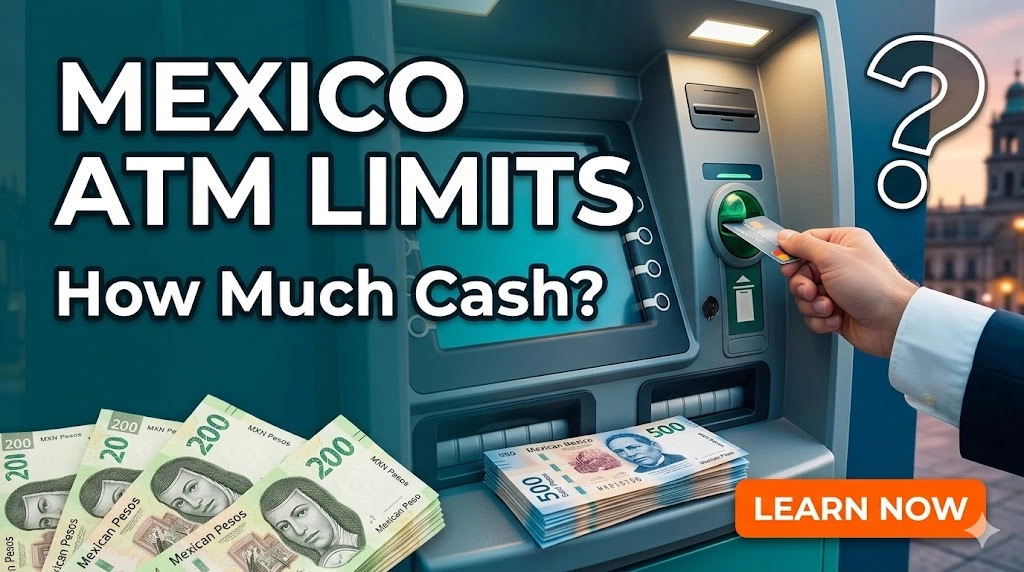
The most common point of confusion for foreigners using Mexican ATMs is understanding who is actually blocking their transaction. When an ATM spits out a receipt saying “Transaction Declined” or “Exceeds Limit,” it is usually due to the dual-limit system. Every time you insert your card, you are restricted by two entirely separate ceilings:
Ceiling 1: Your Home Bank’s Daily Limit
Your bank in the United States, Canada, or Europe imposes a strict daily cash withdrawal limit on your debit card to protect against fraud. For a standard checking account, this limit is typically between $500 and $1,000 USD (or the equivalent in EUR/CAD) per 24-hour rolling period.
If you try to withdraw 20,000 Mexican Pesos (roughly $1,100 USD), the transaction will fail not because the Mexican ATM lacks the cash, but because your home bank’s algorithm instantly blocked the request for exceeding your daily security cap. Before you travel or attempt a large withdrawal, you must log into your home banking app and manually raise your daily international ATM limit.
Ceiling 2: The Mexican ATM’s Transaction Limit
Even if your home bank allows you to withdraw $2,000 USD a day, the physical Mexican ATM has its own internal security limits. Mexican banks impose a strict maximum amount of pesos you can withdraw per transaction.
Furthermore, ATMs have physical limitations. The dispenser slot can only push out a certain number of banknotes (usually around 40 bills) at a single time. If the machine only has 200-peso notes available, it simply cannot physically dispense 15,000 pesos in one go. If you need more cash than the ATM’s single-transaction limit allows, you must perform back-to-back transactions—which means you will be charged the local ATM fee multiple times.
3. 2026 Breakdown: Mexican Bank ATM Limits and Fees
Not all ATMs in Mexico are created equal. The amount of cash you can withdraw and the fee you are charged vary wildly depending on which bank’s logo is printed on the machine. Based on 2026 banking data, here is the factual breakdown of the major Mexican financial institutions:
The High-Limit Heavyweights
If you need to pull out a massive amount of cash to pay a deposit or a contractor, you need to target the banks with the highest per-transaction limits.
- Santander: Consistently a favorite among expats, Santander ATMs offer some of the highest withdrawal limits in the country, allowing up to 11,000 to 12,500 MXN per transaction. Furthermore, their usage fee is moderate, typically hovering between 30 and 45 MXN.
- BBVA: As Mexico’s largest bank, BBVA machines are ubiquitous. They also allow very high withdrawals, usually up to 11,000 to 12,000 MXN per day. However, there is a massive catch. BBVA has realized they control the market and frequently charge exorbitant fees to foreign cards, often demanding 170 to 220 MXN (roughly $10 to $12 USD) just to use their machine. Unless it is a dire emergency, using a BBVA ATM is a terrible financial decision.
- Banco Azteca: Often found inside Elektra department stores, these ATMs generally allow up to 10,000 MXN per transaction with moderate fees.
The Reliable Mid-Tier Banks
These banks strike a solid balance between reasonable limits and low access fees.
- Citibanamex (Banamex): A subsidiary of Citigroup, Banamex is highly reliable. They typically allow withdrawals of up to 9,000 MXN per transaction. Their ATM fee is highly competitive, usually sitting around 30 to 40 MXN.
- Banorte: A massive domestic bank that generally limits foreign cards to 7,000 to 9,000 MXN per transaction. Their fees vary by location but usually range from 40 to 70 MXN.
- Scotiabank: A great option, especially for Canadian expats who bank with Scotiabank back home (as fees are often waived through the Global ATM Alliance). Standard limits hover around 9,000 MXN, with an access fee of roughly 50 to 100 MXN for non-alliance cards.
The Low-Fee Underdogs
If you only need a smaller amount of walking-around cash (e.g., 3,000 to 5,000 MXN) and want to minimize your overhead, look for these specific regional and secondary banks. They offer the lowest ATM surcharge fees in Mexico, though their transaction limits may cap out earlier (around 5,000 to 8,000 MXN).
- Banca Mifel: Exceptional value, frequently charging less than 20 MXN per withdrawal.
- Banco Inbursa: Located inside many Sanborns department stores, they charge roughly 20 to 25 MXN.
- BanBajío: A regional powerhouse with fees often sitting in the low 20s (MXN).
Understanding how these banks fit into your broader localized financial strategy is a concept we explore deeply in Banking in Mexico: Complete Guide for Foreigners.
4. The Three Pillars of ATM Costs
When you extract cash from a Mexican ATM using a foreign debit card, your money is subjected to a gauntlet of potential fees. To protect your budget, you must understand the three distinct ways the banking sector attempts to skim your wealth.
Pillar 1: The Surcharge (Cuota)
This is the flat fee charged by the Mexican bank that owns the physical ATM. It pays for the convenience, electricity, and security of the machine. As outlined above, this fee can range from a highly reasonable 20 to 25 MXN at Inbursa to an outrageous 220 MXN at BBVA. You will always be notified of this fee on the screen and asked to accept it before the machine dispenses cash.
Pillar 2: Your Home Bank’s Foreign Transaction Fee
Your bank in the US, UK, or Canada may penalize you simply for using an out-of-network, international ATM. Traditional retail banks often charge a flat out-of-network fee (e.g., $5.00 USD) plus a percentage-based foreign transaction fee (typically 1% to 3% of the total withdrawal amount). If you use a legacy bank card, you are effectively paying a massive penalty for accessing your own money. To avoid this, you must travel with a card optimized for international use that explicitly waives foreign transaction fees.
Pillar 3: The Dynamic Currency Conversion (DCC) Trap
This is the single most lucrative banking trap in the international travel industry, and millions of tourists fall for it every year.
When you request 10,000 pesos, the Mexican ATM recognizes your card is linked to a foreign currency (like US Dollars). Before dispensing the cash, the screen will suddenly display a prompt stating something like: “Would you like us to convert this transaction to US Dollars for your convenience? Your account will be charged $610.00 USD.”
The screen is heavily designed using psychological manipulation. The “ACCEPT” button is usually massive and glowing green, while the “DECLINE” button is small and red.
You must always press DECLINE CONVERSION (Rechazar Conversión).
If you press “Accept,” you are authorizing the Mexican ATM’s bank to execute the currency exchange using their own inflated, predatory retail rate. They typically bake a 5% to 10% markup into that rate.
If you press “Decline,” the ATM will still dispense your 10,000 Mexican Pesos. However, because you declined their conversion, the transaction is sent back to your home bank’s network (Visa or Mastercard) to be processed at the highly competitive wholesale interbank rate. By simply pressing the red decline button, you instantly save yourself $30 to $60 USD on a single withdrawal. We detail the mechanics of this trap and safe card usage in Using ATMs in Mexico: Avoiding Fees and Staying Secure.
5. Bypassing the ATM Grind: Smarter Financial Pipelines
While understanding ATM limits is vital for daily cash management, relying entirely on ATMs to fund a long-term expat lifestyle is exhausting, dangerous, and financially inefficient. If you need to pay a landlord 30,000 MXN in cash every month, standing at a Santander ATM for three consecutive days doing back-to-back max withdrawals is a miserable way to live.
To truly thrive abroad, you must build robust financial pipelines that bypass the retail banking sector entirely.
The Daily Operational Bridge: Using Wise
To eliminate the anxiety of hitting daily ATM limits and the frustration of stacking foreign transaction fees, the savvy expat community routes their monthly living expenses through Wise.
Instead of fighting with cash limits to pay for major localized expenses, you can use Wise to push funds directly from your home-country checking account to a Mexican landlord, a local mechanic, or your own local Mexican bank account. Wise guarantees the true mid-market exchange rate—the exact rate you see on Google. They bypass the sluggish SWIFT banking network, depositing your pesos instantly via the domestic SPEI network.
Furthermore, if you utilize the physical Wise debit card, it automatically converts your home currency to pesos at that same mid-market rate when you withdraw from local ATMs, completely insulating you from your home bank’s 3% international penalty fees. It is the ultimate tool for stretching your monthly budget, a strategy we detail extensively in Transferring Money Internationally: Best Ways to Send Money to/from Mexico.
Managing Massive Capital: Interactive Brokers
If your cash needs exceed daily rent and groceries—such as buying a used vehicle in cash for 300,000 MXN or placing a massive deposit on a beachfront condo—attempting to fund these purchases via ATMs is functionally impossible.
For massive capital transfers, proactive expats utilize Interactive Brokers. Because Interactive Brokers caters to a global clientele, it provides direct access to institutional-grade spot-market foreign exchange. You can convert massive tranches of capital from USD or CAD directly into Mexican Pesos inside your brokerage account at the raw interbank rate. You can then wire those converted pesos directly to the Mexican notary or dealership, retaining tens of thousands of dollars in equity that would have otherwise been stolen by retail banking spreads.
This level of financial architecture separates the struggling tourist from the optimized, secure expat.
6. ATM Safety and Security Best Practices in Mexico
When you are withdrawing the maximum limit of 10,000+ MXN (which equates to roughly half the average monthly salary of a Mexican worker), you must prioritize your physical and digital security.
Avoid Standalone Machines
Never use a standalone ATM located on a street corner, in a dark alley, or tucked away in a dimly lit convenience store. These machines are massive targets for tampering. Criminals frequently install “skimmers” (devices placed over the card slot that read your card’s magnetic stripe) and tiny, hidden cameras pointed at the keypad to record your PIN.
Always use ATMs located inside a formal bank branch. Branch ATMs are heavily monitored by high-definition security cameras, guarded by physical bank personnel, and physically inspected by managers daily, making it incredibly difficult for criminals to install skimming devices.
The “Quincena” Effect
In Mexico, the traditional payday structure is known as the Quincena—workers are paid on the 15th and the 30th (or 31st) of every month.
If you attempt to visit an ATM on the evening of the 15th or the 1st of the month, you will be met with absolute chaos. Lines will wrap around the block, and the machines will frequently run completely out of cash by the late afternoon. To ensure you have the cash you need, you must proactively time your maximum withdrawals to occur during the middle of the week, avoiding the localized payday rush entirely.
The “Big Bill” Dilemma
When you request a massive withdrawal of 10,000 MXN, the machine will almost certainly dispense a thick stack of 500-peso notes. While these are convenient to carry, they are highly impractical for daily life.
A local street vendor selling a 25-peso elote or a taxi driver completing a 60-peso ride will not have change for a 500-peso note. If you try to hand them one, they will refuse the sale. When you receive large bills from an ATM, immediately walk into the bank branch or a large corporate supermarket (like OXXO or 7-Eleven) to break a few of those 500-peso notes into smaller 100s, 50s, and 20s. Managing your denominations is a core component of daily survival.
Conclusion: Take Control of Your Capital
Understanding Mexican ATM withdrawal limits is not just about knowing how many buttons to press; it is about taking absolute control of your financial destiny abroad.
You can extract significant amounts of cash—often upwards of 10,000 to 12,000 MXN per transaction—provided you navigate the dual-limit system correctly, choose a mid-tier bank like Santander or Banamex to avoid exorbitant fees, and ruthlessly decline the predatory Dynamic Currency Conversion trap every single time.
By mastering the ATM network for your small daily needs, and leveraging powerful, transparent platforms like Wise and Interactive Brokers for your massive capital flows, you transition from a vulnerable target to a highly secure, financially optimized expat. You stop giving your wealth away to banking algorithms and start keeping your money exactly where it belongs: funding the incredible lifestyle you have chosen to build in Mexico.
References
Primary sources (official)
- Banco de México (Banxico): Official central bank portal detailing banking regulations, consumer rights regarding exchange rates, and monetary policy affecting the peso. https://www.banxico.org.mx/
Other helpful sources
- Interactive Brokers: Institutional-grade global brokerage protecting expat wealth from domestic compliance freezes and facilitating spot-market currency exchange for massive capital transfers. https://www.interactivebrokers.com/
- Wise: Transparent cross-border transfer platform providing true mid-market exchange rates and executing instant domestic SPEI transfers to Mexican accounts. https://wise.com/
Disclaimer
The information provided in this article is for educational and informational purposes only and does not constitute financial, investment, legal, or tax advice. Mexican banking regulations, individual ATM withdrawal limits, and specific institutional surcharge fees (cuotas) are highly dynamic and subject to unannounced changes by local bank operators. Exchange rates and banking policies fluctuate constantly. Always consult directly with your home financial institution regarding out-of-network international fees and daily security limits before traveling or relocating. Ensure that any financial platforms, brokerages, or services mentioned meet your specific individual legal residency and international compliance requirements.