Cost of Living: Mexico vs USA – How Much Can You Save?
Watching my US utility bills and health insurance premiums swallow my entire monthly paycheck used to keep me awake at night. I remember the pure relief of paying my first Mexican medical bill in cash for less than the cost of an American copay. This guide breaks down the true 2026 cost of living comparison between Mexico and the USA, showing exactly how much you can realistically save.
Disclosure: This post may contain affiliate links. We may earn a commission at no extra cost to you if you make a purchase through these links. Read full disclosure.
Housing and Real Estate: The Biggest Financial Divide
The Reality of Renting: Urban vs Suburban Costs
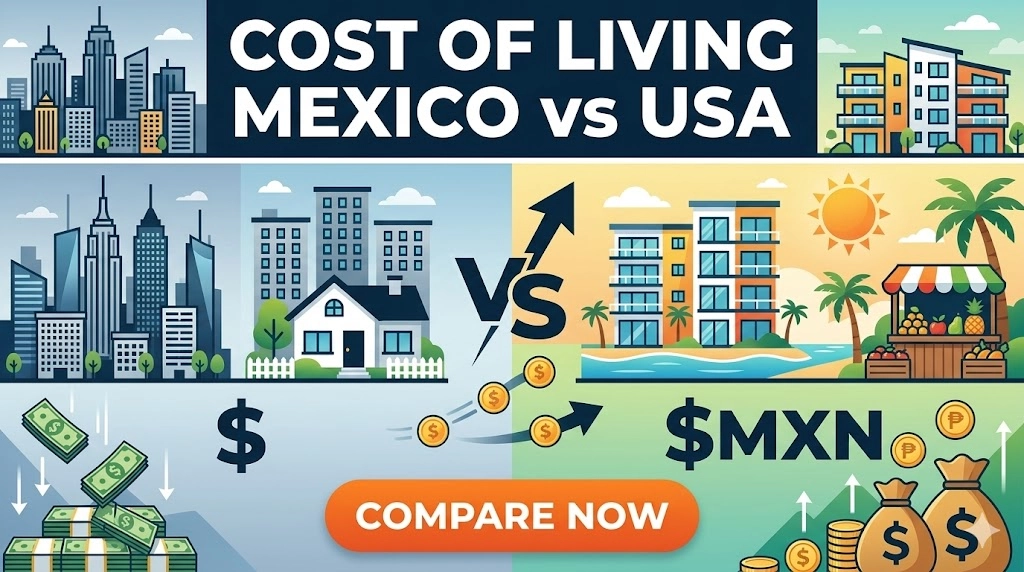
In the United States, housing costs have spiraled completely out of control, consuming up to 40% or 50% of the average American’s take-home pay in 2026. A standard one-bedroom apartment in a mid-tier American city center easily averages $2,000 to $2,500 USD per month. In stark contrast, housing in Mexico remains the single largest area of financial relief for expats. Rent for a one-bedroom apartment in a Mexican city center typically ranges from $400 to $800 USD per month—often reflecting a 400% to 500% difference.
The disparity is even more pronounced when you step outside the gentrified expat bubbles of Roma Norte or Tulum. In culturally rich, mid-sized Mexican cities like Querétaro or Mérida, you can secure a spacious three-bedroom home with a garden for under $1,000 USD monthly—a property that would easily demand over $3,500 USD in a comparable US suburb. However, securing these local rates requires navigating the local market in Spanish and avoiding inflated short-term rental platforms. We break down the negotiation and leasing process deeply in Renting a Home in Mexico: Complete Expat Guide to Leases, Deposits, and More.
Buying Property: Mortgages and the Fideicomiso
When it comes to purchasing property, the Mexican market operates under a completely different paradigm. Buying a single-family home in the US suburbs costs roughly 115% to 150% more than purchasing a comparable property in Mexico. However, the financing structures are vastly different. US buyers are accustomed to 30-year fixed-rate mortgages currently hovering around 6.5%. In Mexico, local mortgage interest rates for foreigners are punitively high, often exceeding 11% to 14%.
Because of these exorbitant lending rates, the vast majority of expats buy their Mexican homes outright in cash. This requires moving hundreds of thousands of dollars across the border. If you rely on a traditional US retail bank for this massive wire, hidden exchange rate spreads will siphon off thousands of dollars in invisible fees. To completely bypass this, savvy buyers use Wise to secure the true mid-market exchange rate, ensuring their purchasing power isn’t decimated before closing.
Furthermore, if you are buying within 50 kilometers of the coast or 100 kilometers of a border, you must utilize a bank trust system. This legal structure incurs annual banking fees of $500 to $1,000 USD, which must be factored into your long-term carrying costs.
Utilities and Home Maintenance Savings
Beyond the base rent or mortgage, the daily carrying costs of a home highlight a massive divergence between the two nations. In the US, heating, electricity, water, and garbage collection for a family home routinely exceed $250 to $400 USD per month. In Mexico, these basic utilities are heavily subsidized by the government, meaning your combined utility bill for a standard apartment will frequently sit between $30 and $60 USD monthly.
The true luxury of Mexican living, however, comes in the form of home maintenance and domestic labor. Hiring a specialized tradesperson—like a plumber, electrician, or weekly housekeeper—costs a fraction of what it does in the United States. In 2026, a full day of deep cleaning by a professional domestic worker in Mexico costs between $20 and $35 USD, whereas the equivalent service in the US would easily exceed $200 USD.
This affordability fundamentally alters your quality of life. Middle-class expats in Mexico frequently employ weekly gardeners and housekeepers, freeing up immense amounts of personal time. It is vital, however, to treat these workers ethically, paying above minimum wage and adhering to local bonus customs—a responsibility that is an inherent part of the expat social contract.
Healthcare and Medical Insurance: A Complete Paradigm Shift
Public vs Private Healthcare Systems
The American healthcare system is notorious globally for its astronomical costs, opaque billing, and the terrifying prospect of medical bankruptcy. For many US citizens, the primary motivator for moving to Mexico is escaping monthly health insurance premiums that frequently resemble a second mortgage. In the US, a family’s private health insurance premium can exceed $1,500 USD per month, often saddled with a $5,000 deductible.
Mexico offers a dual system: a public healthcare program (IMSS) available to legal residents, and a thriving, world-class private sector. While expats can buy into the public IMSS system for roughly $300 to $500 USD per year, the wait times and bureaucracy push most foreigners toward the private sector. Even paying entirely out-of-pocket, private Mexican healthcare is wildly more affordable than its northern counterpart.
A premium, comprehensive international health insurance policy covering major surgeries and hospitalization in top-tier Mexican private hospitals usually costs between $150 and $300 USD per month for a healthy adult. This means you can secure gold-standard, global coverage for a fraction of your American premium. We evaluate these crucial safety nets in Choosing Private Health Insurance: Local Mexican Plans vs International Coverage.
Out-of-Pocket Costs for Routine and Specialist Care
The most refreshing aspect of Mexican healthcare is the transparent, upfront pricing. In the United States, booking an appointment with a specialist often requires a referral labyrinth, weeks of waiting, and a surprise bill of $200 to $400 USD just to walk through the door. In Mexico, you can book a top-tier, English-speaking specialist—such as a cardiologist or a dermatologist—directly via WhatsApp.
A standard consultation with a private specialist in Mexico City or Guadalajara currently averages $30 to $50 USD. Dental care presents an even starker contrast; routine cleanings, fillings, and complex procedures like root canals are roughly 80% cheaper than in the US, with equivalent hygiene standards and modern technology. This pricing structure allows many expats to effectively self-insure for routine care.
For catastrophic emergencies, however, out-of-pocket costs can escalate rapidly. Mexican private hospitals demand upfront deposits before admission. To ensure you aren’t stranded due to US credit card fraud blocks, maintaining an agile spending account is vital. For exact pricing data on specific procedures, review Healthcare Costs in Mexico: Doctor Visits, Hospital Stays, and Surgery Expenses.
Prescription Medications and Pharmacy Access
The pharmaceutical landscape in the United States is heavily monopolized, leading to life-saving medications costing ten to fifty times more than they do in neighboring countries. In Mexico, the pharmaceutical market operates on a much more accessible, consumer-friendly model that slashes monthly medical budgets.
Common medications for blood pressure, cholesterol, and diabetes are available over-the-counter without a doctor’s prescription at major national chains like Farmacias del Ahorro or San Pablo. A month’s supply of a generic maintenance medication that might cost $80 USD in the US with insurance can frequently be purchased in Mexico for under $10 USD in cash.
Furthermore, many pharmacies employ on-site doctors (consultorios) who charge roughly $3 USD for a basic consultation if you do need a prescription for antibiotics. This completely eliminates the American hurdle of scheduling a $150 doctor’s visit and waiting three days just to treat a minor sinus infection or stomach bug.
Daily Living: Groceries, Dining, and Transportation
Supermarkets vs Local Mercados
Grocery shopping highlights a fascinating economic divide between the two countries. Overall, grocery prices in the US are approximately 83% higher than in Mexico. However, maximizing this savings requires adapting your consumer habits to the local environment. If you insist on shopping at massive corporate supermarkets in Mexico (like Walmart or Chedraui Selecto) and purchasing imported American brands, your grocery bill will quickly inflate.
The true savings—and the best culinary experiences—are found in the traditional Mexican mercados and weekly tianguis (open-air street markets). By shopping locally, a couple can easily purchase a week’s worth of fresh, vibrant produce, locally butchered meat, and artisan cheeses for under $30 USD. The agricultural abundance of Mexico means seasonal eating is both a financial and nutritional superpower.
Items like fresh avocados, limes, tomatoes, and tropical fruits cost literal pennies on the dollar compared to US prices. Conversely, imported luxury items like European wine, specific gluten-free baking flours, or American peanut butter carry heavy import taxes. Mastering this hybrid shopping lifestyle is deeply explored in Grocery Shopping in Mexico: Supermarkets vs Local Markets.
The Expat Dining Advantage
Dining out is deeply ingrained in the Mexican social fabric, and the economics of restaurant culture are vastly superior to the United States. In the US, a mid-range, three-course dinner for two people frequently exceeds $80 to $100 USD, before factoring in a mandatory 20% tip. Fast food has also become prohibitively expensive, with a basic combo meal routinely crossing the $12 mark.
In Mexico, the spectrum of dining options caters to every budget. You can enjoy an incredible, authentic street-food lunch of tacos or tamales for under $4 USD. A fixed-price, multi-course lunch (comida corrida) at a neighborhood diner usually runs $5 to $7 USD. Even if you choose to dine at a highly rated, mid-range restaurant in a trendy neighborhood, a beautiful meal for two with craft cocktails will rarely exceed $35 to $50 USD.
Tipping in Mexico is culturally standard but hovers around 10% for good service and 15% for excellent service. This overall affordability completely transforms your social life. Expats in Mexico find themselves dining out, attending cultural events, and socializing significantly more often than they could afford to back home.
Owning a Car vs Public Transit
Transportation logistics offer another major avenue for savings, depending entirely on your chosen lifestyle. In the US, owning a car is a strict necessity in 95% of the country. Factoring in car payments, exorbitant insurance premiums, gasoline, and maintenance, the average American spends over $800 USD a month just to remain mobile.
Mexico presents a highly viable alternative: living completely car-free. Major hubs like Mexico City boast massive, deeply subsidized metro systems where a ride costs roughly $0.25 USD. Ride-sharing apps like Uber and DiDi are ubiquitous and astonishingly cheap; a 20-minute ride across town typically costs between $3 and $6 USD. For many expats, relying exclusively on walking and Uber is vastly cheaper than vehicle ownership.
If you do choose to purchase a car locally, be prepared for high upfront costs. Used cars in Mexico hold their value exceptionally well, and local auto loan interest rates are punitive. Buying in cash is highly recommended. To execute this without losing money on exchange rates, utilize modern transfer platforms to move your capital securely.
Financial Logistics: Managing Money Across Borders
Escaping Hidden Bank Fees on Transfers
The greatest mistake newly relocated expats make is treating their financial logistics exactly as they did in the US. When you move to Mexico, you must regularly convert dollars to pesos to fund your daily life. If you rely on traditional US retail banks (like Chase or Bank of America) to wire your rent or use their debit cards at Mexican ATMs, you are being robbed blindly by “Dynamic Currency Conversion” and flat withdrawal fees.
Traditional banks bake massive profit margins into their exchange rates, often skimming 3% to 5% off your money before it ever reaches Mexico. Over a single year, this invisible “expat tax” can cost you thousands of dollars. To permanently escape this trap, the entire expat community relies on Wise.
By funneling your monthly living expenses through Wise, you guarantee the true mid-market exchange rate—the exact same rate you see on Google or financial news networks. Wise bypasses the sluggish SWIFT banking network, depositing your pesos instantly into your local Mexican bank account via the domestic SPEI system. It is the single most powerful tool for protecting your budget, a core philosophy we detail in Transferring Money Internationally: Best Ways to Send Money to/from Mexico.
Protecting Your Nest Egg and Investments
While you must manage your daily liquidity in pesos, keeping your life savings localized in a Mexican retail bank is incredibly dangerous. The Mexican peso is an emerging market currency subject to intense geopolitical volatility. Furthermore, maintaining significant assets abroad triggers complex IRS reporting requirements (like FBAR and FATCA) that can result in draconian fines if mishandled.
To protect your wealth, you must maintain your primary retirement accounts, stock portfolios, and emergency funds in hard currency (USD) within a globally compliant brokerage. The problem is that many US brokerages (like Fidelity or Vanguard) will forcefully close your account if they discover you have a permanent foreign address due to Patriot Act compliance.
To prevent a catastrophic compliance freeze, proactive expats migrate their assets to Interactive Brokers. Because Interactive Brokers caters explicitly to an international clientele, you can legally maintain your global investment portfolio using your Mexican residential address. This ensures your wealth continues compounding in the US market, safely insulated from Mexican inflation, while remaining instantly accessible. We cover these vital defensive strategies in Banking in Mexico: Complete Guide for Foreigners.
Tax Implications and Local Banking Realities
Moving to Mexico does not sever your relationship with the IRS. The United States taxes its citizens on worldwide income, regardless of physical residency. However, if you spend more than 183 days a year in Mexico, the Mexican tax authority (SAT) also considers you a tax resident, obligating you to declare your global income to them as well.
This dual-taxation threat paralyzes many prospective expats. Fortunately, robust double-taxation treaties exist between the US and Mexico. Utilizing tools like the Foreign Earned Income Exclusion (FEIE) or Foreign Tax Credits ensures you do not pay taxes twice on the same dollar. However, navigating this requires a specialized cross-border accountant.
Locally, you will absolutely need a Mexican bank account (BBVA, Banorte, or Santander) to pay utility bills, sign a lease, and integrate into the local CoDi digital payment networks. Setting up this account requires formal residency, a Mexican tax ID (RFC), and extreme patience with local bureaucracy. We untangle these dual-country obligations comprehensively in Taxes in Mexico for Expats: A Complete Guide to Income Tax and More.
The Final Verdict: How Much Will You Actually Save?
The “Lean and Local” Expat Budget
So, what is the actual bottom line? For individuals willing to fully immerse themselves in the local culture, the savings are astronomical. The “Lean and Local” budget targets smaller, non-touristy colonial cities like Guanajuato or Xalapa. In these locations, expats rent modest, un-air-conditioned apartments, shop exclusively at the mercados, and utilize public transit.
On this budget, a single person can live a vibrant, healthy, and stress-free life for roughly $1,000 to $1,200 USD per month. This is a financial reality that is entirely extinct in the United States. You are entirely immune to the crushing housing crisis back home, and your daily stress levels plummet. You will rely on tools like Wise to tightly manage your currency conversions, ensuring every penny stretches as far as possible.
The “Comfortable Middle-Class” Expat Budget
This is the tier where the vast majority of North American expats land. The “Comfortable” budget targets highly desirable, safe hubs like Mérida, Lake Chapala, or the residential neighborhoods of Puerto Vallarta. At this level, you rent a modern, two-bedroom apartment with air conditioning and high-speed internet.
You adopt a hybrid shopping model, enjoy high-quality international health insurance, dine out at nice restaurants several times a week, and utilize Uber daily. For a couple, this lifestyle typically costs between $2,000 and $2,800 USD per month. To achieve this exact standard of living in a desirable US coastal city, a couple would easily need to spend $6,000 to $8,000 USD monthly. The savings here represent pure, retained wealth that can be redirected into your Interactive Brokers portfolio to secure an early retirement.
The “Luxury Coastal” Expat Budget
If your goal is to live in a highly gentrified, beachfront enclave like Tulum, Los Cabos, or the upscale Polanco district in Mexico City, your budget will scale aggressively. At this tier, you are renting luxury condos with ocean views, dining at Michelin-starred restaurants, shopping at premium imported supermarkets, and employing full-time domestic staff.
Even at this elite level, the savings compared to the US are significant. A luxury lifestyle in Mexico typically costs a couple $4,000 to $6,000+ USD per month. Attempting to replicate this exact level of beachfront luxury, domestic staffing, and constant fine dining in Miami, Los Angeles, or Honolulu would cost well over $15,000 USD a month. Whether you are living lean or living large, the economic arbitrage of moving to Mexico remains one of the most powerful financial strategies available to the modern North American. For a granular look at these specific budget tiers, explore Cost of Living in Mexico: 2026 Comprehensive Guide.
References
Primary sources (official)
- Banco de México (Banxico): Official central bank data on inflation, exchange rates, and monetary policy affecting the Mexican economy. https://www.banxico.org.mx/
- U.S. Bureau of Labor Statistics (BLS): Official US government data on inflation, consumer price indexes, and domestic housing costs. https://www.bls.gov/
Other helpful sources
- Numbeo: Crowd-sourced, highly detailed cost of living comparison database comparing US and Mexican cities in real-time. https://www.numbeo.com/cost-of-living/
- Interactive Brokers: Institutional-grade global brokerage protecting expat wealth and facilitating currency exchange. https://www.interactivebrokers.com/
Disclaimer
The information provided in this article is for educational and informational purposes only and does not constitute financial, legal, investment, or tax advice. The cost of living, inflation rates, and currency exchange markets are highly volatile and subject to rapid macroeconomic changes in both the United States and Mexico. Individual lifestyle choices, health status, and geographic location will dictate your actual expenses. Always consult with a certified cross-border financial planner, legal counsel, and a qualified tax professional before relocating, restructuring your retirement assets, or making significant financial decisions. Ensure any financial platforms or services mentioned meet your specific individual legal residency and compliance requirements.