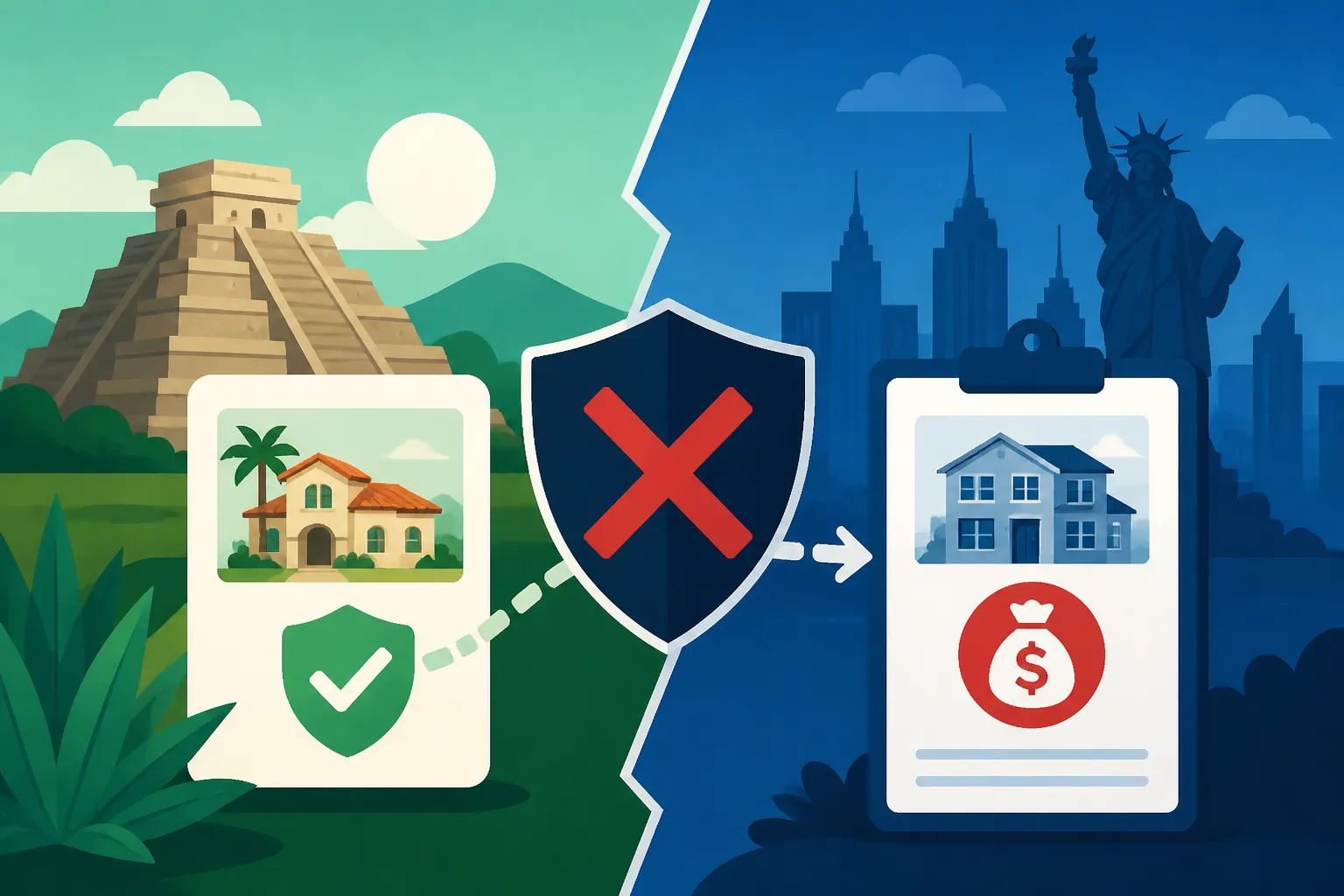
The Mexican Capital Gains Exemption and Your US Return: Why It Doesn’t Transfer
Oh, the joy of owning property in Mexico! It’s a dream for so many of us, isn't it? But then comes the day you decide to sell, and suddenly you’re plunged into a bureaucratic labyrinth, especially if you’re a US citizen trying to navigate both Mexican and US tax laws. Many expats are caught off guard, believing that Mexico's generous capital gains exemption will magically transfer to their US tax return, only to face a harsh dose of reality. This guide is here to shed light on exactly why that Mexican exemption won't help you with Uncle Sam and what you can do to prepare.
Disclosure: This post may contain affiliate links. We may earn a commission at no extra cost to you if you make a purchase through these links. Read full disclosure.
Understanding Mexico's Capital Gains Exemption When Selling Your Home
Let's start with the good news, at least from the Mexican side of things. Mexico offers a really appealing capital gains exemption when you sell your primary residence. It’s designed to encourage homeownership and ensure that ordinary citizens aren't heavily taxed on what's often their largest asset. But like all things official in Mexico, qualifying for it is rarely straightforward and usually involves a mountain of paperwork.
What is the Mexican Capital Gains Exemption?
In a nutshell, this exemption allows you to sell your primary residence in Mexico without paying capital gains tax to the Mexican government, up to a certain value. The amount is linked to the Unidad de Medida y Actualización (UMA), which is an economic reference unit in Mexico. It's a significant benefit that can save you a considerable amount of money, which is why it's such a popular topic among expats. The intent behind it is noble: to protect homeowners from a hefty tax bill on a home they've lived in and loved. It's a recognition that selling your home is often a necessity, not just a profit-making venture.
For many years, this exemption has been a beacon of hope for retirees and long-term residents. Imagine selling your beautiful home in San Miguel de Allende or your beachfront condo in Puerto Vallarta, thinking you’ve made a clean exit without a massive tax bite. On the Mexican side, that can absolutely be true if you've done your homework. The key is proving to the tax authorities (SAT) that the property was indeed your principal residence. Without that proof, you're looking at a standard capital gains tax rate on your profit.
Who Qualifies for This Exemption?
To qualify for the Mexican capital gains exemption, the property must be your primary residence. This isn't just a casual claim; you need to demonstrate it through official documentation. Typically, this means you must have lived in the home for at least six months of the year for the five years prior to the sale. The most common ways to prove this involve:
- Utility Bills: Having electricity (CFE), water, or telephone bills in your name, with the property's address, for the required period.
- Voter ID (Credencial de Elector): If you're a Mexican citizen or a naturalized citizen, this is a very strong piece of evidence.
- Bank Statements: Statements showing your address at the property.
- RFC (Registro Federal de Contribuyentes): Your Mexican tax ID should be registered to that address. Getting an RFC is crucial for many financial activities here. Do You Need an RFC Number? Why a Tax ID Matters for Expats' Finances
- Proof of Residency: Your Mexican Temporary or Permanent Resident card with the property address can also be helpful.
This part of the process is often where expats hit their first snag. Many of us haven't diligently kept all utility bills in our name, or perhaps our residency card still lists an old address. It’s a common pitfall. The notario público (public notary), who handles the property transaction, is responsible for ensuring all conditions for the exemption are met before signing off. They’re usually very thorough, and for good reason—they want to avoid future headaches with the SAT. So, gather those papers! It’s not just about meeting criteria; it’s about providing the undeniable proof.
The Paperwork Trail: Proving Your Primary Residence
Navigating the bureaucracy to prove your primary residence is a rite of passage for many expats in Mexico. It can feel like you're playing a game where the rules are constantly shifting, or at least interpreted differently by various officials. You'll need original copies of everything, and often, they'll demand the most recent versions, even if you’ve been at the same address for a decade. Imagine having to track down five years of CFE bills! It's a common frustration, and it speaks to the meticulous nature of official processes here.
The notario will request a variety of documents, often including proof of your property's cadastral value, your escritura (deed), and your identification. For the exemption, expect a deep dive into utility bills (light, water, phone, internet), bank statements, and your RFC registration. The address on all these documents must match the property you're selling. If you have any discrepancies, you'll need to sort them out before the sale can proceed with the exemption. For instance, if you've been paying your internet bill online and never bothered to get a physical statement with your address, you might run into trouble. It's a testament to why keeping meticulous records from day one in Mexico is absolutely essential. Dealing with Bureaucracy in Mexico: Tips for Handling Paperwork and Appointments
The Hard Reality: Why the Exemption Doesn't Apply to Your US Tax Return
Here’s where things get tricky, especially for our US expat friends. You’ve diligently collected all your Mexican utility bills, proved your residency, and the notario has confirmed you're exempt from Mexican capital gains tax. You might be feeling a huge sense of relief, thinking you’ve cleared the biggest hurdle. But then you remember your US tax obligations, and a new wave of anxiety sets in. This is where the crucial disconnect happens.
Mexico vs. US Tax Systems: A Fundamental Difference
The United States has a unique tax system: it taxes its citizens and permanent residents on their worldwide income, regardless of where they live or where the income is earned. This means that even if Mexico doesn't tax your capital gain on your home sale, the US still sees that gain as taxable income. It’s a concept that often feels unfair, even like double taxation in spirit, because another country chose not to tax you, but your home country still wants its share.
Mexico's tax laws are separate and distinct from US tax laws. While both countries have mechanisms to prevent double taxation on income (like the Foreign Earned Income Exclusion), these typically don't apply directly to capital gains from property sales in the same way. The Mexican capital gains exemption is a Mexican law, applicable only within Mexico's tax jurisdiction. It doesn't magically transfer or translate into an exemption on your US tax return. For the US, it's as if that exemption never existed; they simply look at the sale price minus your adjusted cost basis (what you paid for it, plus improvements, in US dollars).
The Foreign Earned Income Exclusion and Housing Exclusion
Many US expats are familiar with the Foreign Earned Income Exclusion (FEIE) and the Foreign Housing Exclusion/Deduction. These are incredibly helpful tools that allow you to exclude a significant portion of your earned income (like salary or freelance income) and certain housing expenses from your US taxable income if you meet specific residency tests while living abroad. Declaring Foreign Income in Mexico: Tax Rules for Expats
However, and this is a big "however," capital gains from the sale of real estate are generally considered passive income, not earned income. Therefore, the FEIE and the Foreign Housing Exclusion do not apply to these gains. This is a common misunderstanding that can lead to a nasty surprise come tax season. You might have been diligently excluding your Mexican salary for years, only to find out that your home sale is treated entirely differently. This distinction is critical and often overlooked, leading to considerable frustration for expats who thought they were well-versed in their overseas tax obligations.
Double Taxation: The Unavoidable Truth for US Expats
So, what happens when Mexico says you owe zero capital gains tax, but the US says you owe some? This is the very real scenario of potential double taxation that many US expats face when selling property in Mexico. Because the US taxes worldwide income, the profit you make from selling your Mexican home is taxable by the IRS, even if Mexico gives you a pass.
The good news is that there are mechanisms to mitigate this, primarily through the Foreign Tax Credit (FTC). If Mexico had charged you capital gains tax, you could generally claim a credit on your US return for the taxes paid to Mexico, dollar-for-dollar, reducing your US tax liability. The problem arises when Mexico doesn't charge you tax because of its exemption. If you paid no tax to Mexico, you have no foreign tax credit to claim for that specific income. This means the US gets to tax the entire gain, potentially at long-term capital gains rates, without any offset from Mexican taxes. It's a stark reminder that when you're dealing with Taxes for Expats, especially between Mexico and the US, the rules can be incredibly complex and often seem to work against you.
Strategies for US Expats: Mitigating Capital Gains Tax
While the news about the Mexican exemption not transferring might feel like a punch to the gut, don't despair entirely. There are strategies and tools available to help US expats manage their capital gains tax when selling property in Mexico. It's all about proactive planning and getting the right professional advice.
Foreign Tax Credits: Your Best Defense
As mentioned, if Mexico does levy a capital gains tax on your property sale (e.g., if you don't qualify for their exemption, or if you sell a secondary property), then the Foreign Tax Credit (FTC) becomes your best friend. This credit allows you to subtract the amount of income tax you paid to a foreign country directly from your US income tax liability. It’s usually much more beneficial than a deduction, as it reduces your tax bill dollar-for-dollar.
However, remember the catch: you can only claim a credit for taxes actually paid. If you successfully used Mexico's capital gains exemption and paid zero tax to the SAT, then you have no Mexican tax to credit against your US tax bill on that specific gain. This is why the non-transferability of the Mexican exemption is so impactful.
Despite this, it's still crucial to work with a tax professional who understands the intricacies of US Taxes for Americans Living in Mexico to explore all possible avenues. They might find other foreign taxes you paid throughout the year that could be applied, or help you structure your affairs in a way that minimizes your overall tax burden.
Planning Ahead: Documenting Your Basis and Costs
This is perhaps the most critical piece of advice for any expat considering selling property in Mexico: meticulous record-keeping. The capital gain for US tax purposes is calculated as the sale price minus your adjusted cost basis. Your cost basis includes not just the original purchase price but also significant improvements you've made to the property (e.g., adding a pool, renovating a kitchen, major structural repairs).
You must keep detailed records of:
- Original Purchase Price: The amount you paid for the property, converted to USD on the date of purchase.
- Closing Costs: Fees paid to the notario, legal fees, appraisal costs, etc., also converted to USD.
- Improvements: Any major upgrades or additions to the property, with receipts and dates, converted to USD. Regular maintenance (like painting or minor repairs) generally doesn't count, but things that add value or extend the property's life do.
- Selling Costs: Real estate agent commissions, legal fees, etc., incurred when selling the property.
Without proper documentation in US dollars, the IRS might disallow these additions to your basis, leading to a much larger taxable gain. Imagine you bought a home for $200,000 USD and put $50,000 into improvements over the years. If you sell it for $350,000, your gain is $100,000 ($350k – $250k). But if you can't prove those $50,000 in improvements, your gain could be seen as $150,000, meaning a much higher tax bill. This is an area where a little foresight goes a very long way in managing your Taxes for Expats.
Professional Guidance: The Ultimate Necessity for Taxes for Expats
Let's be honest, navigating the tax systems of two different countries is not for the faint of heart, or for the DIY enthusiast unless you have a strong background in international taxation. The complexities involved, especially with something as significant as a property sale, make professional guidance not just a recommendation, but an absolute necessity.
You need an accountant or a tax advisor who specializes in Taxes for Expats, specifically for US citizens living in Mexico. They should be well-versed in both Mexican tax implications (even if only to confirm your exemption) and, critically, US tax law regarding foreign property sales. A good professional will help you:
- Calculate your US cost basis accurately.
- Determine your capital gain for US tax purposes.
- Explore all available credits and deductions.
- Ensure compliance with both IRS and SAT regulations.
- Potentially advise on strategies before selling to minimize future tax liabilities.
They can answer nuanced questions, like how currency exchange rates affect your cost basis, or whether you can utilize any portion of the US primary residence capital gains exclusion ($250,000 for single filers, $500,000 for married filing jointly) if you meet the "use and ownership" tests for a property that was your main home for a certain period, even if it was abroad. This specific US exemption can apply to a foreign primary residence if you meet the criteria, but again, you need an expert to confirm.
Don't leave something this important to chance. A few hundred dollars spent on expert advice can save you thousands in unexpected tax bills and sleepless nights. Invest in a professional who understands the unique intersection of Mexican property sales and your US tax obligations. It's the smartest move you can make for your financial peace of mind as an expat. Do You Need an Accountant? Navigating Tax Filing as an Expat in Mexico
| Feature | Mexican Capital Gains Exemption | US Capital Gains Tax (for Expats) |
|---|---|---|
| Eligibility | Primary residence (main home for 6+ months/year for 5 years). | Worldwide income, regardless of primary residence location. |
| Tax Impact in Mexico | Potential for 0% capital gains tax to SAT up to UMA limit. | No direct impact; separate calculation. |
| Tax Impact in US | Does not transfer or exempt you from US tax. | Taxable event on the gain (sale price – adjusted basis in USD). |
| Key Documentation | Utility bills (CFE, water, phone), RFC, residency card, voter ID. | Original purchase documents, receipts for improvements, closing costs, all in USD. |
| Mitigation Strategy | Prove primary residence to notario with meticulous records. | Foreign Tax Credits (if Mexican tax was paid), accurate cost basis tracking, US primary residence exclusion (if applicable). |
| Professional Advice Needed | Yes, for notario process and understanding local rules. | Absolutely crucial for international tax specialist guidance. |
Disclaimer
This article is for general informational purposes only and does not constitute professional advice. Laws, prices and regulations vary by location and change over time. Consult a qualified professional for guidance on your specific situation.