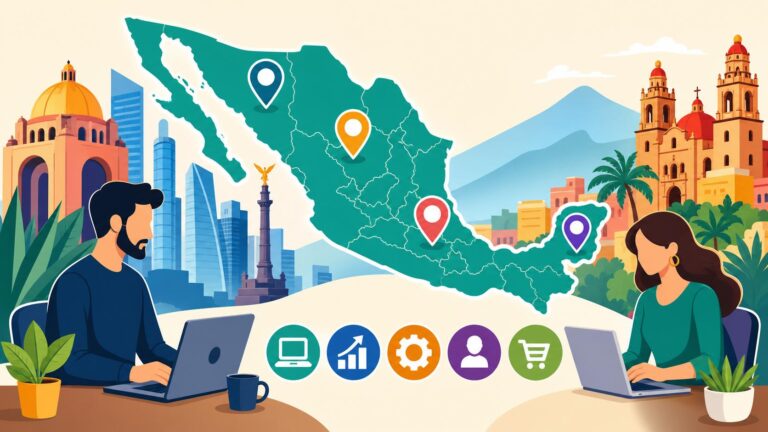
Starting a Small Business in Mexico: Practical Steps
Getting a business off the ground here often feels like running a marathon through a swamp of paperwork and "come back tomorrow" excuses. I still remember the first time I stood in a three-hour line at the SAT office only to realize I was missing a single photocopied document. This guide untangles the red tape so you can actually start earning.
Disclosure: This post may contain affiliate links. We may earn a commission at no extra cost to you if you make a purchase through these links. Read full disclosure.
Choosing Your Legal Identity: Persona Física vs. Persona Moral
One of the first and most paralyzing decisions you will face is how to define your business in the eyes of the Mexican government. In Mexico, you generally choose between being a Persona Física (a natural person/individual) or a Persona Moral (a legal entity/corporation). This isn't just a tax preference; it dictates your level of personal liability, the complexity of your monthly reporting, and how much you will pay in initial setup fees.
The Persona Física Path
For many solo entrepreneurs, digital nomads, or small shop owners, registering as a Persona Física con Actividad Empresarial is the most logical starting point. This structure is essentially a sole proprietorship. The primary advantage is the lack of a complex incorporation process. You do not need a notary to create a set of bylaws, which can save you anywhere from $1,000 to $3,000 USD in startup costs. You simply register your activity with the tax authorities and begin operating.
However, the "I’ve-been-there" reality is that as a Persona Física, your personal assets are not separated from your business assets. If your business faces a lawsuit or incurs significant debt, your personal bank accounts and property in Mexico could be at risk. This is a vital consideration if you are planning to open a high-risk venture, such as a construction company or a large-scale restaurant. For those managing cross-border income, consulting with a firm like Taxes for Expats can be a lifesaver, as they understand how this individual status in Mexico interacts with your tax obligations back home.
The Persona Moral (Incorporation)
If you have partners or are planning a large-scale investment, you will likely need to form a Persona Moral. The most common types are the S.A. de C.V. (Sociedad Anónima de Capital Variable) and the S.A.S. (Sociedad por Acciones Simplificada). Incorporating provides a "corporate veil" that protects your personal assets, but it comes with a heavy administrative burden. You will need a Notario Público to draft your constitutive act, and you will be required to have a formal board or administrator.
The S.A.S. is a newer, more "expat-friendly" option that can technically be formed online and by a single shareholder. However, in practice, many foreign residents find the online portal for S.A.S. difficult to navigate because it requires a specific level of electronic signature that can be a "chicken-and-egg" problem to obtain. Most long-term expats eventually lean toward the S.A. de C.V. because it is the "gold standard" recognized by every bank and government office in the country.
| Feature | Persona Física (Individual) | Persona Moral (Corporation) |
|---|---|---|
| Setup Cost | Very Low (Government fees only) | High ($1,500 – $3,500+ USD for Notary) |
| Complexity | Low to Moderate | Very High (Requires Bylaws & Meetings) |
| Liability | Unlimited Personal Liability | Limited to Company Assets |
| Tax Filing | Monthly and Annual | Monthly and Annual (Strict Reporting) |
| Setup Time | 1–2 Weeks | 4–8 Weeks |
| Best For | Freelancers, Small Shops, Consultants | Partnership, High-Risk, Large Investment |
The Administrative Gauntlet: Registering with the SAT
Once you’ve decided on your structure, you enter the world of the SAT (Servicio de Administración Tributaria). This is the Mexican equivalent of the IRS, but with a much larger physical presence in your life. You cannot legally earn a cent in Mexico without an RFC (Registro Federal de Contribuyentes). This alphanumeric code is the skeleton key for everything from opening a bank account to signing a commercial lease.
Obtaining Your RFC and the e.firma
To get your RFC as a foreigner, you must first have your residency card. I cannot stress this enough: do not try to show up at the SAT with just a tourist visa. You will be turned away before you even get through the door. Once you have residency, the real challenge is securing an appointment (cita). The online portal for appointments is notoriously glitchy, and in many popular expat hubs like Playa del Carmen or San Miguel de Allende, appointments can be booked out for months.
When you finally get your appointment, you will be applying for your e.firma (formerly known as the FIEL). This is a set of encrypted files on a USB drive that serves as your digital signature. In Mexico, this digital signature is just as legally binding as your physical one. You will use it to sign your tax returns, issue invoices, and communicate with government agencies. Guard this USB drive with your life. If you lose it or the files expire (they usually last four years), you have to go back through the entire appointment nightmare to get a new one. For a deeper dive into this process, check out The RFC and SAT: Mexico's Tax System for Foreigners.
The RESICO Regime: A Game Changer for Small Business
In recent years, Mexico introduced the Régimen Simplificado de Confianza (RESICO), which has been a massive boon for small business owners and expats. If your annual income is below 3.5 million pesos (roughly $200,000 USD), you may qualify for incredibly low income tax rates, ranging from 1% to 2.5%. This was designed to bring more "off-the-books" businesses into the formal economy, but it works perfectly for the expat consultant or boutique owner.
However, RESICO has strict rules. You cannot be a shareholder in another company, and you must stay on top of your monthly filings. If you miss even a single month, the SAT can unceremoniously boot you out of the regime and move you to the standard business regime where taxes are significantly higher. Managing these nuances is where many foreigners get tripped up, which is why having an accountant who understands both Mexican law and the requirements for foreigners is essential. Many expats find it helpful to read Taxes in Mexico for Expats: A Complete Guide to Income Tax and More to understand how these local payments affect their global tax standing.
Immigration Hurdles: Aligning Your Visa with Your Ambition
One of the biggest misconceptions I see among new arrivals is the belief that a residency card automatically gives you the right to start a business and earn money. This is a dangerous assumption that can lead to fines or even deportation. Your residency status and your "permission to work" are two separate hurdles managed by the INM (Instituto Nacional de Migración).
Permission to Work (Permiso para Trabajar)
If you have a Temporary Resident visa, it likely says "Resident Temporary" without any mention of work. Before you start selling products or services, you must apply for a "Change of Condition" to add work authorization to your visa. This process involves submitting a letter to immigration explaining what your business will do, providing your RFC (which we discussed above), and paying an additional fee.
The "I've-been-there" tip: immigration wants to see that your business isn't going to take a job away from a Mexican citizen without a good reason. If you are a solo consultant, it’s usually straightforward. If you are opening a physical shop, they may want to see proof of your local permits. For the exact steps, you should follow the guide on How to Add Work Authorization to Your Temporary Residency in Mexico. Once you have Permanent Residency, the situation is much simpler as that status generally includes the inherent right to work and start businesses without seeking additional permissions from the INM.
The Role of Language in Bureaucracy
Navigating the INM and SAT offices requires a level of Spanish that goes far beyond ordering a café con leche. When you are sitting across from an official who is scrutinizing your business plan, being able to explain your "lucrative activities" clearly is the difference between a smooth approval and a "regrese mañana."
I spent my first year stumbling through these meetings with a translation app, but it was stressful and inefficient. I eventually started using iTalki to find tutors who specialized in "Business Spanish for Mexico." It allowed me to role-play the immigration interview and learn the specific vocabulary for tax regimes and legal structures. Being able to say "Régimen Simplificado de Confianza" without stuttering goes a long way in showing the officials that you are a serious, professional contributor to the local economy.
Local Licensing and the "Uso de Suelo" Maze
If your small business is entirely online, you can skip some of the physical red tape. But if you are dreaming of a cozy café in Oaxaca or a boutique in Merida, you are about to meet the local municipality's licensing department. This is where many expat dreams go to die because they sign a lease before checking the Uso de Suelo (Land Use Permit).
The Perils of the Commercial Lease
In Mexico, just because a building looks like a shop doesn't mean it is legally allowed to be a shop. Every property has a specific designation. If you rent a beautiful colonial house with the intention of turning it into a gallery, but the property is zoned as "Habitacional" (Residential), you cannot get a business license. Converting land use from residential to commercial can take months—or years—and involve a mountain of fees and "favors."
Before you sign any lease, demand to see the Uso de Suelo for the property. If the landlord can’t or won’t show it to you, walk away. Once you have the right location, you will also need a Licencia de Funcionamiento (Operating License) from the city, a "Civil Protection" inspection (to ensure you have fire extinguishers and signage), and if you’re serving food, a health permit from COFEPRIS. These local requirements vary wildly from city to city, so what worked for a friend in Puerto Vallarta might not apply in Mexico City. For a sense of regional costs, see Cost of Living in Mexico City (2026): Detailed Expat Budget Guide.
Managing Local Expectations and Neighbors
Small business success in Mexico is as much about social capital as it is about financial capital. In many traditional neighborhoods, the local vecinos (neighbors) have significant sway. If you open a noisy bar without the community's blessing, you might find yourself facing constant inspections triggered by "anonymous" complaints.
I always recommend spending a few weeks in the neighborhood before signing a lease. Talk to other business owners. Is the local police commander "active" in the area? Are there issues with street vendors? Understanding the local rhythm will save you thousands of pesos in unforeseen "security" or "compliance" costs later on.
Banking, Billing, and the Infamous Factura
Welcome to the most unique aspect of doing business in Mexico: the Factura system. Unlike in the US or Canada, where you can print an invoice from Word and call it a day, Mexico uses a sophisticated, real-time electronic invoicing system known as CFDI (Comprobante Fiscal Digital por Internet).
The CFDI System
Every time you spend money on a business expense or receive money from a client, a digital XML file must be generated and "stamped" by the SAT's servers. If you buy a laptop for your business but don't get a formal factura (receipts from a thermal printer don't count), you cannot deduct that expense from your taxes. As a business owner, your clients will expect you to provide them with a factura so they can deduct their payment to you.
This requires specialized software or a "PAC" (Authorized Certification Provider). Most accountants include this as part of their monthly service, but you need to understand the basics to ensure you aren't overpaying on taxes. For a step-by-step tutorial, look at How to Issue a Factura (CFDI) in Mexico. This system is the reason why almost every business in Mexico asks for your "RFC" at the point of sale.
Opening a Business Bank Account
Opening a bank account as a foreign-owned business is one of the most frustrating tasks you will undertake. Mexican banks are under immense pressure to prevent money laundering, and as a foreigner, you are high-risk by default. Even for a Persona Física, many banks like BBVA or Santander will require at least six months of residency and a local utility bill in your name.
For a Persona Moral, it is even harder. They will want to see your constitutive act, your RFC, the e.firma of the administrator, and proof of address for the business. Some banks will refuse to open an account for a company if the majority shareholders are foreigners who aren't physically present in Mexico. It’s often a game of "branch hopping"—if the manager at one branch says no, try the one three blocks away. For a comparison of your options, read Best Banks in Mexico for Expats: Comparing Fees and Services.
Managing Human Capital and Labor Laws
If your business grows to the point where you need to hire help, you are entering one of the most employee-centric legal environments in the world. Mexican labor laws are strictly enforced, and "at-will" employment does not exist here in the way it does in North America.
The Cost of an Employee
When you hire someone, the salary you agree upon is only a fraction of your total cost. You are responsible for paying their IMSS (Social Security), INFONAVIT (Housing Fund), and a 2% or 3% state payroll tax. On top of that, every employee is entitled to an Aguinaldo (a Christmas bonus of at least 15 days' pay) and a Prima Vacacional (a bonus paid when they take their mandatory vacation days).
If you decide to fire an employee without "just cause"—and the legal definition of just cause is very narrow—you are required to pay a severance package that usually equals three months of salary plus 20 days for every year worked. This is why many small business owners are extremely cautious about hiring. You must have a formal contract for every worker, even part-time help. To understand the cultural expectations of your new team, see Mexican Work Culture: Norms and Expectations.
Navigating Benefits and Healthcare
Providing benefits is not just a legal requirement but a vital part of employee retention. Many expats choose to go above and beyond the mandatory IMSS coverage by offering private health insurance or food vouchers (vales de despensa). Understanding the local healthcare landscape helps you explain these benefits to your staff. You can find more information on how the system works in Healthcare in Mexico: Complete Guide for Expats (Public vs Private).
Building a local team also means managing the language barrier and cultural nuances. While you might be focused on "efficiency" and "KPIs," your Mexican employees will often value "loyalty" and "personal connection" far more. Taking the time to have lunch with your team or ask about their families isn't "wasting time"—it’s a critical business investment in Mexico. If your Spanish is still a work in progress, continuing those lessons on iTalki to specifically learn how to give feedback and manage conflict in a culturally sensitive way will pay dividends in your staff's productivity and morale.
Disclaimer
The information provided in this guide is for informational purposes only and does not constitute legal, financial, or tax advice. Regulations in Mexico change frequently. Always consult with a qualified Mexican attorney and a certified accountant (Contador Público) before starting a business or making financial commitments.