Moving Money From Canada to Mexico: CAD to MXN Routes Compared
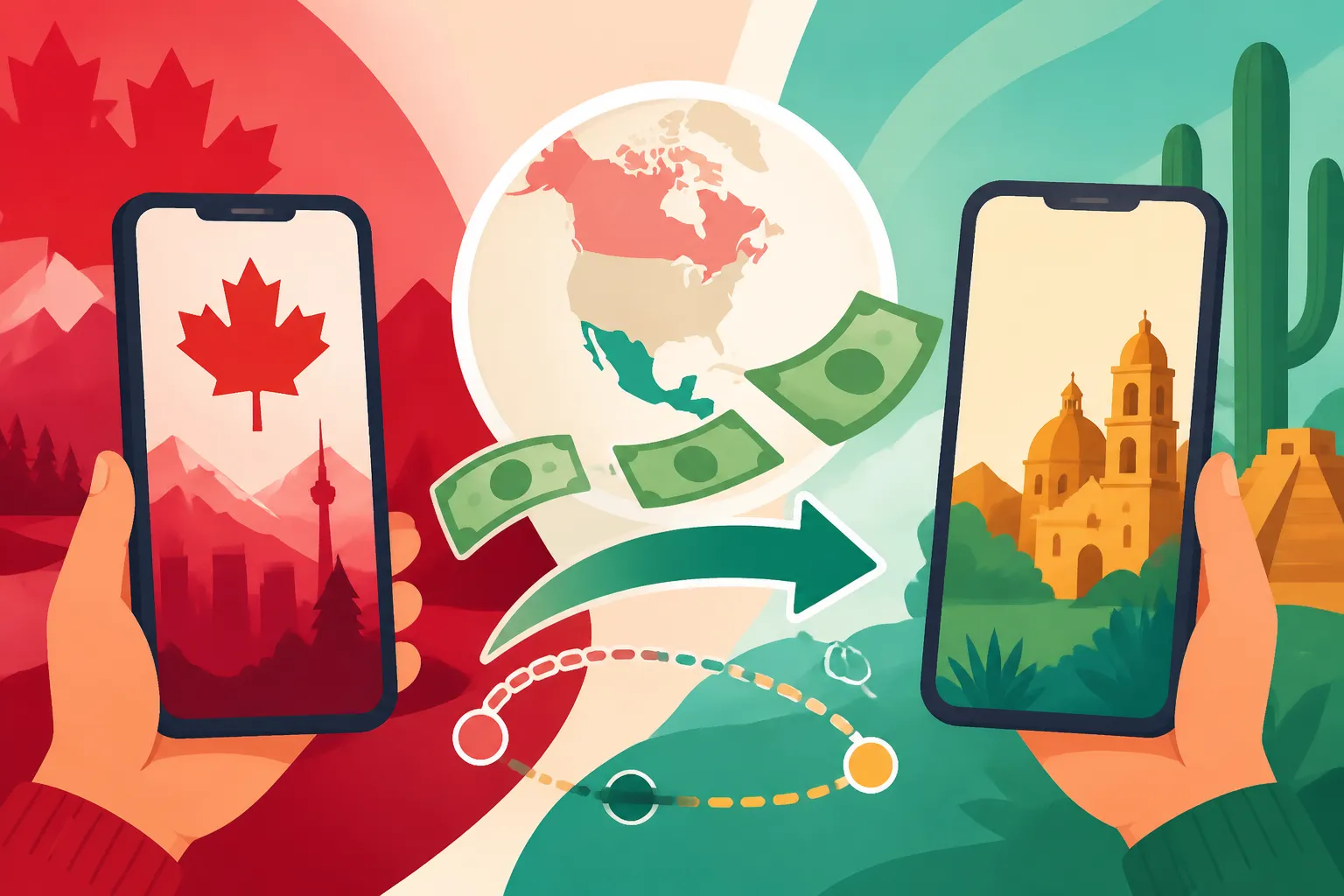
Moving your hard-earned Canadian dollars into Mexican pesos can feel like trying to navigate a labyrinth blindfolded, especially with all the talk of hidden fees and unfavorable exchange rates. As an expat who's been here a while, I know the frustration firsthand when your money seems to shrink before it even hits your Mexican bank account. This guide is going to walk you through the various ways to send money from Canada to Mexico, comparing your options so you can keep more of your money where it belongs: in your pocket, here in Mexico.
Disclosure: This post may contain affiliate links. We may earn a commission at no extra cost to you if you make a purchase through these links. Read full disclosure.
The Challenges of International Money Transfers from Canada to Mexico
Let's be honest, moving money across borders is rarely a straightforward, cheap, or quick affair. When you’re an expat sending Canadian dollars (CAD) to Mexican pesos (MXN), you're not just dealing with two different currencies; you’re wrestling with banking systems, regulations, and often, a hefty dose of hidden charges. It’s a common pain point for all of us living abroad.
High Bank Fees and Hidden Costs
Traditional banks, bless their hearts, are often the first place we think of when we need to send money internationally. You’ve probably walked into your Canadian bank, asked about a wire transfer, and been quoted a flat fee. Seems simple enough, right? Wrong. That flat fee is just the tip of the iceberg. What they often don’t tell you upfront is that there can be multiple intermediary banks involved in a SWIFT transfer, each taking their own cut. It’s not uncommon for a transfer to pass through two or three correspondent banks, and each one shaves off a piece of your pie. By the time your pesos arrive in Mexico, you might find yourself short a significant amount, and you often won’t know the exact cost until after the transfer is complete. This lack of transparency is incredibly frustrating when you’re trying to manage your finances.
Unfavorable Exchange Rates
Beyond the overt fees, the biggest culprit for expats losing money is often the exchange rate. Banks typically offer what’s called a "retail" exchange rate, which is significantly worse than the mid-market rate you see on Google or Reuters. The mid-market rate is the true rate at which banks trade currencies amongst themselves. When you send money through a traditional bank, they buy your CAD at one rate and sell you MXN at another, pocketing the difference as profit. This margin might seem small on paper, but when you're transferring thousands of dollars, it can add up to hundreds, or even thousands, of pesos that simply vanish into thin air. It’s a profit center for them, and a silent drain on your funds. It pays to be vigilant about the exchange rate you're being offered, as even a small difference can have a huge impact.
Slow Transfer Times and Bureaucracy
Ah, bureaucracy, our old friend in Mexico! And sometimes, in Canada too. Traditional bank transfers, particularly international wires, can be painfully slow. You might be quoted 3-5 business days, but sometimes it takes longer. I've heard stories of transfers taking over a week, leaving expats in a lurch when they need funds for rent or an urgent bill. This delay is often due to the manual processing required, security checks, and the aforementioned chain of intermediary banks. Add to that the potential for errors in SWIFT codes, recipient details, or missing information, and you’re looking at additional delays and even more fees to correct things. For those of us living day-to-day here, these delays aren't just an inconvenience; they can disrupt our lives significantly.
Traditional Methods for Sending CAD to MXN (And Why They Fall Short)
When I first moved here, the options felt pretty limited. You either went to the bank, or you risked carrying cash. Thankfully, things have evolved, but it's still worth understanding why some of the older methods aren't always the best choice for a regular expat.
Bank Wire Transfers
Let's start with the classic: the bank wire transfer. You go to your Canadian bank, fill out a form, provide the recipient's bank details (including the all-important CLABE number, which is like a Canadian transit and account number combined), and pay a fee. For a transfer from Canada to Mexico, you might pay CAD $25-$50 in outgoing fees from your Canadian bank. Then, your Mexican bank might charge a receiving fee, perhaps MXN $100-$300, depending on the bank. As I mentioned earlier, intermediary banks can also deduct fees along the way, often unknown to you until the money arrives, if you even get a detailed breakdown.
The process involves SWIFT codes, which are international bank identifiers, and making sure every single digit is correct is paramount. A single typo can lead to your money getting lost in limbo or returned, incurring more fees and delays. While banks like RBC, TD, or Scotiabank in Canada will facilitate these, they rarely offer competitive exchange rates. They have their own markup, sometimes as high as 3-5% above the interbank rate, which means for every $1,000 CAD you send, you could be losing $30-$50 just on the exchange rate, on top of all the transfer fees. This really adds up over time for regular transfers, making them a costly option for ongoing financial needs. It’s a method for occasional, non-urgent, high-value transfers, where the absolute security of a traditional bank might feel reassuring, but the cost is undeniable.
Using International Money Transfer Services (Western Union, MoneyGram)
Then there are the well-known international money transfer services like Western Union or MoneyGram. These services are widely available in both Canada and Mexico, with countless agent locations. They're undeniably convenient if you need to send money to someone who doesn't have a bank account, or if you need cash picked up quickly. The recipient can often collect the funds in cash within minutes or hours, which is great for urgent situations or for supporting family members who don't rely on digital banking.
However, this convenience comes at a price – usually, a very high one. While their advertised fees might seem low, or even "free" for certain amounts, these services make a significant portion of their profit on the exchange rate. Their rates are often among the worst you’ll find, with markups that can be even higher than traditional banks. For instance, sending CAD $500 might cost you $10-$20 in fees, but the exchange rate could mean you lose another $25-$40 compared to the mid-market rate. If you're a Canadian expat sending money to your own Mexican bank account regularly, these services are simply too expensive for the value they provide. They’re best reserved for emergencies or one-off small cash transfers, not for managing your expat finances.
Carrying Cash Across Borders
Some expats, especially those living close to the border or frequently traveling between Canada and Mexico, might consider carrying large sums of cash. On the surface, it seems like a way to avoid fees and get the best exchange rate by converting it at a local casa de cambio (money exchange house) in Mexico. And yes, sometimes, the exchange rates at a reputable casa de cambio can indeed be better than what banks offer.
However, carrying large amounts of cash is fraught with risks. First and foremost, there are legal limits. You must declare any amount over $10,000 CAD (or equivalent in other currencies) when leaving Canada and over $10,000 USD (or equivalent) when entering Mexico. Failing to declare can lead to fines, confiscation of funds, and serious legal trouble. Beyond the legalities, there's the very real danger of theft or loss. Mexico, like any country, has its risks, and being an obvious target with a large wad of cash is never a good idea. Plus, once you have the pesos, you then have to deposit them into your Mexican bank account, which can raise questions with the bank, especially if it's a large, unexplained sum. Banks in Mexico are increasingly stringent about large cash deposits due to anti-money laundering regulations, and you might be asked to provide proof of origin for the funds. So, while it avoids transfer fees, it introduces other, potentially more severe, problems.
Modern Solutions: Digital Platforms for CAD to MXN Transfers
The digital age has truly been a game-changer for expats, and nowhere is that more apparent than in how we move our money. Gone are the days of being beholden to exorbitant bank fees and terrible exchange rates. Now, a new breed of services has emerged, designed specifically to make international transfers faster, cheaper, and more transparent.
Why Digital Platforms are a Game Changer for Expats
Digital money transfer platforms have completely revolutionized the expat experience. What makes them so appealing? For starters, they operate online or through mobile apps, which means you can initiate a transfer from anywhere, at any time – no need to trek to a bank during business hours. This flexibility is invaluable when you're managing finances across different time zones or just trying to squeeze it in between enjoying life here in Mexico.
More importantly, these platforms are built on a different model than traditional banks. They focus on providing competitive exchange rates, often very close to the mid-market rate, and charge low, transparent fees. This means less of your money gets eaten up by hidden markups, and you know exactly how much your recipient will receive before you even hit 'send'. They leverage technology to streamline the process, cutting out costly intermediaries and allowing for much faster transfer times, often with funds arriving in minutes or hours rather than days. For those of us who make regular transfers, the cumulative savings are substantial, freeing up more funds for the things that truly matter, like exploring more of this incredible country or enjoying a delicious taco al pastor. This shift has genuinely empowered expats to take control of their cross-border finances.
Introducing Wise (formerly TransferWise)
Now, let's talk about the real hero of the international money transfer world for expats: Wise. If you haven't heard of them, you absolutely need to. Wise, formerly known as TransferWise, has been a trailblazer in transparent and fair international money transfers, and it's become the go-to solution for countless expats for good reason. What sets Wise apart is its unwavering commitment to giving you the real exchange rate – the mid-market rate – with absolutely no hidden markups. This is a game-changer because, as we discussed, those hidden markups are where traditional banks and older transfer services really get you.
Instead of hiding profit in the exchange rate, Wise charges a small, upfront fee that is clearly displayed before you confirm your transaction. This fee is usually a combination of a fixed amount and a small percentage of the transferred sum, making it highly competitive, especially for larger amounts. For a Canadian expat sending CAD to MXN, this means you get more pesos for your loonies. The service is incredibly fast, with many transfers arriving in Mexico within hours, or even minutes, depending on the banks involved and the specific transfer method. Plus, their platform is super user-friendly, whether you're using their website or the mobile app, making it easy to set up and track your transfers. Wise has truly simplified the process, offering transparency, speed, and cost-effectiveness that traditional options simply can't match. It’s what I, and many other expats, rely on to keep our financial lives running smoothly across borders.
Other Digital Transfer Services
While Wise stands out as my top recommendation for its commitment to transparency and the mid-market rate, it's worth noting that the digital money transfer landscape has expanded considerably. You'll find other reputable services that offer alternatives to traditional banks. Companies like Remitly, Xe, and OFX are also popular choices, each with their own strengths and slightly different models.
Remitly, for example, often offers competitive rates and promotional first-time transfer offers. They focus heavily on speed and ease of use, making them a good option for urgent, smaller transfers, and they have various delivery options including cash pickup, which can be useful for family in Mexico who might not have bank accounts. Xe is well-known for its excellent currency converter tools and has expanded into transfers, offering decent rates, especially for larger sums. OFX tends to cater more to higher-value transfers and businesses, offering personalized support and competitive rates without fixed fees on larger amounts, though their exchange rate might have a slightly higher margin compared to Wise. While these services are certainly far superior to traditional banks in terms of cost and speed, it's crucial to always compare their total cost, including fees and the exchange rate offered, against Wise to ensure you're truly getting the best deal. Often, when you factor in the mid-market rate guarantee, Wise still comes out on top for overall value.
A Deep Dive into Using Wise for Your CAD to MXN Transfers
Okay, let's get practical. If you're serious about saving money and time when sending funds from your Canadian account to your Mexican one, Wise is the answer. It's not just a recommendation; it's a proven tool that makes expat life easier. Here’s how to really make the most of it.
Setting Up Your Wise Account and First Transfer
Getting started with Wise is remarkably straightforward, and that's part of its appeal. You begin by visiting the Wise website or downloading their intuitive mobile app. The sign-up process is quick, requiring basic personal information like your name, address, email, and phone number. Like any reputable financial service, they will need to verify your identity to comply with regulations, which typically involves uploading a photo of a government-issued ID (like your Canadian passport or driver's license) and sometimes proof of address. This KYC (Know Your Customer) process is standard and ensures the security of your transactions. Don't worry, it's usually very fast.
Once your account is verified, you can set up your first transfer. You'll specify that you want to send money from CAD to MXN. You'll enter the amount you wish to send in CAD, and Wise will immediately show you the exact amount in MXN the recipient will receive, along with the transparent fee and the current mid-market exchange rate. There are no surprises. You'll then provide the recipient's bank details in Mexico – usually their bank name, their full name, and their 18-digit CLABE number. You can pay for your transfer using various methods, including Interac e-Transfer, debit card, or even a direct bank transfer from your Canadian bank account. Interac e-Transfer is often the fastest way to fund your Wise transfer from Canada. It’s truly designed for ease, allowing you to move money efficiently without jumping through hoops.
Understanding Wise Fees and Exchange Rates
One of the cornerstones of Wise's popularity among expats is its transparent fee structure and commitment to the mid-market exchange rate. Unlike traditional banks that often bury their profits in an inflated exchange rate, Wise prides itself on giving you the real rate – the one you see on independent financial news outlets like Reuters or Google. They then charge a small, transparent fee on top of this.
Let's break it down with an example. Say you want to send CAD $1,000 to Mexico. When you set up the transfer on Wise, you'll immediately see the exchange rate, which will be very close to the live mid-market rate. Then, you'll see a specific, calculated fee, perhaps around CAD $8-15 for that amount, depending on the exact method you use to pay and the current market conditions. So, if the mid-market rate is 1 CAD = 13.5 MXN, you'd calculate your MXN amount based on that rate, minus the small fee in CAD. Compare this to a traditional bank where the exchange rate might be 1 CAD = 13.0 MXN, meaning you lose 0.5 MXN on every dollar before any transfer fees even apply. Over time, these savings with Wise really add up, giving you a tangible advantage. The beauty is that you know exactly what you’re getting, and you can trust that there are no hidden costs lurking in the shadows of an unfavorable exchange rate.
Maximizing Your Transfers with Wise
Wise offers several features that can help Canadian expats in Mexico manage their money even more effectively. One of the handiest tools is the ability to set up rate alerts. If you're not in an immediate rush to send money, you can tell Wise your desired exchange rate, and they'll notify you when the CAD to MXN rate hits that mark. This allows you to time your transfers for maximum benefit, ensuring you get more pesos for your Canadian dollars without constantly monitoring the market yourself.
Another fantastic feature for those who need to hold money in multiple currencies is the Wise multi-currency account. With this, you can hold, send, and receive money in over 50 currencies, including CAD and MXN, and even get local bank details for several currencies. This means you could, theoretically, receive money directly into your Wise account in CAD, convert it to MXN within the same account when the rate is favorable, and then send it to your Mexican bank account. This eliminates multiple conversion steps and can be particularly useful for freelancers or those who receive payments from various countries. For Canadian expats managing their finances in Mexico, leveraging these Wise features means optimizing every single transfer, which leads to significant savings and greater financial control in the long run.
Important Considerations When Moving Money to Mexico
Moving your money is more than just picking a service; it's also about understanding the financial ecosystem in Mexico and staying compliant with regulations. It’s easy to get caught off guard if you don’t do a little homework.
Mexican Banking System and Receiving Funds
Once you’ve sent your CAD through Wise or any other service, the money needs to land smoothly in a Mexican bank account. The key identifier in Mexico for bank transfers is the CLABE (Clave Bancaria Estandarizada). This is an 18-digit interbank key that uniquely identifies every bank account in Mexico. It's crucial to have the correct CLABE number, as well as the full name of the recipient (which must match the bank account name exactly), and the correct bank name. Without these, your transfer could be delayed, rejected, or even sent to the wrong account.
Most domestic transfers in Mexico happen via SPEI (Sistema de Pagos Electrónicos Interbancarios), which is an immediate electronic payment system. When Wise sends your MXN, it typically utilizes this system to ensure fast delivery to your Mexican bank, whether that's Bancomer (BBVA), Banamex (Citibanamex), Santander, or Banorte. If you're trying to open a bank account here, remember that the requirements for foreigners can sometimes be tricky. For more on that, you might want to read up on How to Open a Bank Account in Mexico: Requirements and Tips. Just be aware that banks in Mexico, like anywhere else, have daily limits on incoming and outgoing transfers, and very large transfers might sometimes be flagged for additional verification, so it's always good to be prepared.
Tax Implications and Reporting Requirements
Ah, taxes. The one certainty in life, even for expats! When you're moving money from Canada to Mexico, it's important to be aware of potential tax implications in both countries, especially for larger sums. While simply moving your own money between your accounts isn't usually a taxable event in itself, the source of the funds and the amounts can trigger reporting requirements.
In Canada, there are no specific reporting requirements for sending money out of the country for individuals, unless it's income. However, financial institutions do have reporting obligations to FINTRAC for large or suspicious transactions. On the Mexican side, banks are required to report large cash deposits to the SAT (Servicio de Administración Tributaria), Mexico’s tax authority. While electronic transfers through platforms like Wise are generally less scrutinized than cash, very large, regular transfers could still potentially raise questions if they appear to be income rather than personal funds. It's always a good idea to keep clear records of your transfers. For U.S. citizens, FATCA and FBAR rules require reporting foreign bank accounts and assets if they exceed certain thresholds, so understanding those rules if you’re a dual citizen or American resident in Canada is critical. It's best to consult with a tax professional who specializes in international taxation to ensure you're fully compliant, particularly if you're Declaring Foreign Income in Mexico: Tax Rules for Expats or dealing with significant amounts.
Security and Fraud Prevention
In the digital age, security is paramount. While services like Wise employ robust security measures, including two-factor authentication and encryption, you also have a role to play in protecting your money. Always ensure you are on the legitimate Wise website (wise.com) or using their official app. Phishing scams are prevalent, so be wary of emails or messages asking for your login credentials or personal financial information.
When entering recipient details, double-check everything – the name, the bank, and especially that 18-digit CLABE number. A single incorrect digit could mean your money goes to the wrong person, and recovering funds from an incorrect transfer can be a long and difficult process, if not impossible. Never share your password or security codes with anyone. While the convenience of digital transfers is immense, a moment of carelessness can cost you dearly. Treat your online financial accounts with the same caution you would your physical wallet.
Choosing the Best Method for Your Specific Needs
The "best" way to move money isn't a one-size-fits-all answer; it really depends on your individual circumstances as an expat in Mexico. What works for one person making small, frequent payments might not be ideal for another sending a large lump sum.
Small, Frequent Transfers vs. Large, Infrequent Sums
For Canadian expats making small, frequent transfers – say, sending a few hundred CAD every month to cover daily expenses or rent – digital platforms like Wise are unequivocally the superior choice. The low, transparent fees and excellent mid-market exchange rates mean you maximize every single dollar converted. The speed and convenience of initiating these transfers from your phone or laptop in minutes also adds tremendous value to your day-to-day life here. You're not losing a significant chunk to fees, and the money arrives quickly, allowing you to manage your budget effectively.
However, if you're moving a very large, infrequent sum – perhaps you've sold a property in Canada and are bringing a substantial amount down for a home purchase in Mexico – the landscape can shift slightly. While Wise still offers excellent rates and transparency, some might consider traditional wire transfers through their bank for perceived added security or if they prefer to deal with a human advisor for such significant transactions. But even then, comparing the total cost, including exchange rate markups and all fees, is critical. For instance, services like OFX (though less expat-focused than Wise) sometimes offer slightly better margins for very large, one-off transfers (think tens of thousands or more) and might have a dedicated currency specialist, but they typically don't offer the same transparency on the mid-market rate that Wise does for all transfers. Always crunch the numbers meticulously for those big transfers.
Speed vs. Cost Considerations
Often, when sending money internationally, you're juggling two primary factors: how quickly the money needs to arrive and how much it will cost. For most expats, finding the sweet spot between these two is key. If you have an urgent bill due, or a medical emergency, speed becomes paramount, and a slightly higher fee might be acceptable. In such cases, digital platforms like Wise often provide the best of both worlds. Many Wise transfers to Mexico are completed within hours, and sometimes even minutes, for a minimal fee and excellent exchange rate. This strikes an ideal balance, allowing for rapid transfers without the exorbitant costs of traditional urgent wire services.
Traditional services like Western Union also offer speed, with cash pick-up often available within minutes, but as discussed, their exchange rates are notoriously poor, making them a very expensive option if you're concerned about cost. Traditional bank wires, while sometimes quicker for certain corridors, can be unpredictable in their delivery times and are generally more expensive overall due to bundled fees and poorer exchange rates. For most planned transfers, whether monthly rent or a larger purchase, prioritizing cost-effectiveness with a service like Wise that also offers good speed will yield the best results for your expat budget.
The Long-Term Perspective for Expats
As an expat living in Mexico, your financial needs aren't usually a one-off event. You're likely managing ongoing expenses, perhaps a Mexican mortgage (if you've been able to get one), or even sending money back home sometimes. Therefore, choosing a money transfer solution requires a long-term perspective. You need reliability, consistency, and a service that truly supports your life here.
This is where Wise really shines for the long haul. Its consistent use of the mid-market rate, low and transparent fees, and user-friendly platform make it an indispensable tool for routine financial management. You can set up recurring transfers, track your financial history, and integrate it seamlessly into your budgeting. The cumulative savings over months and years can be enormous, freeing up significant funds that you would otherwise lose to hidden fees and unfavorable rates. Establishing a dependable method like Wise from the outset means less financial stress and more time to enjoy your life in Mexico. It’s not just about saving money on one transfer; it’s about optimizing your entire financial flow as an international resident. For general tips on managing your money, you might find value in Managing Your Money in Mexico: Budgeting, Saving, and Currency Tips.
Comparison Table: CAD to MXN Transfer Methods
To give you a clearer picture, here's a quick comparison of the most common ways to send money from Canada to Mexico:
| Feature | Traditional Banks (e.g., RBC, TD) | International Transfer Services (e.g., Western Union) | Digital Platforms (e.g., Wise) |
|---|---|---|---|
| Exchange Rate | Retail rate (significant markup) | Marked-up rate (often poor) | Mid-market rate (no markup) |
| Fees | High (fixed + intermediary + receiving) | Varies (often fixed + hidden in rate) | Low, transparent (fixed + percentage) |
| Speed | 3-5+ business days | Minutes to hours (cash pickup) | Minutes to hours (bank transfer) |
| Transparency | Low (hidden exchange rate markup) | Medium (rate markup still applies) | High (all costs shown upfront) |
| Convenience | Branch visit, online | Agent location, online/app | Online/App (24/7 access) |
| Best For | Very large, infrequent transfers (perceived security) | Urgent cash pickup for unbanked recipients | Regular transfers, any amount, expats |
| Overall Value | Poor | Fair (for specific urgent cash needs) | Excellent |
Disclaimer
The information provided in this guide is intended for general informational purposes only and does not constitute financial, legal, or immigration advice. While we strive to keep the information up-to-date and accurate, regulations, fees, and exchange rates are subject to change without notice. Always consult with a qualified financial advisor, tax professional, or legal expert for advice tailored to your specific situation before making any financial decisions or international money transfers. We do not endorse any specific financial product or service beyond general informational comparisons. You are encouraged to conduct your own research and due diligence.