How to Wire Money to Mexico: SWIFT Codes and Bank Details Explained
Trying to send money to your new Mexican landlord, only to watch your home bank swallow unpredictable wire fees and hold the funds for a week, is infuriating. I remember losing my dream apartment because an international wire got flagged and delayed in transit. This guide explains exactly how to wire money to Mexico, decode SWIFT requirements, and bypass archaic fees.
Disclosure: This post may contain affiliate links. We may earn a commission at no extra cost to you if you make a purchase through these links. Read full disclosure.
The Traditional Bank Wire: SWIFT Codes and Hidden Fees
When you first move to Mexico, your initial instinct for moving money across the border is likely to walk into your local Chase, HSBC, or Barclays branch and ask for an international wire transfer. This initiates a process through the SWIFT network. While it feels secure because it involves major financial institutions, relying on traditional bank wires for your daily expat life is one of the most expensive and frustrating mistakes you can make.
Decoding the SWIFT Code
To send an international wire to Mexico, your home bank will ask for the receiving bank’s SWIFT code. This is an 8 to 11-character alphanumeric code that identifies the specific bank and branch in Mexico. For example, BBVA Mexico or Santander will have a unique SWIFT code that tells your home bank’s computer exactly which institution should receive the funds.
However, the SWIFT network does not actually move physical money; it simply sends secure messages between banks to adjust ledgers. Because thousands of smaller banks do not have direct relationships with Mexican banks, your money rarely goes straight from Point A to Point B. This brings us to the most painful aspect of traditional wiring.
The Hidden Costs of Correspondent Banks
When your home bank cannot communicate directly with the Mexican bank, the SWIFT system routes your money through intermediary banks. Every single time your money touches an intermediary bank, that bank takes a cut of your funds—usually a flat fee ranging from $15 to $30 USD.
Your home bank will not tell you about these correspondent fees because they do not control them. You might send exactly $1,000 USD, pay a $40 outgoing wire fee at your home branch, and expect the equivalent of $1,000 to arrive. Instead, only $960 arrives before the final exchange rate is even calculated. Furthermore, traditional banks pad their profit margins by giving you an abysmal exchange rate, often 3% to 5% worse than the actual market rate. Understanding how these institutional markups drain your savings is heavily detailed in our guide on Bank Fees in Mexico: Tips to Avoid Unnecessary Charges.

Essential Mexican Bank Details: The CLABE
If you want to wire money into the Mexican banking system successfully, you have to abandon the North American and European concepts of routing numbers and IBANs. Mexico operates on a highly efficient, proprietary domestic transfer system, and it requires a very specific piece of data to function.
Why the 18-Digit CLABE is Mandatory
Whether you are using a traditional wire or a modern digital platform, you cannot send money to a standard 10-digit Mexican account number or a 16-digit debit card number from abroad. You absolutely must have the recipient’s CLABE.
The CLABE is an 18-digit number that explicitly identifies the bank, the specific city branch, the individual account, and a mathematical control digit to prevent routing errors. If you input the CLABE correctly, the funds are routed through the Bank of Mexico’s SPEI network. The SPEI system is a technological marvel that operates around the clock, processing transfers in a matter of seconds. To fully grasp how this 18-digit number protects your funds from disappearing into the void, you must review What Is a CLABE? Understanding Mexican Bank Account Numbers.
RFC and Beneficiary Details
The Mexican banking system is notoriously rigid when it comes to matching beneficiary data on international wires. If your home bank asks for the name of the recipient, it must match the name on the Mexican bank account perfectly. If the Mexican account is under “Maria Elena Garcia Lopez” and you only write “Maria Garcia” on the wire transfer form, the Mexican receiving bank will likely reject the wire. The funds will bounce back to your home country, and you will still be charged the non-refundable wire fees.
Additionally, some international transfers may require the recipient’s RFC, which is the Mexican tax identification number. Having this information ready before you hit “send” will save you weeks of bureaucratic nightmares, especially if you are transferring funds to your own account after Opening a Bank Account in Mexico.
Smarter Alternatives to Traditional Wires
Veteran expats rarely step foot inside a traditional bank to move money across borders anymore. The rise of financial technology has completely disrupted the SWIFT monopoly, allowing you to move capital faster, cheaper, and with absolute transparency.
Bypassing SWIFT with Digital Platforms
For daily expenses, paying local contractors, or simply funding your monthly lifestyle, relying on specialized digital platforms is the gold standard. Using Wise is arguably the most empathetic and cost-effective way to manage your cross-border finances.
Wise entirely bypasses the archaic SWIFT network by utilizing localized banking systems. When you want to send money to Mexico, you simply log in and pay Wise domestically in your home country. Wise then uses their own corporate Mexican bank accounts to push a local SPEI transfer directly to your recipient’s CLABE. Because the money never actually crosses borders via SWIFT, there are no intermediary banks to steal a cut.
More importantly, Wise offers the true mid-market exchange rate without any hidden spread. They charge a small, incredibly transparent upfront fee. When I was meticulously tracking my Cost of Living in Mexico: A Realistic Budget Breakdown, transitioning to Wise saved me hundreds of dollars a month because I was finally getting the exact market exchange rate for my dollars. The platform even allows you to hold a digital balance in Mexican Pesos, so you can execute an instant SPEI transfer from your phone while standing in front of your landlord. If you are paying a local handy-man, a quick transfer through Wise is significantly safer than carrying cash. Ultimately, by holding a digital balance with Wise, you avoid sudden currency dips entirely.
Handling Large Asset Transfers
What happens when you need to move a massive amount of capital? If you are purchasing property, funding a business, or securing assets, standard consumer apps might impose transfer limits or trigger uncomfortable security audits. When you are navigating the massive six-figure down payments required when Buying Real Estate in Mexico: A Step-by-Step Guide for Foreigners, you need institutional-level exchange rates.
This is where leveraging Interactive Brokers becomes an incredible strategy for serious expatriates. Many expats use Interactive Brokers as their primary tool for managing their global portfolio. While it is primarily a global trading platform, Interactive Brokers provides direct access to the Forex market. You can deposit hundreds of thousands of dollars into your account and convert it to Mexican Pesos at the literal, real-time institutional spot rate. Setting up an account with Interactive Brokers before you cross the border ensures your capital is ready to deploy.
Traditional banks will routinely charge a 3% hidden markup on a currency conversion. On a $200,000 USD house purchase, that spread costs you $6,000 USD just in lost exchange value. By using Interactive Brokers to convert the funds, you pay a fraction of a percent in commission. Once the funds are converted into MXN, Interactive Brokers allows you to wire the pesos directly out to your Mexican CLABE. While the platform has a steeper learning curve than a simple mobile app, utilizing Interactive Brokers for your major asset transfers protects your net worth from predatory banking spreads.
Step by Step: Executing Your Transfer Successfully
To ensure your money arrives safely and you don’t end up locked in a customer service battle across two time zones, follow this definitive checklist before initiating any cross-border transfer.
Gathering the Right Information
Never guess or assume you have the right banking details. Before you send a single peso, demand the following from your recipient (even if the recipient is your own Mexican bank account):
- Full Legal Beneficiary Name: It must match their government ID and bank contract exactly.
- The 18-Digit CLABE: Do not accept a 16-digit debit card number.
- The Receiving Bank’s Name: Ensure you know the exact institution (e.g., Banorte, Scotiabank Mexico).
- The SWIFT Code: Only necessary if you are forced to use a traditional bank wire.
- The Beneficiary’s Address: Often required by international anti-money laundering laws.
If you are currently Finding an Apartment in Mexico: Renting Guide for Expats, your new landlord should provide all of this information formally in your lease agreement. Always send a tiny “test transfer” of 100 pesos before wiring the full deposit to ensure the connection works.
Tracking and Tax Implications
If you use a traditional wire, tracking it can be a nightmare of opaque reference numbers. However, once funds enter the Mexican SPEI system, they generate an official digital receipt issued by the Bank of Mexico that proves the money was successfully deposited into the target account. If a landlord ever claims they “didn’t receive the rent,” generating the receipt from the Banxico website ends the argument instantly.
Finally, you must be hyper-aware of how the Mexican Tax Authority views your inbound transfers. If you are wiring money from your US bank account to your Mexican bank account to pay for daily living expenses, algorithms might flag those inbound international transfers as “undeclared local income,” triggering a tax audit.
You must be able to prove to the Mexican government that those transfers are merely movements between your own personal accounts, fueled by savings or foreign income that has already been taxed abroad. Properly structuring these transfers to avoid dual taxation requires strict oversight, a topic heavily detailed in Taxes in Mexico for Expats: A Complete Guide to Income Tax and More.
Comparison of Transfer Methods
| Transfer Method | Speed | Exchange Rate Quality | Best Used For |
| Traditional Bank Wire | 2 to 5 Business Days | Poor (High hidden markups and intermediary fees) | Emergency transfers when digital platforms are unavailable. |
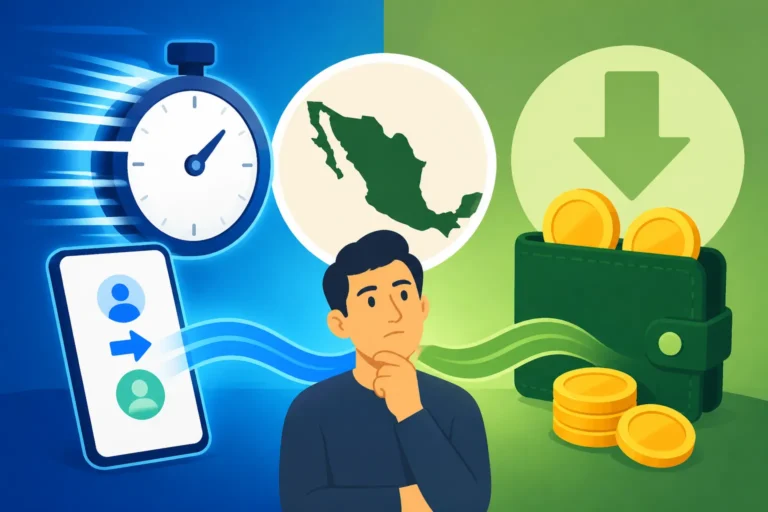
| Wise | Seconds to 1 Business Day | Excellent (True mid-market rate with low, transparent fees) | Paying rent, daily expat living expenses, and sending under $10,000 USD. |
| Interactive Brokers | 1 to 3 Business Days | Institutional (Direct Forex spot rate with minimal commission) | Massive capital movements, buying real estate, and funding businesses. |
References
Primary sources (official)
- Banco de México: The definitive federal portal explaining the mechanics of the Interbanking Electronic Payment System, the requirement of the 18-digit CLABE, and tracking electronic payment receipts. https://www.banxico.org.mx/services/interbanking-electronic-payme.html
- Procuraduría Federal del Consumidor: The federal consumer protection agency’s official guidelines on international money transfers, detailing your rights and the pricing comparator programs. https://www.gob.mx/profeco/articulos/envio-de-dinero-lo-que-debes-saber?state=published
Other helpful sources
- Mexperience: A highly trusted expat portal providing simplified explanations of the Mexican banking landscape, setting up local accounts, and managing the logistics of international asset transfers. https://www.mexperience.com/lifestyle/mexico-immigration-guide/
- ExpatDen Mexico: A detailed, firsthand resource offering granular breakdowns of navigating dual-country tax liabilities, preventing frozen accounts during massive inbound wires, and identifying the best digital remittance tools. https://www.expatden.com/mexico/
Disclaimer
The information provided in this guide is for educational, logistical, and informational purposes only and does not constitute formal financial, banking, legal, or tax advice. However, international wire protocols, SWIFT intermediary fees, and Bank of Mexico SPEI transfer limits are subject to frequent, sudden, and unannounced administrative changes. Digital platforms and brokerage services operate under their own strict terms of service, compliance checks, and fluctuating fee structures. Always conduct a small test transfer before moving large sums of capital across borders, verify the exact exchange rate being applied to your funds, and consult with a certified cross-border financial advisor and a Mexican accountant to ensure your inbound transfers comply with local tax regulations.