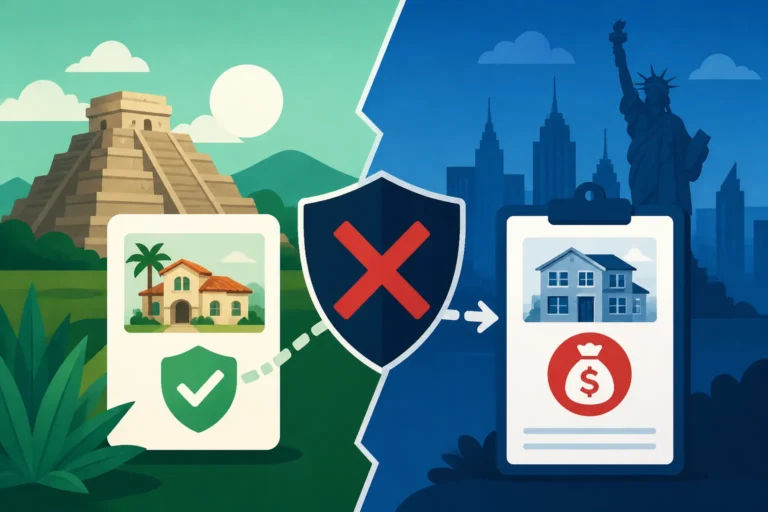
Roth Conversions While Living in Mexico: Timing and Treaty Effects
Moving your life to Mexico is an incredible adventure, but let's be honest, the financial side can sometimes feel like trying to solve a Rubik's Cube blindfolded, especially when you're dealing with both US and Mexican tax systems. If you're an American expat contemplating a Roth IRA conversion while enjoying your new life south of the border, you're not alone in scratching your head. This guide is here to walk you through the tricky nuances of Roth conversions, particularly focusing on the crucial elements of timing and how the US-Mexico tax treaty might (or might not) factor into your plans, helping you navigate these complex Taxes in Mexico for Expats: A Complete Guide to Income Tax and More.
Disclosure: This post may contain affiliate links. We may earn a commission at no extra cost to you if you make a purchase through these links. Read full disclosure.
Understanding the Roth IRA Conversion in a Nutshell
Before we even bring Mexico into the picture, let's quickly recap what a Roth IRA conversion is and why people generally consider it. A Roth IRA is fantastic because your qualified withdrawals in retirement are tax-free. Unlike a traditional IRA, where contributions might be tax-deductible and growth is tax-deferred until withdrawal, Roth contributions are made with after-tax money. A Roth conversion is simply moving funds from a traditional IRA (or 401k, etc.) into a Roth IRA.
The catch? You pay taxes on the converted amount in the year you make the conversion. The idea is to pay taxes now, at what you hope is a lower tax bracket, to enjoy tax-free growth and withdrawals later. This strategy is often appealing if you expect to be in a higher tax bracket in retirement or if you want to leave a tax-free inheritance to your beneficiaries. For many, it's a solid financial play. However, adding an international move and a new country's tax system, like Mexico's, into this equation introduces layers of complexity that require careful consideration and often, the help of a specialist in US Taxes for Americans Living in Mexico.
Why Expats Consider Roth Conversions
Expats, specifically, might look at Roth conversions for several reasons that differ slightly from their US-based counterparts. For one, if you are earning foreign income and utilizing the Foreign Earned Income Exclusion (FEIE) or Foreign Tax Credit (FTC) to reduce your US tax liability, your effective US tax rate might be lower while living abroad. This could make the "pay taxes now" part of a Roth conversion more palatable. Imagine if your taxable income is significantly reduced due to the FEIE; the income from a Roth conversion could potentially be taxed at a lower marginal rate than if you were fully subject to US income taxes without any exclusions.
Another common scenario involves future planning. Many expats eventually consider repatriating to the US, or they plan to stay in Mexico indefinitely but want to simplify their financial picture for later years. Having tax-free withdrawals in retirement, regardless of where you live then, offers tremendous peace of mind. It also protects you from potential future changes in US tax law that could make traditional IRA withdrawals less favorable. Plus, a Roth IRA has no required minimum distributions (RMDs) for the original owner, which provides greater flexibility in managing your retirement funds, especially if your other income sources are robust.
The Expat Conundrum: Mexico, Tax Residency, and Your Roth
Here's where things get complicated for us expats. When you live in Mexico, you're not just dealing with US tax rules; you're also subject to Mexican tax rules. Mexico has its own definitions of tax residency, and once you meet them – generally by having your "center of vital interests" in Mexico, meaning your primary home, family, and main source of income are here – you become a tax resident of Mexico. This means your worldwide income could be subject to Mexican taxes, alongside your continuing US tax obligations as a US citizen or Green Card holder. This is why understanding Income Tax Basics for Expats: Understanding Mexico’s Tax System is so important.
A Roth conversion generates taxable income in the US. The critical question becomes: does this conversion income also become taxable in Mexico? And how does the US-Mexico tax treaty factor into this double taxation dilemma?
Mexican Tax Residency and the Conversion Income
If you are a tax resident of Mexico when you perform a Roth conversion, Mexico generally considers you taxable on your worldwide income. This could include the income generated by a Roth conversion. However, Mexico's tax system, like many, often struggles with how to classify and tax certain US-specific financial instruments that don't have a direct Mexican equivalent. Retirement accounts are a classic example.
For a Roth conversion, the lump sum amount that moves from a traditional (pre-tax) account to a Roth (after-tax) account is considered taxable income in the US. In Mexico, the tax authorities (SAT) might view this lump sum as income derived from an investment or a capital gain. The specific classification can have a significant impact on how it's taxed, or if it's taxed at all. This is a highly nuanced area and not one where you want to guess. Without specific guidance, you could easily trigger unexpected tax liabilities in Mexico. A qualified tax professional, ideally one specializing in Declaring Foreign Income in Mexico: Tax Rules for Expats, can help you understand the current interpretation and application of Mexican tax law to this type of transaction.
The Impact of the US-Mexico Tax Treaty
The tax treaty between the United States and Mexico exists primarily to prevent double taxation and clarify which country has the right to tax certain types of income. For expats, this treaty is often a lifesaver. However, for a Roth conversion, its direct benefits might be more limited than you'd hope.
Generally, the US retains the right to tax its citizens on worldwide income, regardless of where they live. The treaty doesn't override this. What it does do is provide mechanisms, like foreign tax credits, to offset taxes paid to Mexico against your US tax liability on the same income.
The challenge with a Roth conversion is that the "income" it generates is specifically from a US retirement account, usually before the money is ever distributed to you as a resident of Mexico. Often, retirement plan distributions are covered by specific articles in the treaty. For instance, Article 18 of the US-Mexico tax treaty typically addresses pensions and annuities, assigning primary taxing rights to the country of residence. However, a Roth conversion isn't a pension distribution in the traditional sense; it's a conversion event that triggers US income recognition.
While the treaty aims to prevent double taxation, the specific language might not explicitly cover Roth conversion income in a way that exempts it from Mexican taxation. You might find yourself in a situation where the US taxes the conversion, and Mexico also taxes it based on your tax residency. Then, you'd rely on foreign tax credits (Article 24) on your US tax return to alleviate the Mexican tax burden, if applicable. But if Mexico classifies it differently or treats it as non-treaty income, the credits might not fully apply. This is an area where precise interpretation from a specialist in Double Taxation Treaties: How Expats Can Avoid Paying Taxes Twice is absolutely paramount.
Timing is Everything: Strategic Considerations for Expats
When you decide to pull the trigger on a Roth conversion can be just as important as deciding to do it at all, especially when you're navigating two tax systems. Poor timing could lead to higher tax bills than necessary in both countries.
Before Establishing Mexican Tax Residency
One of the most strategic times to consider a Roth conversion is before you officially become a Mexican tax resident. If you execute the conversion while you are still definitively a US tax resident (even if you've physically moved but haven't met Mexico's residency tests), then the income from the conversion would only be subject to US taxes. You wouldn't have to worry about the Mexican tax implications because, from Mexico's perspective, you weren't a tax resident at the time the income was recognized.
This approach minimizes complexity, as you're dealing solely with US tax law for that specific transaction. It avoids the murky waters of how Mexico's SAT would classify and tax the conversion income and how the US-Mexico tax treaty would apply to it. This requires careful planning around your move dates and understanding Mexico's Becoming a Tax Resident in Mexico: What It Means.
During Residency: When Your Income is Lower
If you're already a Mexican tax resident, timing your Roth conversion for a year when your overall income is lower (for US tax purposes) might still be a smart play. For instance, if you're taking a sabbatical, starting a new venture with initial low income, or have a year where your foreign earned income exclusion significantly reduces your US taxable income, that could be an opportune moment.
The goal remains the same: convert when you can pay the least amount of tax on the conversion. However, while doing this, you'll still need to factor in the potential Mexican tax implications discussed earlier. This is where the guidance of an expert in Do You Need an Accountant? Navigating Tax Filing as an Expat in Mexico truly becomes invaluable. They can model different scenarios for you, taking into account both US and Mexican tax rates, the FEIE, and foreign tax credits to identify the most tax-efficient window.
Annual Caps and Staggered Conversions
You don't have to convert your entire traditional IRA balance at once. Many people choose to perform staggered Roth conversions over several years. This allows them to manage the taxable income generated each year, potentially keeping it within lower US tax brackets. For expats, this strategy can be even more crucial.
By staggering conversions, you might be able to leverage the FEIE more effectively each year, assuming your other foreign earned income allows. It also gives you flexibility to adapt to changes in your financial situation or tax laws in either country. A careful analysis of your overall income, your potential US tax liability after exclusions and credits, and any potential Mexican tax implications for each partial conversion should be part of your annual financial planning. It's a key tactic for smart Money-Saving Tips: How Expats Can Cut Costs Living in Mexico when it comes to taxes.
Key Considerations for Your Roth Conversion in Mexico
A Roth conversion isn't just about paying taxes now versus later; it's a decision with many facets, especially for expats. Here's a quick rundown of critical elements to ponder.
| Consideration | US-Based Perspective | Expat in Mexico Perspective |
|---|---|---|
| Tax Residency | Straightforward US tax laws apply. | Dual tax residency (US citizen, MX resident) complicates things; conversion income may be taxable in Mexico. |
| Treaty Benefits | Not applicable; internal US matter. | Treaty may offer foreign tax credits, but specific articles on Roth conversions are ambiguous. |
| Tax Bracket | Convert in a year with lower anticipated US income. | Convert when US taxable income (after FEIE/FTC) is low, but also consider Mexican tax impact. |
| FBAR/FATCA | Standard US reporting for all accounts. | Still applies to Roth IRAs; Mexican bank accounts also reported. No change in reporting rules for Roth. |
| State Taxes | May apply depending on state residency. | For most expats, state tax residency is severed, avoiding state taxes on conversion. |
| Future Planning | Tax-free growth and withdrawals in retirement. | Continued tax-free growth and withdrawals, regardless of future residence. Excellent for long-term certainty. |
| Professional Advice | Recommended for complex situations. | Essential. Seek specialist in Filing Taxes in Mexico as a Foreigner and US expat taxes. |
Foreign Bank Account Reporting (FBAR) and FATCA
Even if you convert your traditional IRA to a Roth, it's still a US account and subject to US reporting requirements like FBAR and FATCA, if your aggregate foreign account balances meet the reporting thresholds. This doesn't change because you're an expat or because it's a Roth. You'll still need to ensure these accounts are properly disclosed to the IRS. While it's generally good practice to keep these filings in mind, a Roth conversion itself doesn't introduce new FBAR or FATCA reporting obligations beyond what you already have for your US and Mexican accounts.
State Tax Implications
One silver lining for many US expats is that by establishing bona fide residency outside of the US, you can often sever your ties to your former US state. This is particularly relevant for Roth conversions because state income tax can add a significant chunk to your tax bill. If you're no longer considered a resident of a state with income tax, you may be able to avoid state taxes on the Roth conversion, only paying federal tax. This isn't universally true and depends heavily on your specific state's rules for residency and non-residency, so it's worth confirming with your expat tax professional.
Professional Guidance: Your Best Ally
Given the intricate interplay of US tax law, Mexican tax law, and the US-Mexico tax treaty, attempting a Roth conversion without professional guidance is like trying to build a casa with a blindfold on – you'll likely miss a few crucial beams. You need a tax professional who is not only familiar with US tax law but specifically expats and ideally has a grasp of Mexican tax principles or works in conjunction with a Mexican contador (accountant).
This specialized knowledge is critical for:
- Determining Mexican Taxability: How Mexico's SAT would view your Roth conversion income.
- Applying Treaty Benefits: Properly leveraging the US-Mexico tax treaty to avoid or mitigate double taxation.
- Timing the Conversion: Identifying the most financially advantageous time to convert, considering both US and Mexican tax implications.
- Compliance: Ensuring all US and Mexican reporting obligations are met.
Finding an English-speaking accountant in Mexico who understands these cross-border complexities can be tricky, but it's not impossible. Look for firms that explicitly advertise services for expats or international tax planning. They are your essential resource for navigating the ins and outs of How to Find an English-Speaking Accountant (Contador) in Mexico.
In conclusion, a Roth IRA conversion can be a powerful financial tool for expats in Mexico, offering long-term tax-free growth and withdrawals. However, the decision should be made with a full understanding of the dual tax implications and the strategic timing involved. Don't go it alone – arm yourself with knowledge and the right professional help to ensure your financial future in Mexico is as bright as a sunny day on the Riviera Maya.
Disclaimer
This article is for general informational purposes only and does not constitute professional advice. Laws, prices and regulations vary by location and change over time. Consult a qualified professional for guidance on your specific situation.