Hurricane and Weather Cancellations: How Tour Refunds Actually Work
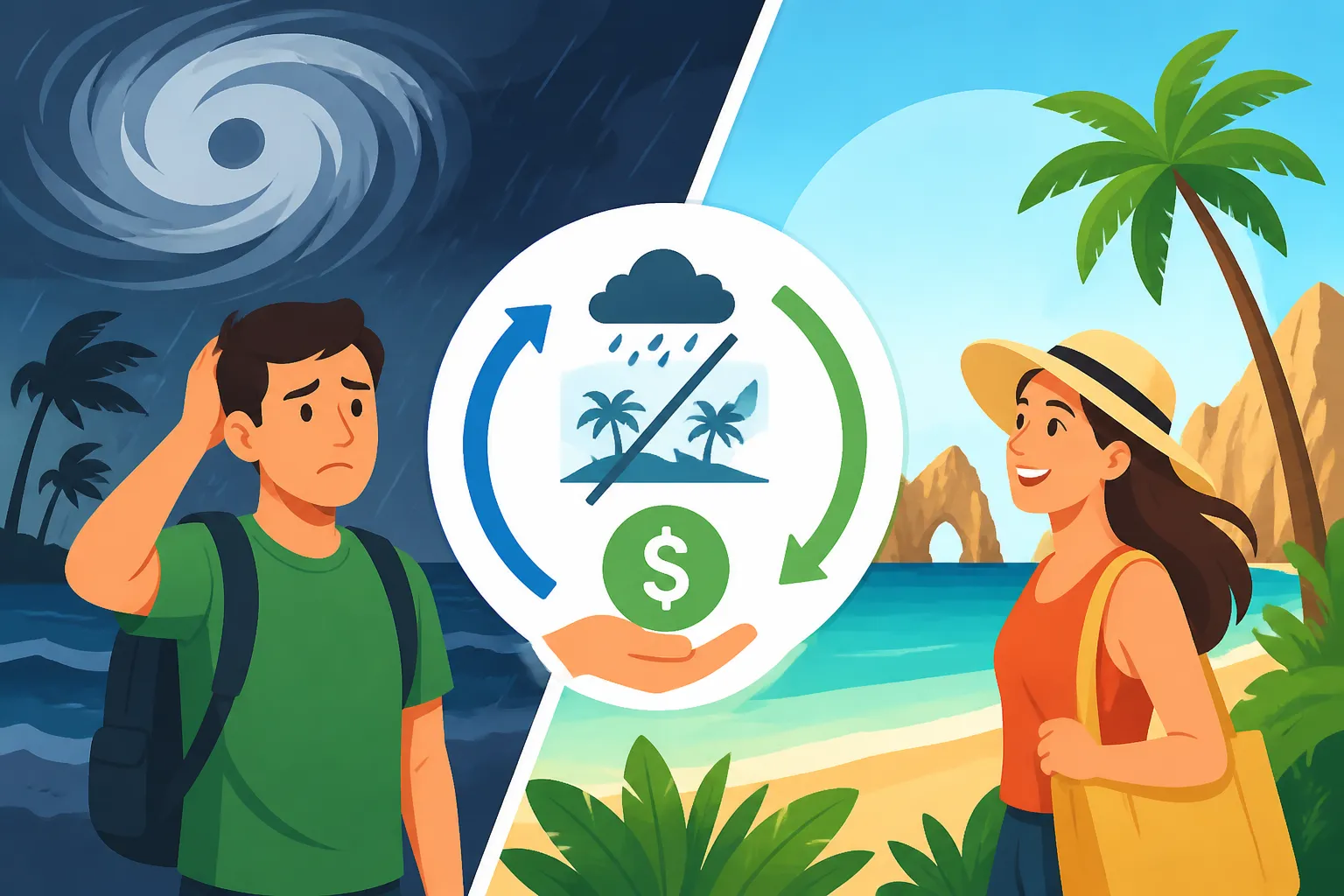
You booked the whale shark trip from Isla Mujeres three weeks in advance. Then the night before, a tropical storm warning goes up, the port captain closes the harbor, and your inbox fills with confusing messages. Is your money coming back, or will you get a voucher you will never use? This guide explains how weather cancellations and tour refunds actually work in Mexico.
Disclosure: This post may contain affiliate links. We may earn a commission at no extra cost to you if you make a purchase through these links. Read full disclosure.
Why Weather Cancellations in Mexico Work Differently
I have lived on the Caribbean side of Mexico for years. In that time I have watched dozens of visitors lose money they didn’t need to lose, and plenty of others get every peso back. The difference was rarely luck. It came down to who cancelled, why, and how the tour was booked in the first place.
Before you can sort out a refund, you need to understand how weather decisions get made here. They are not made the way you might expect if you come from a place where a tour company simply checks the forecast and decides for itself.
Hurricane Season, Nortes, and Other Weather That Disrupts Tours
Most visitors know Mexico has a hurricane season. On both the Caribbean and Pacific coasts it runs from early summer into late autumn, and activity usually peaks in late summer and early autumn. If you want the big-picture view of whether to travel during those months at all, see Is Hurricane Season a Problem for Visiting Mexico?.
What surprises people is how much weather disrupts tours outside hurricane season. On the Yucatán Peninsula and the Gulf coast, the winter months bring nortes. These are cold fronts that sweep down from the north with strong winds and rough seas. A sunny January day in Cancún can still mean the catamaran to Isla Mujeres stays tied up, because the wind is churning the channel into whitecaps.
Then there are the quieter problems:
- Heavy afternoon rains in the highlands around Oaxaca and Chiapas can wash out mountain roads to waterfalls and canyons.
- Morning winds can ground hot air balloons over Teotihuacán even on a clear day.
- Sargassum seaweed can make certain beach and snorkel stops unpleasant. It rarely cancels a tour outright, but it can change the itinerary.
Each of these situations leads to a different refund outcome. That is why a blanket “weather policy” on a website often does not tell you what will happen to your specific booking.
Who Actually Makes the Call to Cancel
For anything on the water, the operator often does not get to decide. Mexico’s port authority, the Capitanía de Puerto, can close a port to small vessels when wind and wave conditions cross safety thresholds. When that happens, every boat tour, snorkel trip, fishing charter and island ferry from that port is grounded, whether the operator likes it or not. In the Cancún area you will hear locals say “cerraron el puerto,” meaning they closed the port. Once you hear that phrase, your tour is not happening.
For land tours the operator usually makes the call, sometimes together with park authorities. Archaeological sites like Chichén Itzá rarely close for ordinary rain, but they can close during a hurricane warning or for civil protection reasons. Protección Civil, the state emergency management agency, can order closures of cenotes, beaches and parks before and after a major storm.
This matters for your refund because an official closure is the cleanest possible cancellation scenario. Nobody can argue that you chose not to show up. The tour could not legally operate, and that puts you in a strong position.
How Tour Refunds Actually Work When the Weather Turns
Once you strip away the jargon, refunds in weather situations fall into a few predictable scenarios. Think of these as the branches of a decision. Find yours and the outcome becomes much easier to predict.
When the Operator Cancels the Tour
This is the best scenario for you. If the operator cancels because of weather, a port closure or an official warning, you are generally entitled to choose between a new date and a full refund. Reputable operators, and the major booking platforms that list them, treat an operator-initiated weather cancellation as the business’s problem, not yours.
Here is a scenario I see often. A couple from Toronto books a Cozumel snorkel trip on their second day. A norte rolls in, the port closes, and the operator messages them that morning. Because they still have four days left, they move the trip to day five, when the seas have calmed. If the storm had hit on their last day, they would have taken the refund instead. Either outcome costs them nothing. For more on how boat departures out of Cozumel are organized, see Diving and Snorkelling Trips in Cozumel: Booking Boats and Gear.
The catch is that you must respond. Some operators default to rebooking if you stay silent. If the new date does not work, say so clearly and in writing so the record shows you asked for a refund.
When You Cancel Because the Forecast Looks Bad
This is the scenario where people lose money. A forecast shows a tropical system forming. You get nervous and cancel two days out. Then the storm veers away, the tour runs in sunshine, and your cancellation is treated as a normal customer cancellation.
In that case the standard cancellation terms on your booking apply. If you cancel inside the free cancellation window, you get your money back. If you cancel after the cutoff, you may get nothing at all, even though the weather worried you. The actual weather does not change the terms. Only the operator’s decision, or an official closure, triggers weather-specific protection.
My advice from experience is to wait whenever the cancellation window allows it. Keep watching the forecast, and if the window is about to close and the forecast is still ugly, contact the operator before it does. Ask directly: “If the port closes, will you cancel and refund?” Most will say yes, and that answer lets you hold your booking with confidence. For a deeper look at standard cancellation terms on tours here, see Cancellation Policies on Mexican Tours: What You Get Back and When.
When the Tour Runs in Marginal Weather
The third scenario is the grey zone. It is windy but the port is open. It is drizzling at the ruins but nobody has closed anything. The operator runs the tour, and you do not want to go.
Generally, if the tour operates and you do not show up, you will not get a refund. If you go and the experience is degraded, for example the snorkel stop is moved to a sheltered spot or the whale sharks never surface, you are usually not entitled to a refund either. Wildlife and weather-dependent experiences are almost always sold on a “conditions permitting” basis. The exception is when an operator substantially changes what was promised, such as cancelling the island portion of an island tour. Then a partial refund or credit is worth requesting politely, with photos and specifics.
Whale shark trips are the classic example. They are long boat rides, highly weather-dependent, and the animals do not follow schedules. For season and operator details, see Whale Shark Tours Near Cancun and La Paz: Operators and Season.
Weather Cancellation Scenarios at a Glance
| Scenario | Who Decides | Typical Outcome | What You Should Do |
|---|---|---|---|
| Port captain closes the port | Port authority | New date or full refund | Respond quickly and state your choice in writing |
| Protección Civil closes a site or beach | State emergency agency | New date or full refund | Screenshot the official notice if possible |
| Operator cancels for safety | Operator | New date or full refund | Ask for a refund if the new date does not suit you |
| You cancel inside the free cancellation window | You | Full refund | Cancel through the same channel you booked |
| You cancel after the cutoff because of the forecast | You | Often no refund | Contact the operator before the cutoff instead |
| Tour runs in rain or wind and you skip it | You | Usually no refund | Treat it as a no-show unless the operator agrees otherwise |
| Tour runs but the itinerary changes significantly | Operator | Possible partial credit | Request it politely with specifics and photos |
Why Viator Is the Smartest Way to Book Weather-Sensitive Tours
I have booked tours every way possible in Mexico. I have paid cash at a beach kiosk in Playa del Carmen, sent bank transfers to small operators over WhatsApp, booked through hotel concierge desks, and used online platforms. For anything on the water or anything weather-sensitive during storm season, I now book through Viator almost every time. The reason is simple: when the weather turns, the booking channel decides how much fight you have to put up to get your money back.
Clear Cancellation Terms You Can Read Before Paying
Every experience on Viator shows its cancellation policy on the listing before you pay. Many tours in Mexico carry a free cancellation option, which lets you cancel for a full refund up to a set point before the start time. The exact cutoff varies by experience, so read it on each listing rather than assuming.
Compare that with a cash booking at a kiosk on Quinta Avenida. You get a paper receipt, maybe a WhatsApp number, and a verbal promise. When the port closes, the vendor may offer to move your date but grumble about refunding cash, especially if you are leaving tomorrow. I have watched visitors spend their last morning walking back and forth between a kiosk and an ATM trying to recover a deposit.
Viator also handles operator-initiated weather cancellations in a structured way. If the operator cancels because of poor weather, the platform’s standard approach is to offer you a different date or a full refund. That is exactly the protection you want during hurricane season or a norte. Check the policy wording on Viator’s own help pages for the current details, since terms can be updated.
Many listings also offer a reserve now, pay later option. This helps when you are planning a trip in the shoulder of storm season and want to lock in a spot without having money tied up while you watch the forecast. Availability varies by experience, so check each listing.
Weather Rebooking Without the Language Barrier
Weather cancellations happen fast, often at six in the morning, and usually in Spanish. A local operator in Bacalar or Holbox may message you a short note saying the tour is cancelled because of “mal tiempo,” then wait for you to sort out the rest. If your Spanish is shaky and you are standing on a dock in the rain, that is stressful.
Booking through Viator gives you a single place to manage the reservation. You can see your booking status, cancel within the free window, and reach customer support in English if something goes wrong. When an operator cancels, the cancellation and refund run through the platform rather than depending on someone remembering to send you money from a personal account.
That matters more than people realize. I once had a sailing trip on the Bacalar lagoon cancelled by a sudden storm. Because I had booked through Viator, the refund was processed through the platform without me chasing anyone. A friend who had booked the same operator directly over WhatsApp eventually got her money back too, but only after several days of messages and a lot of patience.
Reviews That Tell You How Operators Handle Bad Weather
One underrated advantage is the review history. Before booking a weather-sensitive trip on Viator, I search the reviews for words like “cancelled,” “weather,” “storm,” and “refund.” Reviews show you how an operator actually behaves when conditions turn. Do they cancel proactively and communicate well, or do they run boats in dangerous seas to avoid refunding? An operator that pushes out in conditions others avoid is a safety red flag as well as a refund risk. For a fuller method of reading reviews and vetting operators, see Tour Safety in Mexico: Vetting Operators and Reading Reviews Properly.
None of this means booking directly is always wrong. For some small, community-run operators, or when you are already on the ground in calm season, direct booking can make sense. For a fair look at when going direct wins, read Booking Platforms vs Local Operators in Mexico: When Direct Is Cheaper. And if you want to compare Viator against its closest rival on cancellation terms specifically, see Viator vs GetYourGuide for Mexico: Coverage, Price, and Cancellation.
Booking Channels Compared for Weather Risk
| Booking Channel | Cancellation Terms Visible Before Paying | Weather Cancellation Handling | Ease of Getting a Refund | English Support |
|---|---|---|---|---|
| Viator | Yes, on every listing | Different date or full refund when the operator cancels | Processed through the platform | Yes |
| Booking directly via WhatsApp | Rarely in writing | Depends on the individual operator | Requires follow-up with the operator | Varies |
| Street kiosk with cash | Usually verbal only | Often a reschedule only | Difficult once you leave town | Varies |
| Hotel concierge desk | Sometimes | Depends on the operator the hotel uses | Goes through the hotel, which can be slow | Usually |
What to Do When a Storm Is Heading Your Way
Here is the routine I follow, and the one I give every visiting friend, when a tropical system or norte shows up in the forecast during a trip.
Step-by-Step Plan for Protecting Your Tour Booking
- Check your booking’s cancellation cutoff the moment the forecast changes. Write down the exact date and time the free cancellation window closes.
- Follow official sources, not social media rumors. In Quintana Roo and Yucatán, watch for announcements from state Protección Civil and port closure notices. Your hotel front desk usually knows about port closures quickly.
- Contact the operator before your cutoff. Ask whether they expect to cancel and what they will offer if they do. Get the answer in writing through the booking platform’s messaging or by email.
- Do not cancel early out of nerves if you can wait. If the operator is likely to cancel, letting them do it protects your right to a refund or new date.
- If the operator cancels, respond with your choice immediately. If you prefer a refund, ask for one explicitly rather than accepting a default reschedule.
- If you need to cancel yourself, do it inside the free window and through the same channel you booked. On Viator, cancel from your booking page so the refund is processed automatically.
- Rebook strategically. Move water-based tours to later in your trip, and swap in land-based options such as the ruins at Cobá, colonial Valladolid or a cooking class for the storm days.
- Keep records. Screenshot cancellation messages, port closure notices and any written promises from operators.
Planning a Hurricane Season Trip Without Losing Money
If you are traveling during hurricane season, structure your itinerary around the weather instead of hoping for the best. Front-load land tours and keep boat trips for the middle of your stay, so a cancelled day can be rebooked before you fly out. Always prefer experiences with free cancellation, and avoid paying non-refundable deposits by bank transfer to operators you have never met.
Think about your accommodation too. A refundable tour does little good if you are locked into a non-refundable hotel in a town that has evacuated. For strategy on hotel rates in storm season, see Hurricane Season in Mexico: Refundable Rates and Booking Strategy. If you are visiting out of season, consider that low-season tours sometimes run with small minimums and can be cancelled for low numbers as well as weather; Booking Tours in Low Season: Cancellations, Minimums, and Private Upgrades covers that.
Some trips layer the weather risk. Cruise passengers can find their ship rerouted away from Cozumel or Costa Maya entirely when a storm approaches. Independently booked excursions then depend on the excursion’s own cancellation terms, which is another reason to choose free cancellation listings. If you arrive by ship, see Cruise Passenger Excursions: Booking Independently vs Through the Ship.
For island hops to Isla Mujeres or Cozumel, the boats are the most cancellation-prone part of a Caribbean coast trip. Compare your options in Caribbean Island Boat Trips: Catamaran, Speedboat, and Ferry Tours Compared before you commit.
A Realistic Mindset for Weather in Mexico
After many seasons here, my honest advice is to accept that weather will move at least one plan on a long trip, especially between summer and late autumn or during a strong norte. The visitors who leave happy are not the ones who never had a cancellation. They are the ones who booked flexibly, waited for the operator to make the call, and had a plan B ready.
Book your weather-sensitive experiences with clear, visible cancellation terms. Let the operator or the port captain carry the risk of a storm instead of carrying it yourself. And when the sky turns grey over the Caribbean, remember that the cenotes, the ruins and the taquerías are still open. If you want to lock in your tours with that kind of protection, browse the free cancellation options on Viator before your trip and read each listing’s policy before you pay.
Disclaimer
This article is for general informational purposes only and does not constitute professional advice. Laws, prices and regulations vary by location and change over time. Consult a qualified professional for guidance on your specific situation.