Earning Dollars, Spending Pesos at the Border: Daily Currency Mechanics
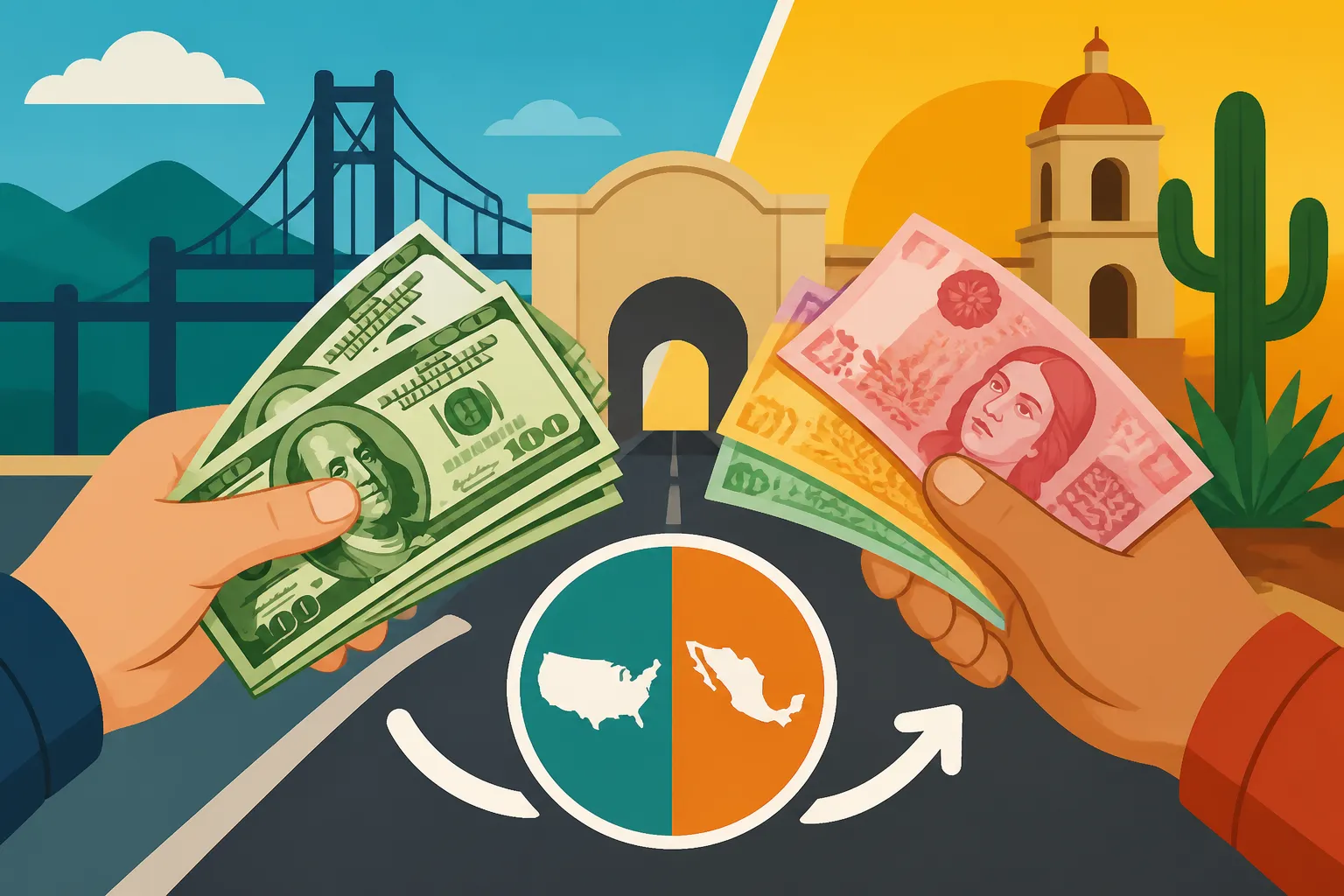
Living in Mexico, especially near the border, often means navigating a constant currency dance: you're earning in good old US dollars, but every trip to the mercado or the utility bill screams for pesos. It's a logistical headache that can feel like you're losing money on every conversion, and the frustrations of fluctuating exchange rates and hidden fees are all too real. This guide will walk you through the daily mechanics of managing your USD income while spending in MXN, focusing on smart strategies and tools like Wise to keep more pesos in your pocket.
Disclosure: This post may contain affiliate links. We may earn a commission at no extra cost to you if you make a purchase through these links. Read full disclosure.
The Daily Grind: Earning Dollars, Living in Pesos
For many of us expats, the dream of affordable living in Mexico comes with a financial reality check: our income often originates from abroad, usually in US dollars, while our daily expenses are firmly rooted in Mexican pesos. This constant need for conversion can feel like a game you're always losing if you don't have the right strategy.
The Currency Conundrum for Border Expats
Imagine you're a digital nomad, getting paid by your US employer directly into your American bank account. Or perhaps you're a retiree whose pension comes in USD. Maybe you even work a cross-border job, living in Tijuana but commuting to San Diego, or vice versa, and receive your paycheck in dollars. These are fantastic opportunities that make living in Mexico possible for many, but they create a unique financial puzzle. Every time you need to buy groceries, pay your rent, cover your utility bills, or enjoy a meal out, you need pesos. And not just any pesos, but pesos obtained at a favorable exchange rate, without exorbitant fees eating into your hard-earned income.
The frustration is palpable when you see the official exchange rate online, only to find a significantly worse rate offered at a local casa de cambio or bank. It feels like you're being penalized simply for trying to convert your own money. The difference, even a few cents per dollar, adds up significantly over a month, let alone a year. It can easily impact your budget, turning what you thought was a comfortable income into a tighter squeeze than you anticipated. This constant vigilance over exchange rates and transaction costs becomes another chore in the expat experience, on top of everything else.
Why the Border Zone is Unique for Currency Exchange
While the USD vs. MXN dance is common throughout Mexico, living in a border city or town like Tijuana, Ciudad Juárez, or Nogales presents its own peculiar set of circumstances. Here, the US dollar often holds an almost mythical status, sometimes being accepted directly by vendors. But don't be fooled by the apparent convenience. While a small shop or a street vendor might take your dollars, they are almost certainly using an informal, often very unfavorable, exchange rate. They're doing you a favor by taking USD, and they'll make sure they profit from it.
You might walk into a local pharmacy or convenience store and see prices listed in both pesos and dollars, or just a sign proudly stating "USD Accepted." It’s tempting, I know, to just hand over those crisp bills. But the conversion rate they use is rarely, if ever, in your favor. It's a form of embedded fee. The sheer volume of cross-border traffic, with people living, working, and shopping on both sides of the line, means there's a constant flow of both currencies. However, this doesn't automatically translate to better deals for the individual expat. Instead, it creates an environment where being financially savvy is paramount to avoid being shortchanged on every transaction. Understanding the nuances here can save you a bundle over time.
Traditional Methods of Currency Exchange and Their Pitfalls
Before we dive into the smarter solutions, let’s talk about the traditional ways many expats initially try to convert their dollars to pesos, and why these methods often leave you feeling like you're getting the short end of the stick. It's a learning curve we've all been through!
Physical Money Changers and Banks: Convenience vs. Cost
When you first arrive, or when you need a quick injection of pesos, your first thought might be to hit up a casa de cambio (money exchange house) or a local bank branch. They're ubiquitous, especially in tourist areas and border towns, promising a straightforward exchange. But let's be real about the experience.
Casas de cambio often advertise their buy and sell rates clearly, and they might seem competitive at a glance. However, those rates are often less favorable than the interbank exchange rate, which is the rate financial institutions use to trade money among themselves. For smaller amounts, the difference might seem negligible, but if you're converting hundreds or thousands of dollars regularly, those little discrepancies add up fast. Plus, you’re dealing with cash, which always carries a certain level of risk, especially if you're walking around with a significant sum after a transaction.
Then there are the traditional Mexican banks like BBVA, Banorte, or Santander. While they generally offer more stable and slightly better rates than smaller casas de cambio, dealing with them can be an exercise in patience. Long queues, extensive paperwork, and language barriers (unless you've really honed your Spanish) can make a simple exchange feel like an ordeal. Their hours might not always align with your schedule, and the process can be slow. For someone living on the border and constantly needing pesos, this can be a significant time sink. While opening an account with a local institution like How to Open a Bank Account in Mexico: Requirements and Tips is crucial for managing your finances, relying solely on them for frequent USD-to-MXN conversions isn't always the most efficient.
Using US Bank Accounts and Credit Cards in Mexico
"Why not just use my US debit card at an ATM?" you might ask. It's a valid thought, and certainly more convenient than carrying huge stacks of cash. However, this convenience comes at a cost, often a multi-layered one.
Firstly, most Mexican ATMs, whether from Banamex, HSBC, or other local banks, will charge you an ATM usage fee. This is on top of any fees your own US bank might charge for international withdrawals. So, for a single transaction, you could be paying two separate fees. Secondly, the exchange rate used by the ATM is typically determined by the local bank, and it's almost never the best rate available. It’s designed to benefit them, not you. Repeatedly withdrawing small amounts means repeatedly paying those fees and getting less favorable rates, which chips away at your spending power. For more details on avoiding these costs, check out our guide on Using ATMs in Mexico: Avoiding Fees and Staying Secure.
Then there's the credit card scenario. Using your US credit card for purchases is tempting, especially for larger items. However, many US credit cards charge a "foreign transaction fee," typically around 1-3% of the purchase amount. This means every time you swipe, you're paying a little extra. Even more insidious is "dynamic currency conversion" (DCC). This is when a merchant offers to process your transaction in US dollars instead of Mexican pesos. They’ll usually present it as a convenience, but in reality, they're converting it at their own, often terrible, exchange rate, again profiting from your lack of local currency. Always insist on being charged in the local currency (MXN) to let your bank (or a smarter service) handle the conversion, even if your US bank charges a foreign transaction fee, it's often still better than the DCC rate. It’s a frustrating reality, but thankfully, there are better options out there.
The Smarter Way to Convert: Enter Wise
This is where the game truly changes for expats. Managing your money shouldn't feel like a constant battle against hidden fees and unfavorable rates. For me, and countless other expats who've cracked the code, Wise (formerly TransferWise) has been an absolute lifesaver. It’s not just a transfer service; it’s a complete game-changer for cross-border living.
How Wise Streamlines Cross-Border Finances
Imagine receiving your salary or pension in US dollars and being able to convert it to pesos at the real, mid-market exchange rate – the one you see on Google – with only a small, transparent fee. That's exactly what Wise offers. They’ve built their entire business around transparency and fairness, and for anyone earning in one currency and spending in another, it’s a revelation.
With a Wise multi-currency account, you can hold balances in multiple currencies, including USD and MXN. This means you can receive your income in US dollars directly into your Wise account, just as if you had a US bank account. Then, when you need pesos for your daily expenses or to pay rent, you simply convert the desired amount from your USD balance to your MXN balance. You see the exact mid-market rate, the small fee, and how many pesos you'll get before you confirm the transfer. No hidden markups, no nasty surprises.
Once your money is in your MXN balance, you have several convenient options. You can send it directly to a local Mexican bank account (like your Banorte or BBVA account) via SPEI, often arriving almost instantly. Or, even better, you can use your Wise debit card. When you spend using the card in Mexico, it automatically draws from your MXN balance, behaving just like a local Mexican debit card and completely bypassing those annoying foreign transaction fees and dodgy DCC options. This level of control, transparency, and efficiency is simply unparalleled by traditional banking methods.
If you're tired of losing money on every conversion, or constantly worrying about the latest exchange rate, you absolutely need to explore Wise. It makes managing your money across borders feel effortless and fair.
Real-World Scenarios with Wise for Expats
Let's look at how Wise can integrate into your expat life and make a tangible difference in your daily finances. These aren't just hypotheticals; these are real situations many of us navigate daily.
Consider Maria, a remote marketing professional living in Mérida, who earns $3,000 USD a month from her employer in New York. Before Wise, Maria would receive her salary in her US bank account, then make a large international transfer to her Mexican bank, incurring wire fees and getting whatever rate her bank offered that day. Or, she'd withdraw large chunks of cash from ATMs, dealing with multiple fees and less-than-ideal rates. Now, Maria has her employer direct deposit into her Wise USD account details. When her landlord needs the 10,000 MXN for rent, Maria simply opens her Wise app, converts the equivalent USD to MXN at the mid-market rate, and sends it via SPEI to her landlord's Mexican bank account, all within minutes. She saves on transfer fees, gets a better rate, and has full control. For her daily gastos (expenses), she uses her Wise debit card, knowing she’s spending directly from her MXN balance without extra fees.
Or take David, a retiree in San Miguel de Allende, who receives his pension payments in USD. His core expenses – groceries, utilities, occasional doctor visits – are all in pesos. David doesn't need all his money in pesos at once; he prefers to convert as needed to take advantage of favorable exchange rates. With Wise, he can set up rate alerts, so he gets a notification when the USD to MXN rate hits a point he likes. He then converts a portion of his USD to MXN, keeping the rest in dollars. This flexibility means he maximizes every dollar, rather than being forced to convert his entire pension at whatever rate is available on a specific day. This strategy of converting strategically helps tremendously in managing your overall Cost of Living in Mexico: 2026 Comprehensive Guide. Wise empowers you to be proactive and informed, rather than reactive and at the mercy of banks.
Maximizing Your Pesos: Practical Tips Beyond Conversion
Having a fantastic tool like Wise is a huge step, but truly maximizing your pesos in Mexico involves a few other smart strategies that integrate with your conversion habits. It's all about being intentional with your money, which, let's face it, is a skill we all hone living abroad.
Timing Your Conversions and Monitoring Rates
One of the biggest advantages of a service like Wise, which allows you to hold balances in both currencies, is the ability to choose when you convert. You don't have to convert all your incoming USD at the exact moment it arrives. Instead, you can become a savvy currency observer.
Here’s a tip: set up rate alerts directly through the Wise app or other financial websites. These alerts will notify you when the USD to MXN exchange rate hits a certain point. Over time, you’ll start to notice patterns. While no one can predict currency fluctuations perfectly, converting when the peso is slightly weaker (meaning your dollars buy more pesos) can make a significant difference over months. For example, if you know your rent is due on the first of the month, you can keep an eye on the rate in the weeks prior and convert the necessary amount when it's most favorable, rather than being stuck with whatever the rate is on payday. This proactive approach ensures you’re not leaving money on the table due to sheer timing. Learning about Currency Exchange in Mexico: Getting the Best Rates on Pesos will further empower you.
Budgeting in Two Currencies
This might sound like a headache, but it’s a crucial mental shift for expats. If your income is in USD and your expenses are in MXN, you need to budget accordingly. It’s not enough to just know you have "enough money." You need to understand how much of your USD income translates into your fixed and variable peso expenses.
Start by clearly listing all your monthly expenses in MXN: rent, utilities, groceries, transportation, entertainment. Then, convert that total to USD at a conservative (slightly worse than average) exchange rate. This gives you a clear picture of how many dollars you need to set aside each month for your Mexican life. The remaining USD can then be kept in dollars, used for international travel, or invested. Many expats find it useful to use a spreadsheet or a budgeting app that can handle multiple currencies to track this. This dual-currency budgeting helps you maintain clarity and control, preventing that unsettling feeling of not quite knowing where your money is going or how much "extra" you truly have. Keeping track of your spending is one of the best Money-Saving Tips: How Expats Can Cut Costs Living in Mexico .
Local Banking Integration (with Wise as the bridge)
While Wise is an incredible tool for cross-border conversions and spending, it's still highly advisable, and often necessary, to have a local Mexican bank account. Why? Because some things in Mexico are just easier, or only possible, with a local account. Direct debits for utilities, receiving payments from local Mexican clients if you freelance, or even just building a financial footprint in the country often require an actual Mexican bank account.
The beauty is that Wise doesn't replace your local bank; it enhances it. You can seamlessly transfer your converted pesos from your Wise MXN balance directly to your Mexican bank account. This way, you get the best of both worlds: the superior exchange rates and transparent fees of Wise for converting your dollars, and the local convenience of a Mexican bank for everything else. This hybrid approach is what most long-term expats eventually adopt. Whether you choose BBVA, Banorte, or another, our guide on Best Banks in Mexico for Expats: Comparing Fees and Services can help you pick the right one. This way, you don't have to constantly ask yourself, Do You Need a Mexican Bank Account or Can You Rely on Your Home Bank? – you can do both, strategically.
Navigating the Cash vs. Card Dilemma
Mexico is a diverse country, and how you pay for things can vary wildly depending on where you are – from bustling metropolises like Mexico City to charming small towns or remote coastal villages. Understanding when to pull out cash and when to swipe your card (especially your Wise card!) is another key financial skill for expats.
When to Use Cash in Mexico
Despite the rise of digital payments, cash (pesos, of course!) remains king in many parts of Mexico. You'll definitely want to have small denominations on hand for these situations:
- Local Markets (Mercados and Tianguis): This is where haggling (politely!) happens, and cash is almost exclusively accepted. From fresh produce to artisan crafts, small bills and coins are essential.
- Street Food Vendors: Your taco stand favorite, the esquites seller, the agua fresca cart – they all operate on cash. It's quick, easy, and expected.
- Small Shops and Tienditas: Many mom-and-pop stores, especially in smaller towns, prefer or only accept cash for small purchases.
- Taxis: While ride-sharing apps like Uber are popular in big cities, traditional taxis, particularly in areas where apps aren't as prevalent or during peak hours, often operate on a cash-only basis. Always agree on the fare beforehand if possible.
- Tipping: From the helpful baggers at the supermarket (cerillitos) to restaurant servers and musicians, tipping is customary, and cash is always preferred for these gestures. Knowing the local customs for Tip Culture: How Much to Tip for Services (From Maids to Waiters) is very helpful.
Carrying too much cash can be risky, but not enough cash can leave you stranded or unable to make a purchase. It's a balance you'll learn with experience.
When to Use Cards (and Your Wise Card)
For larger purchases or in more modern establishments, cards are widely accepted and often more convenient. This is where your Wise debit card truly shines.
- Supermarkets and Big Box Stores: Chains like Walmart, Chedraui, Soriana, and Costco readily accept card payments. This is an ideal place to use your Wise card, drawing directly from your MXN balance.
- Restaurants and Cafes: Most mid-to-high-end restaurants and cafes will accept cards. Just be sure to specify en pesos if they ask about currency, avoiding that dreaded dynamic currency conversion.
- Department Stores and Malls: Shopping malls and larger retail outlets are fully equipped for card payments.
- Online Purchases: Whether it’s Mercado Libre, Amazon Mexico, or paying for streaming services, your Wise card can be linked for seamless online transactions.
- Paying Utility Bills: While some utility payments can be made in cash at OXXO, many can also be paid online or directly through your Mexican bank account, which you can fund efficiently with Wise.
Using your Wise debit card, loaded with pesos, ensures you’re not incurring foreign transaction fees or getting hit with bad exchange rates at the point of sale. It provides a secure and transparent way to spend your converted funds, keeping more of your money where it belongs: in your wallet. When it comes to Using Credit and Debit Cards in Mexico: What Expats Need to Know, having a card that truly works for you makes all the difference.
Comparing Currency Conversion Methods for Expats in Mexico
| Method | Exchange Rate | Fees | Convenience | Transparency | Best For |
|---|---|---|---|---|---|
| Wise | Mid-market rate | Low, transparent (variable %) | High (online, debit card, local transfers) | Very High | Regular transfers, daily spending, budgeting |
| Traditional Banks (MX) | Bank's daily rate | Variable (wire fees, transaction fees) | Moderate (in-person, online banking) | Moderate | Large, infrequent transfers to MX accounts |
| Casas de Cambio | Marked-up rate | Often none explicitly stated, hidden in rate | High (quick cash exchange) | Low (rate markup isn't clear) | Small, urgent cash needs |
| ATMs (Foreign Card) | ATM network's rate | ATM fee + your bank's international fee | High (24/7 access) | Low (fees can surprise) | Emergency cash, but not cost-effective |
| Foreign Credit/Debit | Card network's rate | Foreign transaction fees (1-3%), DCC risk | High (POS purchases) | Moderate (DCC is bad) | Limited use, or cards with no foreign fees |
Disclaimer
The information provided in this article is intended for general guidance and informational purposes only. While we strive to offer accurate and up-to-date advice based on personal expat experience and research, financial regulations, exchange rates, and banking policies in Mexico can change frequently. We recommend consulting with a qualified financial advisor or immigration expert for personalized advice regarding your specific situation in Mexico. This content does not constitute financial or legal advice.