Data Coverage on the Yucatan Highways: Signal Between Cenotes and Ruins
Ah, the Yucatán! That magical peninsula filled with ancient mysteries, refreshing cenotes, and stretches of highway that promise adventure… and sometimes, a terrifying drop into the abyss of zero cell signal. You’ve pictured it, haven’t you? Cruising along, Google Maps confidently guiding you, then suddenly, the little blue dot freezes. Your heart sinks a little. Will you find that hidden cenote? Will you miss the turn for Chichén Itzá? More importantly, will you be able to call for help if you need it? This guide is here to shed light on the often-patchy reality of data coverage on Yucatán's beautiful, yet sometimes challenging, highways, and crucially, how to ensure you stay connected with a reliable solution like Airalo.
Disclosure: This post may contain affiliate links. We may earn a commission at no extra cost to you if you make a purchase through these links. Read full disclosure.
The Reality of Yucatán Highway Data Coverage
Let's get real about connectivity in the Yucatán. While cities like Cancún, Mérida, and Playa del Carmen generally offer decent signal, the moment you hit the open road, especially when veering off the main cuotas (toll roads) or heading to more secluded attractions, things can get dicey. It's a common frustration for both seasoned expats and first-time tourists alike. One minute you're streaming your favorite playlist, the next it’s pure radio silence, leaving you scanning for Wi-Fi or frantically restarting your phone.
The "Big Three" Providers and Their Footprint
Mexico has a few major players in the mobile network game: Telcel, AT&T, and Movistar. Historically, Telcel has been the undisputed king of coverage, particularly in more rural and remote areas. Their infrastructure is simply more widespread, a legacy of being the dominant provider for decades. However, "more widespread" doesn't mean "everywhere," especially when you're driving through dense jungle or between small pueblos.
AT&T and Movistar have made significant strides, particularly in urban centers and along major tourist corridors. You'll likely have good service in Cancún, Tulum, and along Highway 307 which connects them. But stray just a little, perhaps taking a back road towards an archaeological site like Ek Balam or exploring the lesser-visited cenotes near Homún, and their coverage can quickly degrade or disappear entirely. It’s a constant gamble. You might find a single bar of 3G, just enough to tantalize you before it vanishes completely.
The "Dead Zones" Between Points of Interest
This is where the rubber meets the road, or rather, where your signal doesn't. Many of the Yucatán's most incredible sights are precisely where cell towers are sparse. Think about the drive from Mérida towards the Ruta Puuc, where magnificent Mayan cities like Uxmal, Kabah, and Sayil dot the landscape. The scenery is breathtaking, but don't expect reliable 4G the entire way. Similarly, the roads leading to some of the more authentic, less touristy cenotes – the ones you really want to discover – are notorious for dead zones.
Imagine you're driving down the 180D highway towards Chichén Itzá. For much of the journey, especially after you pass Valladolid, the signal can be intermittent. Or heading to the pink lakes of Las Coloradas, a beautiful, remote destination where you’ll definitely want to Instagram, but good luck getting consistent service on the way. These patches of no-man's-land aren't just an inconvenience; they can be genuinely concerning if you're navigating unfamiliar roads, need to check an urgent message, or heaven forbid, encounter a roadside issue. Your trusty GPS becomes a static map, and that feeling of self-reliance starts to fray at the edges.
Impact on Travelers and Expats
For travelers, spotty data means a few things:
- Navigation Nightmares: Getting lost is less of an adventure and more of a headache when you can't refresh your maps. Trying to find that specific turn-off for a little-known cenote or the entrance to a ruin site without real-time updates can be frustrating.
- Emergency Concerns: This is the big one. If you have car trouble, a medical issue, or need to contact someone urgently, a dead zone means you're truly on your own until you find a town or a miraculous patch of signal. Staying Safe in Mexico: Practical Tips for Travelers includes advice that applies here.
- Missed Connections: Whether it's coordinating with fellow travelers in another car, checking reservation details for your next stop, or simply telling family back home you're okay, a lack of data isolates you.
- Research on the Fly: Want to quickly look up opening hours for a site, a restaurant recommendation in the next town, or the history of the ruins you're approaching? Forget about it.
For expats, the impact is similar but amplified. We rely on connectivity for everything from paying bills (yes, even in the middle of nowhere, sometimes a bill needs to be paid!) to coordinating with local contacts. We've all had those moments where we pull over, hold our phone up to the sky like a prayer, hoping for a bar or two. It's part of the charming chaos, but it's also a legitimate concern.
Why Traditional SIM Cards Often Fall Short on Yucatán's Rural Roads
You might think, "Well, I'll just get a local SIM card!" And yes, for day-to-day life in the city, getting a SIM Card in Mexico (Telcel, AT&T, Movistar) is absolutely the way to go. But when you venture into the Yucatán's wilder corners, even a local SIM can leave you in the lurch.
The Limitations of Single Network Dependence
The fundamental issue with a traditional physical SIM card, whether it's from your home country or a local Mexican provider, is that it ties you to a single network. If you have a Telcel SIM, you're relying solely on Telcel's towers. If you're with Movistar, you're stuck with Movistar. While Telcel generally offers the best coverage, even they have their blind spots.
Imagine you're driving towards Uxmal, a spectacular Mayan site on the Ruta Puuc. For segments of that drive, Telcel might have good 4G, but then you hit a dip in the terrain or a particularly dense patch of jungle, and suddenly, their signal is gone. If AT&T or Movistar happened to have a tower within range there, your Telcel SIM wouldn't be able to access it. You're simply out of luck until you roll into the next area covered by your provider. This single-point-of-failure system is precisely what makes connectivity so unreliable on the more adventurous routes of the Yucatán.
The Hassle of Acquiring and Managing Physical SIMs
Let's be honest, dealing with physical SIM cards is a bit of a relic these days. First, you need to find a store that sells them, often needing your passport for registration. Then you have to deal with topping up the credit, which means finding OXXO stores or specific kiosks, navigating Spanish menus (if your Spanish isn't stellar), and hoping the transaction goes through smoothly. It's not exactly what you want to be doing when you're excited to explore ancient ruins or cool off in a cenote.
For short trips, it feels like a waste of time. For longer stays or frequent visits, it's a recurring chore. And if you're someone who likes to keep your home number active for important calls or two-factor authentication, juggling two physical SIMs (or carrying a second phone) is an unnecessary inconvenience. This administrative overhead just adds to the stress when all you want is to be connected without a fuss.
Variable Performance and Unexpected Charges
Even when you do get signal with a traditional SIM, the quality can be wildly inconsistent. One minute you might have decent 4G, the next it's sputtering on 2G, barely enough to load a text message, let alone a map or a photo. This "phantom signal" can be even more frustrating than no signal at all, as it gives you false hope.
Then there are the potential hidden costs. If you're relying on your home country's roaming plan, prepare for sticker shock. Even with "international plans," data roaming can chew through your budget faster than a swarm of mosquitos in the jungle. Many expats have tales of returning home to unexpectedly massive phone bills because they didn't realize how quickly their data allowance was used up outside their usual network. It’s a gamble you just don’t need to take when trying to enjoy the beauty of Mexico.
Airalo: Your Connectivity Lifeline for Yucatán Adventures
This is where a solution like Airalo truly shines, transforming a potential connectivity headache into a seamless experience. As an expat who's navigated these highways more times than I can count, I can tell you that having reliable data is not a luxury, it's a necessity, especially when you're exploring the more remote treasures of the Yucatán.
How Airalo Leverages Multiple Networks for Better Coverage
Here's the magic behind Airalo: it’s an eSIM (digital SIM card) service that doesn’t tie you to a single local provider. Instead, Airalo partners with multiple networks within a country. In Mexico, this typically means they can access the infrastructure of major players like Telcel, AT&T, and Movistar.
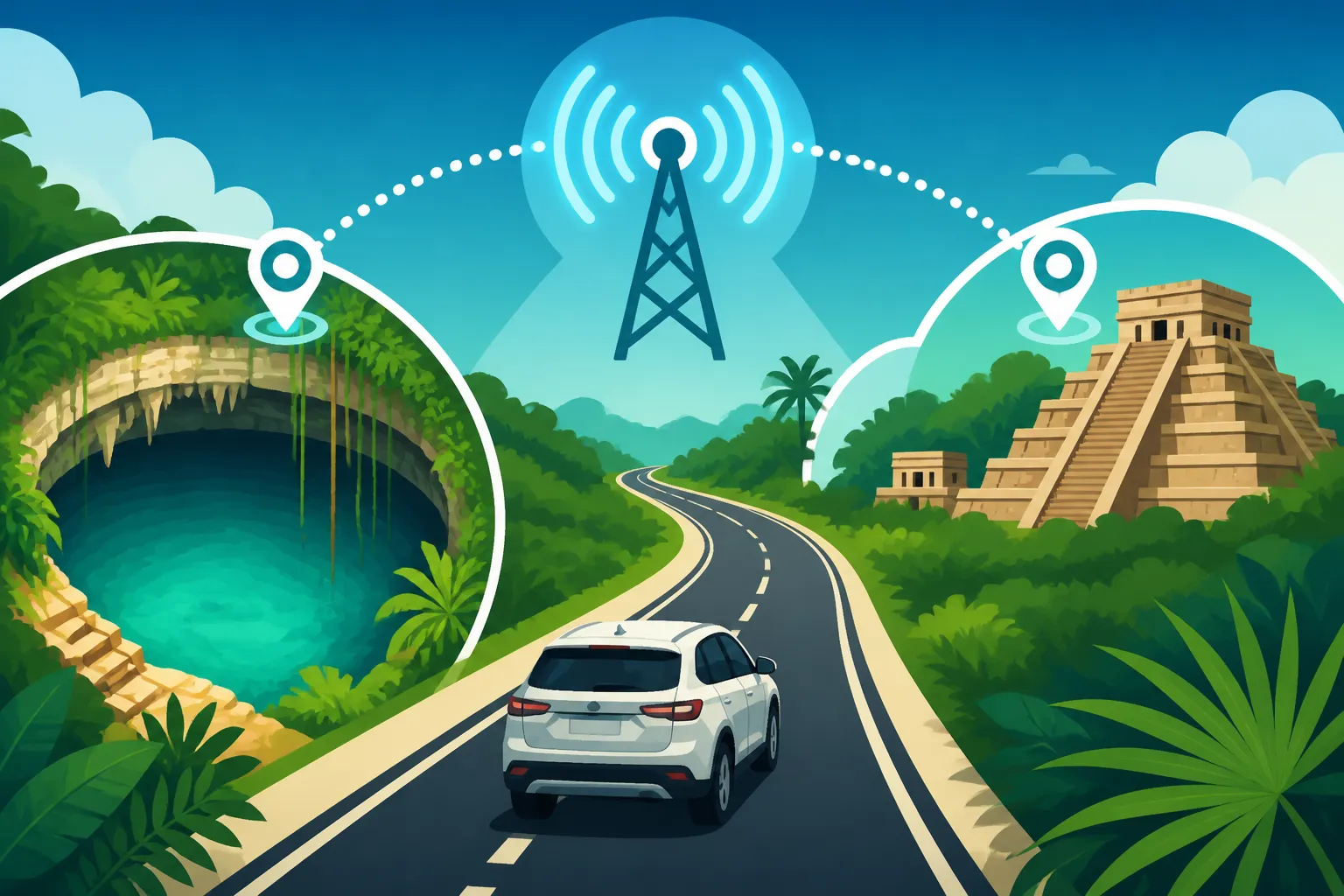
What does this mean for you on those Yucatán highways between cenotes and ruins? It means that if Telcel’s signal drops out, Airalo automatically tries to connect you to AT&T or Movistar’s network if they have a stronger presence in that particular spot. It’s like having a little smart assistant in your phone constantly searching for the best available signal. This multi-network approach dramatically increases your chances of staying connected, even in those notorious dead zones we discussed. You're no longer dependent on the single strongest provider; you're leveraging the combined strength of several. This is a game-changer when you're trying to refresh your map near an isolated ruin like Ek Balam, or simply looking to share that incredible photo from Cenote Suytun.
Seamless Activation and Management for Stress-Free Travel
One of the biggest advantages of Airalo is its incredible ease of use. You don't need to visit a physical store, present your passport, or fumble with tiny SIM cards. The entire process is digital:
- Download the Airalo app: You can do this before you even leave home.
- Choose your destination and data plan: They offer various packages for Mexico, depending on how much data you need and for how long.
- Install the eSIM: This is done directly through your phone’s settings in just a few taps.
- Activate when ready: You can buy your plan weeks in advance and activate it only when you land in Mexico, or even just before you drive out of Wi-Fi range.
It's truly a "set it and forget it" solution. You can top up your data plan directly from the app if you need more, without hunting down an OXXO or dealing with language barriers. This means you can focus on enjoying the magnificent sights of the Yucatán, knowing that your connectivity is sorted. Whether you're planning a trip to the Yucatán Peninsula: Beaches, Ruins, and Cenotes or simply venturing from your accommodation, knowing your data is handled allows for much greater peace of mind.
Real-World Scenarios Where Airalo Shines
Let’s talk specifics. Imagine these common Yucatán scenarios:
- The Chichén Itzá Trek: You've left Mérida early, excited to beat the crowds at Chichén Itzá. Somewhere past Piste, your traditional SIM might start to flicker. With Airalo, you're far more likely to maintain enough signal to double-check the opening hours, quickly book tickets online to save time, or even stream an audio guide about the site as you approach.
- Lost on the Ruta Puuc: Exploring the less-traveled Mayan sites like Labná or Sayil, you take a scenic detour. Suddenly, the road sign is ambiguous, and your navigator has gone silent. An Airalo eSIM provides a much better chance of pulling up that crucial map refresh or calling a local contact for directions, turning a potential panic into a minor blip.
- The Hidden Cenote Hunt: You heard about a gorgeous, tranquil cenote that's off the main tourist trail, perhaps near Yaxcabá. The directions are vague, and it involves a few turns down unpaved roads. Relying on Airalo means you’re more likely to keep your GPS updated, find that exact turn, and arrive at your pristine swimming spot without the stress of being truly lost.
- After a Day at Uxmal: You've spent hours marveling at the Governor's Palace and the Pyramid of the Magician. You’re tired, hungry, and need to find a good dinner spot in Santa Elena or coordinate with your Airbnb host. Your Airalo connection helps you browse local restaurants, check reviews, and send messages without delay, ensuring a smooth end to a fantastic day.
In these moments, having a robust data connection is invaluable. Airalo isn't just about convenience; it's about safety, peace of mind, and maximizing your travel experience in the beautiful, wild parts of the Yucatán.
Practical Tips for Staying Connected (Even with Great Data!)
Even with the stellar multi-network capabilities of Airalo, it's always wise to have a few backup strategies, especially when venturing into truly remote corners of the Yucatán. Remember, technology is wonderful, but a little preparation goes a long way in ensuring a smooth and enjoyable trip.
Download Offline Maps and Essential Information
This is non-negotiable for any road trip, even with the best data plan. Before you leave a Wi-Fi zone (like your hotel in Mérida or Playa del Carmen), always download offline maps of your route and destination areas using Google Maps, Apple Maps, or dedicated apps like Maps.me. This way, if you do hit an unexpected dead zone, you’ll still have turn-by-turn navigation without an internet connection.
Beyond maps, download or screenshot any crucial information:
- Accommodation details: Addresses, phone numbers of your host, booking confirmations.
- Emergency contacts: Local emergency numbers, your embassy details, family contacts.
- Attraction information: Opening hours, entrance fees, and any pre-booked ticket details for ruins like Chichén Itzá or Uxmal.
- Translation apps: Many translation apps allow you to download language packs for offline use, which can be a lifesaver when asking for directions or ordering food in a small town where English isn't common.
For more general Travel Logistics in Mexico: Safety, Money, and Connectivity, having this information readily available will significantly reduce stress.
Inform Others of Your Itinerary and Expected Return Times
This is basic travel safety, but it bears repeating, especially when you're exploring areas with potentially spotty reception. Before heading out on a day trip to a series of cenotes or a remote archaeological site, tell someone (a friend, family member, hotel staff) your planned route, your destinations, and when you expect to return.
If you're traveling with companions in separate cars, agree on check-in points or times. If you have an unexpected delay or problem and lose signal, at least someone knows your general whereabouts and when to expect to hear from you. This simple step provides an extra layer of security, regardless of how good your data coverage is.
Power Banks and Car Chargers are Your Best Friends
A dead phone is just as useless as a phone with no signal. Exploring the vastness of the Yucatán, with its long drives and countless photo opportunities, can quickly drain your battery. Think about all those navigation apps, cameras, and potential communication needs!
Make sure you have:
- A fully charged power bank: A high-capacity one is ideal, capable of recharging your phone multiple times.
- A car charger: This is a must-have for keeping your devices topped up while on the road. Many rental cars in Mexico will have USB ports, but a cigarette lighter adapter is a reliable backup.
- Backup battery for camera: If you're using a dedicated camera, carry extra charged batteries.
Remember, even if your Airalo eSIM is working flawlessly and picking up every available network, it can't help if your phone is powered off.
Consider Local Wi-Fi Spots When Available
While Airalo gives you freedom, don't shy away from using free Wi-Fi when it's readily available. Many restaurants, cafes, and hotels in towns throughout the Yucatán offer Wi-Fi. It's a great opportunity to:
- Offload heavy data tasks: Upload all those amazing photos and videos from your day's adventures to the cloud.
- Update apps: Download any necessary app updates without eating into your data plan.
- Video calls: Enjoy video calls with loved ones without worrying about data consumption.
Think of it as complementing your Airalo eSIM. Use your eSIM for on-the-go navigation and essential communication, and leverage Wi-Fi for all the data-intensive tasks. It's a smart strategy for managing your data plan and ensuring you’re always connected in the most efficient way possible while navigating the vibrant and adventurous landscape of the Yucatán.
Connectivity Comparison: Yucatán Highways
Here's a quick overview of how different connectivity options stack up on those adventurous Yucatán highways.
| Connectivity Method | Pros (especially for Yucatan highways) | Cons (especially for Yucatan highways) |
|---|---|---|
| Airalo eSIM | – Multi-network access: Connects to best available network (Telcel, AT&T, Movistar) for better coverage in patchy areas. – Easy digital setup: No physical SIM, no store visits, activate before arrival. – Cost-effective: Transparent pricing, easy top-ups within the app. – Keep your home number active for calls/SMS. |
– Requires an eSIM-compatible phone. – Primarily data-focused; not for local calls/SMS (though WhatsApp/VoIP works). – Still subject to some complete dead zones where no network exists. |
| Local Physical SIM (e.g., Telcel) | – Often the best single network coverage (Telcel generally superior). – Includes a local phone number for calls/SMS within Mexico. – Relatively inexpensive for high data allowances. |
– Tied to a single network; if that network fails, you're offline. – Requires physical purchase and registration (passport needed). – Topping up can be inconvenient. – Juggling two physical SIMs if you want to keep your home number active. |
| Home Country Roaming Plan | – Convenient (no new SIM needed). – Uses your familiar home phone number. |
– Extremely expensive if not on a specific international plan. – Data caps are often low, leading to quick depletion and overage charges. – Still relies on single network (your home provider's partner network in Mexico), often with poorer priority than local SIMs. |
| Public/Hotel Wi-Fi | – Free or included with accommodation. – Good for heavy data tasks (uploads, video calls) when available. |
– Zero connectivity on the road (the exact problem we're solving!). – Limited availability, often only in major towns/cities or specific establishments. – Security risks with public Wi-Fi. – Speed and reliability can vary greatly. |
As you can see, for comprehensive and stress-free data coverage while exploring the highways and byways of the Yucatán, especially between those alluring cenotes and majestic ruins, Airalo truly stands out as the most reliable and convenient option for travelers with eSIM-compatible phones. It brings the power of multiple networks right to your fingertips, ensuring you can navigate, communicate, and share your adventures with greater confidence.
Disclaimer
The information provided in this guide is for general informational purposes only and does not constitute professional advice. While we strive to keep the information up-to-date and accurate, network coverage, regulations, and service offerings can change frequently. Always verify current details with service providers. We are not responsible for any decisions made based on this information.