Survival Spanish for Travelers in Mexico: Key Phrases
Landing in Mexico with only high-school textbook Spanish can leave you feeling frozen when a friendly street vendor fires off rapid-fire questions about your taco toppings. Navigating bustling markets, hailing local cabs, or checking into a boutique hotel often triggers immediate language anxiety for foreign visitors. This guide breaks down essential, real-world Mexican Spanish phrases, cultural subtleties, and practical scripts so you can travel confidently, handle daily transactions effortlessly, and connect deeply with the locals.
Disclosure: This post may contain affiliate links. We may earn a commission at no extra cost to you if you make a purchase through these links. Read full disclosure.
Fundamental Courtesy and Daily Politeness
Essential Greetings for Every Interaction
In Mexico, basic social pleasantries are not optional add-ons; they are the essential social lubricant that opens doors and warm up interactions. Jumping straight into a question without a greeting can come across as abrupt or even rude. Whenever you walk into a small shop, board a local bus, or approach a hotel reception desk, begin with a warm greeting based on the time of day. Use buenos días (good morning) before noon, buenas tardes (good afternoon) from midday until sunset, and buenas noches (good evening/night) once dark.
If you want to sound like a seasoned traveler rather than a robotic tourist, pair your greeting with a casual enquiry about their well-being. A simple ¿Cómo está? (How are you? – formal) or ¿Qué tal? (How’s it going?) works wonders. When walking past people in small villages or residential neighborhoods, it is customary to softly say buenas as a universal greeting. To learn more about navigating these nuanced social dynamics, check out our guide on Mexican Social Etiquette for Visitors: Greetings and Warmth.
Greeting Matrix:
- Morning (until 12 PM): Buenos días
- Afternoon (12 PM till dusk): Buenas tardes
- Evening/Night: Buenas noches
- Casual All-Day: ¡Hola! / ¿Qué tal?
Softening Demands with Polite Softeners
Mexican culture heavily values indirectness and gentle speech. Demanding something directly with quiero (I want) can sound harsh to local ears. Instead, soften your requests using conditional phrases or polite verbs. The most common way to ask for items politely is ¿Me da…? (Would you give me…?) or ¿Me regala…? (literally “Would you gift me…?”, used widely in central and southern Mexico for purchasing everyday items).
Another indispensable phrase is por favor (please), which should be attached to almost every request you make. When someone fulfills a request, always reply with muchas gracias (thank you very much). If someone thanks you, the standard response is de nada (you’re welcome) or the equally polite con gusto (with pleasure). When passing someone in a tight space or interrupting a conversation, use con permiso (excuse me) before moving, to which the other person will likely respond propio or adelante (go ahead). If you accidentally bump into someone, use disculpe (sorry/pardon me).
Navigating Soft Refusals and Social Cues
Saying a direct “no” is often considered abrasive in Mexican culture. Locals frequently use softer alternatives to decline offers, signal hesitation, or avoid conflict. Understanding these subtle cues will help you avoid misinterpretations during your trip. If a street vendor offers you goods and you are not interested, avoid a cold refusal. Instead, smile, make brief eye contact, and say no, gracias (no, thank you) or use the hand gesture of lightly waving your index finger side to side while saying gracias.
When a Mexican tells you gracias while handing something back to you, it often serves as a polite signal that they are finished or do not want any more. Another phrase to watch for is luego or al ratito (later / in a little bit), which is often a gentle way of saying “not right now” or “probably never.” Recognizing these soft refusals will keep your social interactions positive and respectful throughout your travels. To understand how formality affects these exchanges, read our breakdown on When to Use Usted vs Tú in Mexico.
Eating Out and Ordering Food Like a Local
| English Phrase | Mexican Spanish Equivalent | Phonetic Pronunciation | Context / Notes |
|---|---|---|---|
| Can I get… / Give me… | ¿Me da…? | meh dah | The standard polite way to order food or drinks. |
| The bill, please. | La cuenta, por favor. | lah kwen-tah por fah-bor | Ask this at the end of your meal to request check. |
| Is it spicy? | ¿Pica? / ¿Es muy pico? | pee-kah / es mwee pee-koh | Essential for assessing salsa hotness levels. |
| To go / Takeaway | Para llevar | pah-rah yeh-bar | Use when ordering food to be packed for takeaway. |
| For here | Para comer aquí | pah-rah koh-mer ah-kee | Use when dining inside the taquería or restaurant. |
| Enjoy your meal! | ¡Buen provecho! | bwen proh-beh-choh | Said to others who are eating around you. |
Deciphering the Taquería and Street Food Menu
Eating at a local street stall or bustling market counter is one of the highlights of visiting Mexico, but ordering under pressure can feel overwhelming. When you approach a counter, the taquero will usually ask ¿Qué le pongo? (What can I get for you?) or ¿De qué va a querer? (What kind would you like?). Respond confidently with ¿Me da tres tacos de pastor, por favor? (Could you give me three tacos al pastor, please?). If you are dining with a friend or grabbing food on the move, specify whether it is para comer aquí (to eat here) or para llevar (to take away).
Understanding salsa dynamics is crucial if you want to protect your palate. Mexican cooks assume tourists have lower spice tolerances, but asking ¿Pica? (Is it spicy?) or ¿Pica mucho? (Is it very spicy?) gives you a realistic assessment. When the vendor asks if you want your tacos con todo (with everything), they mean chopped cilantro and white onions. If you prefer to skip the onions, say sin cebolla, por favor. For deeper insights into navigating street side culinary spots, review our detailed guide on How to Order at a Taquería in Mexico.
Order Flow at a Taquería:
- Greeting: ¡Buenas noches!
- Order: ¿Me da tres tacos de asada, por favor?
- Customization: Con todo, pero poca salsa.
- Location: Para comer aquí.
- Finish: Muchas gracias.
Requesting the Bill and Tipping Etiquette
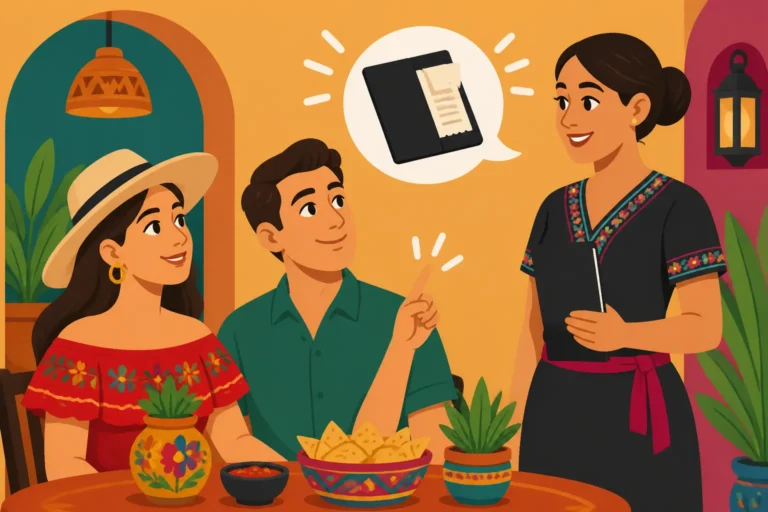
Unlike in some Western countries where waiters drop off the bill the moment you clear your plate, Mexican waitstaff consider delivering an unrequested bill to be poor service, as if rushing the guest. Your waiter will leave you to enjoy conversation after your meal until you explicitly call for the check. To catch their attention, make eye contact, catch their wave gently, and say ¿Me trae la cuenta, por favor? (Could you bring me the bill, please?) or simply make a signing motion with your hand in the air while saying La cuenta, por favor.
When paying, you will need to indicate your payment method by asking ¿Aceptan tarjeta? (Do you accept credit cards?) or confirming Voy a pagar en efectivo (I will pay with cash). If you pay by credit card, the server will bring a portable terminal to your table and ask ¿Desea agregar el servicio? or ¿Gusta agregar propina? (Would you like to add a tip?). You can reply with the percentage you wish to leave, such as el diez por ciento (10%) or el quince por ciento (15%). Learn more about local dining customs with our breakdown on Tipping in Mexico (Propina): When and How Much.
Dietary Restrictions and Special Requests
Communicating dietary preferences clearly ensures you enjoy your meals without unexpected surprises. If you follow a plant-based diet, simply saying “I am vegetarian” might still result in dishes cooked with lard (manteca) or chicken broth (caldo de pollo). Be explicit by saying No como carne, pollo, ni pescado (I do not eat meat, chicken, or fish) or ¿Este platillo tiene manteca? (Does this dish have lard?). For vegan requests, clarify with No como lácteos, huevos, ni miel (I don’t eat dairy, eggs, or honey).
For those with allergies or sensitivities, direct communication is vital. Say Soy alérgico/a a… (I am allergic to…) followed by the ingredient, such as los mariscos (shellfish), los cacahuates (peanuts), or el gluten (gluten). If you prefer water without added sugar at a restaurant, ask for agua del día sin azúcar or stick to agua embotellada (bottled water) or agua mineral (sparkling mineral water). To build a broader food vocabulary before your trip, refer to our comprehensive overview on Ordering Food and Drinks in Spanish in Mexico.
Getting Around: Navigation, Public Transit, and Taxis
Directions and Asking for Help on the Street
When navigating colonial towns, large cities, or coastal villages, you will inevitably need to ask for directions. Start your query politely with Disculpe, ¿dónde está…? (Excuse me, where is…?) or ¿Cómo llego a…? (How do I get to…?). Locals are generally exceptionally helpful and will guide you using key spatial terms. Listen for phrases like a la derecha (to the right), a la izquierda (to the left), todo derecho or derecho (straight ahead), and a dos cuadras (two blocks away).
Navigation Vocabulary:
- Straight ahead: Todo derecho
- To the right: A la derecha
- To the left: A la izquierda
- Block(s): Cuadra(s)
- Corner: La esquina
- Traffic light: El semáforo
If you are trying to locate a specific landmark or transit hub, ask ¿Está lejos de aquí? (Is it far from here?) or ¿Puedo ir caminando? (Can I walk there?). If someone points out a location, they might say está a la vuelta (it is around the corner) or está cruzando la calle (it is across the street). If you don’t catch what they said, politely ask them to slow down by saying ¿Puede hablar más despacio, por favor? (Could you speak more slowly, please?).
Purchasing Intercity Bus and Flight Tickets
Mexico boasts one of the most comfortable long-distance bus networks in the world, with premium coaches featuring reclining seats, personal entertainment screens, and Wi-Fi. When buying tickets at a terminal (central camionera), approach the ticket counter and state your destination: Un boleto para Oaxaca, por favor (One ticket to Oaxaca, please). The clerk will ask ¿Sencillo o redondo? (One-way or round-trip?). Reply sencillo for a one-way ticket or redondo for a return journey.
To select your preferred travel time and seating position, ask ¿A qué hora sale el próximo autobús? (What time does the next bus leave?) and ¿Tiene lugar junto a la ventana / el pasillo? (Do you have a seat by the window / aisle?). If you prefer booking online to avoid line-ups at busy stations, platforms like Busbud allow you to compare schedules and secure long-distance bus seats seamlessly across major Mexican lines like ADO or ETN. When checking into boutique hotels near the stations, booking platforms like Booking.com make it easy to find top-rated stays with bilingual reviews. For detailed transit breakdowns, consult our guide on Long-Distance Buses in Mexico: ADO and Premium Lines.
Hailing Taxis and Communicating with Drivers
While ride-hailing apps operate seamlessly in major cities, traditional street taxis or site-specific cabs (taxis de sitio) remain widely used in smaller towns and beach resorts. Before stepping into an unmetered cab, always negotiate and agree upon the fare to prevent disputes at your destination. Approach the driver and ask ¿Cuánto me cobra para ir a…? (How much will you charge me to go to…?). If the quoted price feels high, you can politely negotiate or simply say gracias and find another taxi.
If you are riding in a street taxi that features a meter (taxímetro), ask the driver to turn it on by saying ¿Puede poner el taxímetro, por favor?. During the ride, guide the driver toward your specific drop-off point using clear directive phrases:
* Aquí a la derecha, por favor (Here on the right, please)
* En la esquina me deja (You can drop me off at the corner)
* Aquí está bien, gracias (Here is fine, thank you)
Shopping, Markets, and Money Matters
Asking for Prices and Clarifying Numbers
Shopping at local street markets (tianguis) or artisan markets gives you access to stunning hand-crafted goods and fresh produce. To ask the price of an item, hold or point to it and ask ¿Cuánto cuesta esto? (How much does this cost?) or ¿Cuánto vale? (How much is it?). If you are buying produce or bulk items by weight, ask ¿A cómo está el kilo de…? (How much is a kilo of…?).
Essential Mexican Spanish Numbers:
| 10 | Diez | 100 | Cien |
| 20 | Veinte | 200 | Dos cientos |
| 50 | Cincuenta | 500 | Quinientos |
| 70 | Setenta | 1000 | Mil |
Understanding spoken prices requires familiarity with Mexican currency terms. Locals often refer to pesos as pesos or casually as lanas or lucas in slang contexts, though prices will always be stated in standard numbers. If a vendor says cincuenta pesos, that means 50 pesos. If you are confused by a rapid response, hold up your phone calculator or notepad and ask politely ¿Me lo puede anotar, por favor? (Could you write it down for me, please?).
Navigating Bargaining and Payment Methods
Unlike fixed-price brick-and-mortar stores, informal markets sometimes leave room for modest price negotiations, particularly when buying multiple items from the same artisan. However, aggressive haggling is discouraged, as these crafts represent hours of hard manual labor. If you wish to ask for a small discount respectfully, ask ¿Es lo menos? (Is that your best price?) or ¿Si me llevo dos, me hace un descuento? (If I take two, will you give me a discount?).
Cash remains king across rural Mexico, small eateries, and street stalls. Always carry smaller bills (billetes chicos) of 20, 50, and 100 pesos, as vendors frequently lack change for a 500-peso note. If you hand over a large bill, ask ¿Tiene cambio de quinientos? (Do you have change for 500?). When paying by card at established shops, ask ¿Aceptan tarjeta de crédito o débito? (Do you accept credit or debit cards?).
Transactions at Convenience Stores and Pharmacies
You will frequently visit neighborhood convenience stores like OXXO or 7-Eleven for snacks, water, SIM card top-ups, and daily necessities. To ask for help finding an item, say Disculpe, ¿dónde puedo encontrar…? (Excuse me, where can I find…?). If you need to reload cell phone data onto a local SIM card, walk up to the cashier and say Una recarga de Telcel, por favor (A Telcel top-up, please), then provide your ten-digit Mexican phone number when prompted.
Pharmacies (farmacias) in Mexico are incredibly efficient, often with an attached consultation room (consultorio) for minor ailments. If you need over-the-counter medicine for an upset stomach or headache, explain your symptom to the pharmacist:
* Tengo dolor de cabeza (I have a headache)
* Tengo malestar de estómago (I have an upset stomach)
* ¿Tiene algo para la gripe? (Do you have something for a cold/flu?)
If you plan on taking day trips to explore regional crafts or archaeological sites, booking organized excursions through trusted platforms like Viator provides bilingual guides while giving you opportunities to practice your conversational Spanish in low-pressure settings.
Essential Mexican Slang and Local Nuances
Understanding “Ahorita” and Mexican Concept of Time
One of the first linguistic quirks you will encounter in Mexico is the ubiquitous word ahorita. While a standard Spanish dictionary translates ahora as “now,” adding the diminutive suffix -ita transforms it into a flexible, context-dependent concept of time. Ahorita can mean right this second, in ten minutes, in a few hours, or potentially never.
The "Ahorita" Spectrum:
- Ahorita luego / Ahorita regreso -> I’ll be back shortly (10-30 mins)
- Ahorita voy -> I’m on my way (Eventually)
- Ahorita -> Sometime today, or maybe not at all
If a server says Ahorita se lo traigo (I’ll bring it to you right away), remain patient; it simply signals that your request has been received and will be processed soon. Avoid pressing for immediate exact times, as flexibility and relaxed scheduling are core to the local rhythm. To master more regional phrasing, dive into our dedicated guide on Mexican Spanish: Slang and Expressions for Visitors.
Expressing Agreement, Enthusiasm, and Confusion
Incorporating authentic Mexican slang and filler words instantly makes your Spanish sound more natural and conversational. Instead of using generic terms, adopt these widely used local expressions during casual chats:
- ¡Qué padre! / ¡Está padre!: How cool! / It’s cool! (Used to express enthusiasm about a place, idea, or object).
- ¡Chido!: Cool / Awesome (A slightly more casual alternative to padre).
- ¡Órale!: Wow! / Let’s do it! / Right on! (An extremely versatile exclamation used for agreement, surprise, or encouragement).
- Sale or Sale y vale: Okay / Sounds good / Agreed (Used to confirm plans or agree with a statement).
- No mames / No manches: No way! / You’re kidding! (No manches is the family-friendly version; no mames is vulgar slang best avoided in polite company).
If you do not understand what someone said to you, avoid shouting “What?” in English. Instead, use the ultra-polite Mexican response ¿Mande? (Pardon? / What did you say?). It is considered far more gracious than saying ¿Qué?, which can sound blunt. If you want them to repeat themselves, say ¿Cómo dijo? (What did you say?) or No entendí, ¿puede repetir? (I didn’t understand, can you repeat that?).
Staying Safe and Handling Unexpected Situations
While Mexico is a warm and welcoming destination, knowing how to express urgency or call for help during unexpected situations is vital for peace of mind. If you feel unwell or encounter a minor safety concern, knowing these key alert phrases ensures you get help rapidly:
- ¡Ayuda! or ¡Auxilio!: Help!
- Necesito un médico: I need a doctor.
- Llame a una ambulancia, por favor: Please call an ambulance.
- ¿Dónde está la comisaría de policía?: Where is the police station?
- Perdí mi pasaporte: I lost my passport.
Keep digital and physical copies of your essential travel documents stored separately from your wallet. If you run into travel challenges or minor safety concerns, refer to our comprehensive practical resource on Avoiding Common Scams in Mexico. Armed with polite greetings, dining phrases, transit vocabulary, and a dash of local slang, you are ready to explore Mexico smoothly and build unforgettable connections along the way.
Disclaimer
This article is for general informational purposes only and does not constitute professional advice. Laws, prices and regulations vary by location and change over time. Consult a qualified professional for guidance on your specific situation.