VAT (IVA) in Mexico: What You Pay
You stand at the checkout of a high-end furniture store in Polanco, having finally found the perfect sofa for your new apartment. The price tag says 20,000 pesos, but when the clerk rings it up, the total jumps to 23,200. I remember the first time this happened to me; I felt like I was being scammed until I realized I’d just met IVA. This guide solves the mystery of Mexico’s Value Added Tax so you never face "sticker shock" again.
Disclosure: This post may contain affiliate links. We may earn a commission at no extra cost to you if you make a purchase through these links. Read full disclosure.
Understanding the Basics of Mexican IVA
In Mexico, the Impuesto al Valor Agregado, or IVA, is a multi-stage tax levied on the consumption of goods and services. For most expats, it is the most frequent interaction you will have with the Mexican tax system. Unlike some countries where sales tax is added at the register, Mexico generally requires the IVA to be included in the advertised price. However, in professional services, B2B transactions, or certain high-end retail environments, you might still see prices listed as "más IVA" (plus tax).
What exactly is Impuesto al Valor Agregado
IVA is an indirect tax, meaning the person who ultimately pays it—you, the consumer—is not the one who hands it over to the government. Instead, businesses act as intermediaries. Every time you buy a bottle of wine, a pair of shoes, or pay your internet bill, the business collects a percentage on behalf of the Servicio de Administración Tributaria (SAT). If you are simply living here as a retiree or a tourist, IVA is just a cost of living factor. But if you are working here, understanding how it flows through the economy is vital for your financial health.
When I first moved to Mexico City, I didn't realize that my monthly rent in a "commercial" loft actually required me to pay 16% IVA on top of the base rent. It was a steep learning curve. In Mexico, the tax is applied to the "value added" at each stage of production and distribution. While this sounds like a headache for the business owner, for the expat, it mostly manifests as a 16% surcharge on almost everything that isn't a basic necessity. Understanding The RFC and SAT: Mexico's Tax System for Foreigners is the first step in seeing how these consumption taxes fit into the broader fiscal landscape of your new home.
The 16 Percent Standard Rate
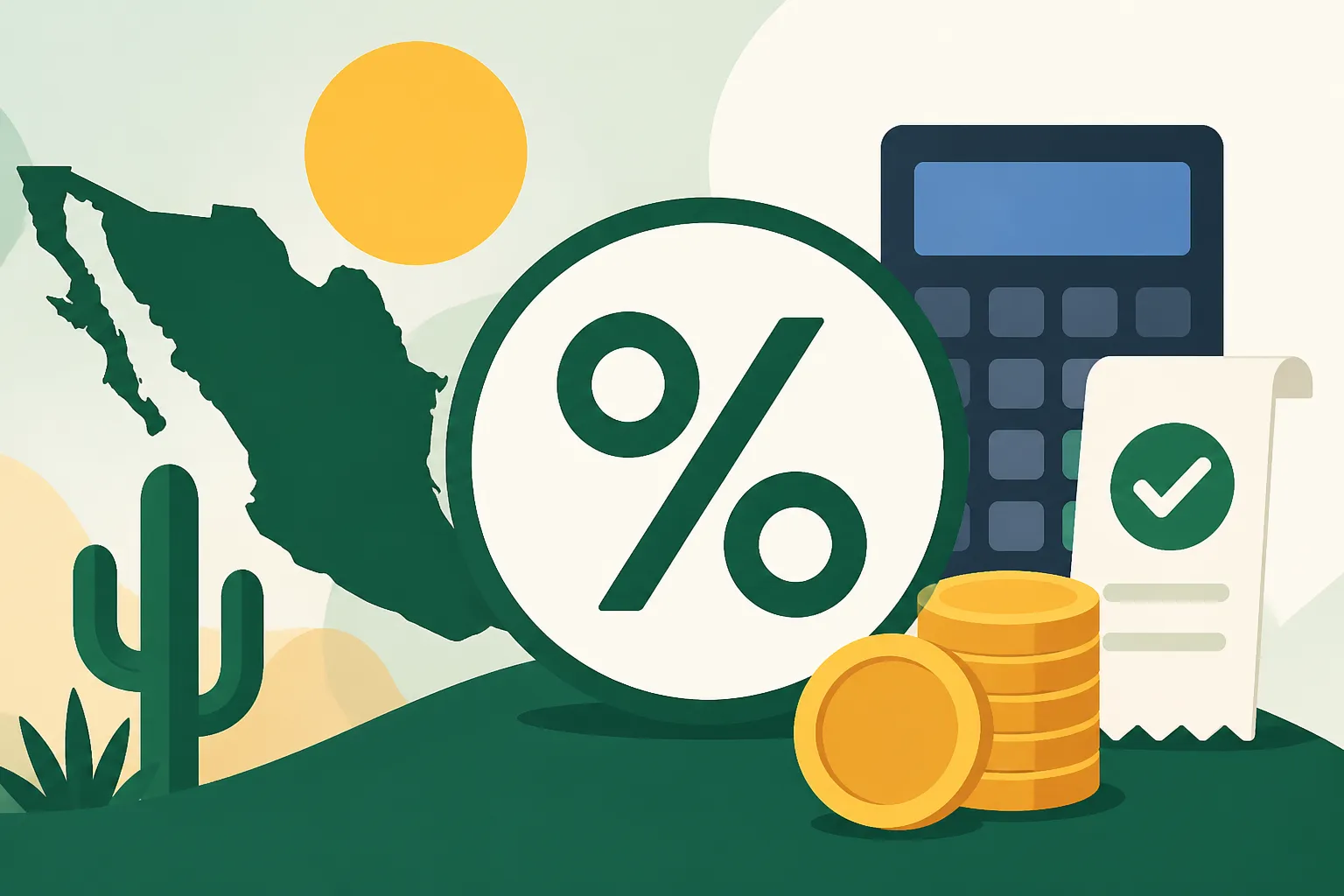
The standard IVA rate in Mexico is 16%. This rate applies to the vast majority of transactions across the country. Whether you are buying a new Jeep, paying for a hotel stay in Cancún, or hiring an architect to renovate your colonial home in Mérida, that 16% is a near-constant companion. It is baked into the Cost of Living in Mexico City (2026): Detailed Expat Budget Guide and affects every level of your discretionary spending.
It is important to note that while the rate is standard, the transparency isn't always consistent. By law, retail prices shown to the public must include IVA. If you go into a grocery store like Chedraui or Soriana, the price on the shelf is exactly what you pay at the till. However, if you are looking at quotes for "professional services"—think lawyers, accountants, or specialized contractors—they almost always quote their fees "más IVA." If you forget to account for that extra 16%, your project budget can be blown out of the water before you even break ground. I once hired a specialized mechanic for a vintage car restoration and forgot to ask if his quote included tax; that 16% "surprise" at the end cost me several thousand pesos I hadn't budgeted for.
Why Prices Might Vary Between Regions
While 16% is the rule, there are regional nuances that can confuse the uninitiated. For years, the border regions had a different fiscal regime to help them compete with lower sales taxes in the United States. This fluctuates based on current political administrations, but it creates a scenario where a laptop in Tijuana might be taxed differently than a laptop in Mexico City.
For most expats, these regional variations are less about saving money and more about understanding why a receipt from a trip to the northern border looks different. If you are moving frequently between regions, keep an eye on your "tickets" (receipts). You’ll see the breakdown of the base price and the IVA clearly listed at the bottom. To manage these fluctuations and ensure you are getting the best rates when paying for high-value items, using a service like Wise can help you keep your currency exchange costs low, effectively offsetting some of the tax burden by avoiding poor bank-mediated exchange rates.
Exceptions to the Rule: The 0 Percent Rate and Exemptions
Not everything in Mexico is taxed at the full 16%. The government uses a "0% rate" and "exemptions" to keep basic necessities affordable for the general population. As an expat, knowing what falls into these categories can help you better understand your grocery bills and healthcare costs. It’s also where many foreigners get confused, as "0% tax" and "exempt" are legally different, even though both result in you paying no tax at the register.
Food, Medicine, and Books: The Essentials
Mexico applies a 0% IVA rate to "unprocessed" foods and essential medicines. This is a massive relief for those living on a fixed budget. If you go to a local tianguis (open-air market) and buy fresh tomatoes, onions, and chicken, you are paying 0% IVA. However, as soon as that food becomes "processed"—think canned soups, frozen pizzas, or even roasted chickens sold in a supermarket—the 16% rate often kicks back in.
Medicines are generally taxed at 0%, which is one reason why many find Healthcare Costs in Mexico: Doctor Visits, Hospital Stays, and Surgery Expenses so much more affordable than in the U.S. or Canada. Books, magazines, and newspapers also benefit from this 0% rate to encourage literacy and information access. I remember being pleasantly surprised that my expensive medical prescriptions were exactly the price listed, with no tax added at the pharmacy counter. It’s one of those small wins that makes the administrative hurdles of living here feel a bit more balanced.
Exporting Services: Why Digital Nomads Care
This is a critical area for the growing community of remote workers. If you are a digital nomad living in Mexico but providing services to a company or client located outside of Mexico, your services are technically "exported." Under Mexican law, the export of services is generally taxed at a 0% IVA rate. This means you do not have to charge your foreign clients an extra 16% on your invoices, which keeps you competitive.
However, proving that your service qualifies for the 0% rate requires a proper paper trail and a deep understanding of Digital Nomads in Mexico: Visa Options for Remote Workers in 2027. You must be registered with the SAT and issue the correct type of electronic invoice (factura). If you mismanage this, the SAT could argue that your work was performed "in Mexico for the benefit of Mexico," potentially hitting you with back taxes and fines. For complex situations involving cross-border income, seeking professional advice from a firm like Taxes for Expats is invaluable. They specialize in the intersection of Mexican obligations and your home country’s requirements, ensuring you don’t pay more than your fair share.
The Difference Between 0 Percent and Exempt
To the average shopper, 0% and "Exempt" look the same: you pay zero tax. But for those of us who eventually run a business or work as freelancers here, the difference is huge. A 0% rate allows the business to "claim back" the IVA they paid on their own expenses (like office rent or supplies). An "Exempt" status (which applies to things like basic education, public transport, and certain residential rentals) does not allow the provider to claim back that input IVA.
This distinction often trickles down into the price you pay for services. If a service is exempt, the business owner still had to pay 16% on their electricity, their rent, and their supplies. Since they can't get that money back from the government, they often bake those costs into your final price. Understanding these "hidden" tax impacts is part of the "veteran" experience of living in Mexico—you start to see the tax architecture behind the daily costs.
| Category | Typical IVA Rate | Real-World Examples |
|---|---|---|
| Standard Goods | 16% | Electronics, Clothes, Alcohol, Car Repairs |
| Processed Foods | 16% | Canned Goods, Snacks, Restaurant Meals |
| Unprocessed Foods | 0% | Fresh Produce, Raw Meat from the Butcher |
| Medicine | 0% | Prescription Drugs, Antibiotics |
| Books & Magazines | 0% | Educational Texts, Newspapers |
| International Services | 0% | Software dev for a US company (with proper RFC) |
| Residential Rent | Exempt | Traditional unfurnished long-term leases |
| Border Zone (Qualified) | 8% | Select retail in border cities like Tijuana |
The Border Zone Discount: Navigating the 8 Percent IVA
If you decide to settle in a border city or frequently travel across the northern frontier, you will encounter the "Región Fronteriza Norte" stimulus. This was designed to keep the Mexican border economy competitive with the U.S., where sales taxes in states like Texas or Arizona are significantly lower than 16%.
Why the border is different
The 8% rate is not an automatic right for all businesses in the border zone; it is a stimulus that businesses must apply for and qualify for with the SAT. The goal is to stimulate consumption and prevent "capital flight," where residents simply cross the bridge to buy everything in San Diego or El Paso. For an expat living in Rosarito or Ensenada, this can mean a significantly lower bill for large purchases like appliances or building materials.
However, don't expect to see 8% everywhere. Small "Mom and Pop" shops might not have the administrative capacity to register for the stimulus, so they continue charging the standard 16%. Large retailers like Costco or Home Depot in the border regions usually have the 8% integrated into their systems. When I lived near the border for a few months, I had to learn which specific gas stations and grocery stores used the lower rate. It takes a bit of local scouting, but it can save you a substantial amount over the course of a year.
Identifying businesses that apply the reduced rate
The best way to know if you are paying 16% or 8% is to check the ticket before you leave the store. By law, the receipt must break down the tax. If you see "IVA 16%" in a border town, you might want to ask if there’s a competitor nearby who has opted into the stimulus program.
Also, be aware that this 8% rate does not apply to everything. Certain "luxury" items or specific services may still be taxed at the full 16% regardless of the location. If you are making a major purchase, like a vehicle or high-end electronics, it is worth confirming the rate beforehand. If you are transferring large sums of money to cover these costs, using Wise ensures that your conversion from dollars or euros to pesos doesn't eat up the savings you gained from the lower tax rate.
IVA and the All-Important Factura
In Mexico, a simple receipt is called a ticket. It is fine for your personal records, but it is useless for any official purpose. If you want to deduct expenses, prove your spending for residency requirements, or get an IVA refund as a business owner, you need a Factura (an official electronic invoice).
Why a receipt isn't always enough
A ticket is just a slip of paper. A Factura is a digital file (XML and PDF) that is registered in real-time with the SAT. For expats, the Factura is the "holy grail" of financial life. If you are trying to show "economic solvency" through spending, or if you are running a business and need to offset the IVA you’ve collected from clients, only the Factura counts.
The most frustrating part for newcomers is that you often cannot get a Factura later. You usually have to request it at the moment of purchase or within the same calendar month. I have lost out on thousands of pesos in potential deductions because I forgot to ask for the factura at the restaurant or the hardware store. It feels tedious at first, but it becomes second nature once you understand how it protects your wallet. You will need to provide your RFC (Tax ID) and your "fiscal data" (tax address and zip code) to every vendor who issues one. Knowing How to Get an RFC in Mexico is the absolute prerequisite for this process.
How to request a Factura at restaurants and stores
When you finish a meal or a shopping trip, you say the magic words: "¿Me da una factura, por favor?" The clerk will then ask for your "datos fiscales." Many expats keep a small card in their wallet or a photo on their phone with their RFC, name, and zip code. Some larger stores now have a website URL printed at the bottom of the ticket where you can go home and generate the factura yourself using the transaction code.
- Step 1: Ensure you have your Constancia de Situación Fiscal (a document from the SAT) handy.
- Step 2: Provide the RFC and the specific "Use of CFDI" code (usually "G03 – Gastos en general" for most things).
- Step 3: Double-check that they have your email address correct, as the XML and PDF files will be sent there.
If you are working with a company like Taxes for Expats to handle your annual filings, they will need these digital files to ensure you are compliant. Even if you aren't a business owner, having facturas for large purchases (like a car or furniture) is vital for insurance claims or if you eventually sell those items and need to prove their original cost to avoid capital gains tax.
Digital IVA: Taxes on your favorite apps
In 2020, Mexico changed the rules for digital services. If you’ve noticed your Netflix, Spotify, or Airbnb bills getting more expensive, it’s because of the "Digital IVA." The government realized it was losing out on millions in revenue from foreign companies providing services to residents in Mexico and mandated that these companies collect 16% IVA.
Why your Netflix bill went up
If you registered your account with a Mexican credit card or a Mexican address, the platform is legally required to charge you 16% IVA. This applies to streaming services, cloud storage (like iCloud or Google Drive), and even digital gaming platforms like Steam. It was a point of major frustration for the expat community when it was first introduced, as many felt it was a "hidden" tax on their entertainment.
The reality is that this tax is here to stay. If you want to avoid it, some people maintain their accounts in their home countries using home-country credit cards, but be careful—many services are now using IP addresses to determine your location. If you are being charged in pesos, you are almost certainly paying the IVA. It’s a small but consistent drain on the budget that you should account for when looking at Monthly Budget in Mexico: Living Well on $1,500, $2,500, and $4,000.
Airbnb and Uber: Who pays the tax?
Platforms like Airbnb and Uber are a bit more complex. They not only charge IVA on the service fee but also withhold income tax (ISR) and IVA from the drivers and hosts. If you are a guest in an Airbnb, your total will include the 16% IVA plus a local "Lodging Tax" (ISH), which varies by state (usually 3-5%).
This is why that "cheap" $50-a-night apartment often ends up being $70 once you reach the checkout screen. When using these services, I always look at the "total including taxes" before getting excited about a price. To manage these digital payments without getting hit by "dynamic currency conversion" fees, I always pay using my Wise card. It allows me to pay in pesos directly from my peso balance, avoiding the hidden 3% markup many traditional banks sneak into the exchange rate.
IVA for Freelancers and Business Owners
If you decide to open a coffee shop in Tulum or work as a freelance consultant in Guadalajara, IVA becomes your full-time job. You are now a tax collector for the Mexican government. This is the part of expat life that causes the most "deer in the headlights" stares at dinner parties.
Collecting IVA from clients
If you provide a service or sell a product in Mexico, you must add 16% to your invoice. If your fee is $1,000 pesos, you charge the client $1,160. That $160 does not belong to you; you are simply holding it for the SAT. Every month, your accountant will calculate how much IVA you collected versus how much IVA you paid on your business expenses (like your office internet, professional fees, or supplies). You only pay the difference to the government.
This "netting out" process is why requesting facturas for every single business expense is so important. If you don't have a factura for your office rent, you can't use the IVA you paid on that rent to offset the IVA you collected from your clients. This is where How Does the RESICO Regime Work for Freelancers in Mexico? becomes a lifesaver. The RESICO regime simplifies income tax, but it doesn't change the IVA rules—you still have to be meticulous with your electronic records.
The art of the IVA refund (Devolución)
Sometimes, you pay more IVA than you collect. This often happens to new businesses that are spending a lot on setup but haven't started selling yet, or to exporters who charge 0% IVA but still pay 16% on their Mexican expenses. In theory, you can ask the SAT for a "devolución" (refund) of this "IVA a favor."
In practice, getting a refund from the SAT is like trying to find a parking spot in Coyoacán on a Sunday—possible, but incredibly difficult and stressful. The SAT is notoriously suspicious of refund requests and will often launch an "audit-light" to verify every single one of your facturas. Most expats and their accountants choose to "carry forward" the credit instead, using it to offset future IVA payments. If you are in a position where you have a large IVA credit, definitely consult with Taxes for Expats or a local specialist. Navigating a refund request without professional help is a recipe for a massive headache.
Summary Table of IVA Scenarios
To help you visualize how this tax hits your wallet in different situations, here is a quick reference table.
| Scenario | Pricing Style | Your Action |
|---|---|---|
| Buying Groceries | Included in price | No action needed for personal use. |
| Dining at a Restaurant | Usually included | Ask for a factura if it's a business meal. |
| Hiring a Lawyer | Usually "plus IVA" | Budget for 16% above the quoted fee. |
| Renting a House | Exempt (Unfurnished) | No IVA, but no factura usually provided. |
| Airbnb Stay | Added at checkout | Check the final "total" before booking. |
| Buying a Car | Included in sticker | Request a factura for ownership proof. |
| Freelance Income | You must add it | Collect 16% and save it for the monthly tax payment. |
| Exporting Code/Design | 0% (No tax added) | Must have a foreign-client factura as proof. |
Practical Tips for Managing Your Finances
Living in Mexico means becoming more "tax-aware" than you probably were back home. To stay on top of your budget and avoid the common pitfalls of the IVA system, follow these simple veteran rules:
- Always ask "Neto or Más IVA?": Before agreeing to any professional service or large purchase, ask if the price is "neto" (final) or "más IVA." This simple question has saved me from dozens of awkward conversations when the bill arrived.
- Organize Your Digital Facturas: Create a folder in your email or cloud storage specifically for XML files. These are your only legal proof of payment in the eyes of the SAT.
- Use Local Currency Accounts: To pay your IVA and other local taxes, you need a way to manage pesos efficiently. Opening a Bank Account in Mexico as a Foreigner is helpful, but for many, a multi-currency account like Wise provides the flexibility to pay bills and taxes online via SPEI (the Mexican electronic transfer system) without the heavy fees of traditional banks.
- Don't DIY Your Business Taxes: The Mexican tax system is incredibly formalistic. One missing XML file or one wrongly categorized invoice can trigger fines. A good contador (accountant) is worth their weight in gold.
Managing your money here isn't just about the exchange rate; it's about understanding the "rules of the road." Once you grasp how IVA works, you’ll stop feeling like you’re overpaying and start feeling like a local who knows exactly where their money is going. Whether you are budgeting for a move or already here and confused by your receipts, staying informed is your best defense against financial stress.
Disclaimer
This article is for informational purposes only and does not constitute legal, financial, or tax advice. Tax laws in Mexico, including IVA rates and regulations, are subject to change by the SAT and the Mexican government. Always consult with a qualified Mexican tax professional or accountant regarding your specific fiscal situation.