Do You Need to Translate Academic Transcripts to Apply to Mexican Universities?
Navigating the Mexican university application process can feel like a labyrinth of paperwork that never ends, especially when you are staring at a stack of documents from your home country. I spent weeks chasing down signatures for my own transcripts only to be told at the last minute that I needed a specific type of stamp I’d never even heard of. This guide clears the confusion around academic translations and the specific legal steps required to study in Mexico.
Disclosure: This post may contain affiliate links. We may earn a commission at no extra cost to you if you make a purchase through these links. Read full disclosure.
The Absolute Necessity of Spanish Translations for Academic Admission
If you are planning to apply to any higher education institution in Mexico, whether it is a massive public university like UNAM or a private powerhouse like Tec de Monterrey, you must assume that every document not originally in Spanish will need a translation. This is not just a preference of the university; it is often a legal requirement dictated by the Secretaría de Educación Pública (SEP). Even if the specific degree program you are applying for is taught entirely in English, the administrative office—known as Servicios Escolares—is legally bound to maintain records in the national language.
In my experience, many students arrive thinking that because their transcripts are from a prestigious global university or are written in a widely understood language like English, they might get a pass. Unfortunately, Mexican bureaucracy is famously rigid. A transcript in English, French, or German is essentially "invisible" to the administrative systems until it has been converted into Spanish. This translation serves as the official bridge between your academic history and the Mexican educational framework.
Beyond the transcript itself, you may also need to translate your diploma, course descriptions (if you are trying to transfer credits), and sometimes even your birth certificate for the residency portion of your stay. When you start searching for these documents, using a resource like SpanishPod101 can help you get familiar with the specific academic vocabulary you will encounter in these forms, such as "promedio" for GPA or "kardex" for a detailed transcript.
Certified Translations and the Perito Traductor
You cannot simply translate your transcripts yourself or have a bilingual friend do it. For the documents to be legally valid in Mexico, they must be completed by a "Perito Traductor." This is a translator who has been officially certified and authorized by the Mexican judicial system or the state government. They have a registered seal and signature that the university and the government recognize as a guarantee of accuracy.
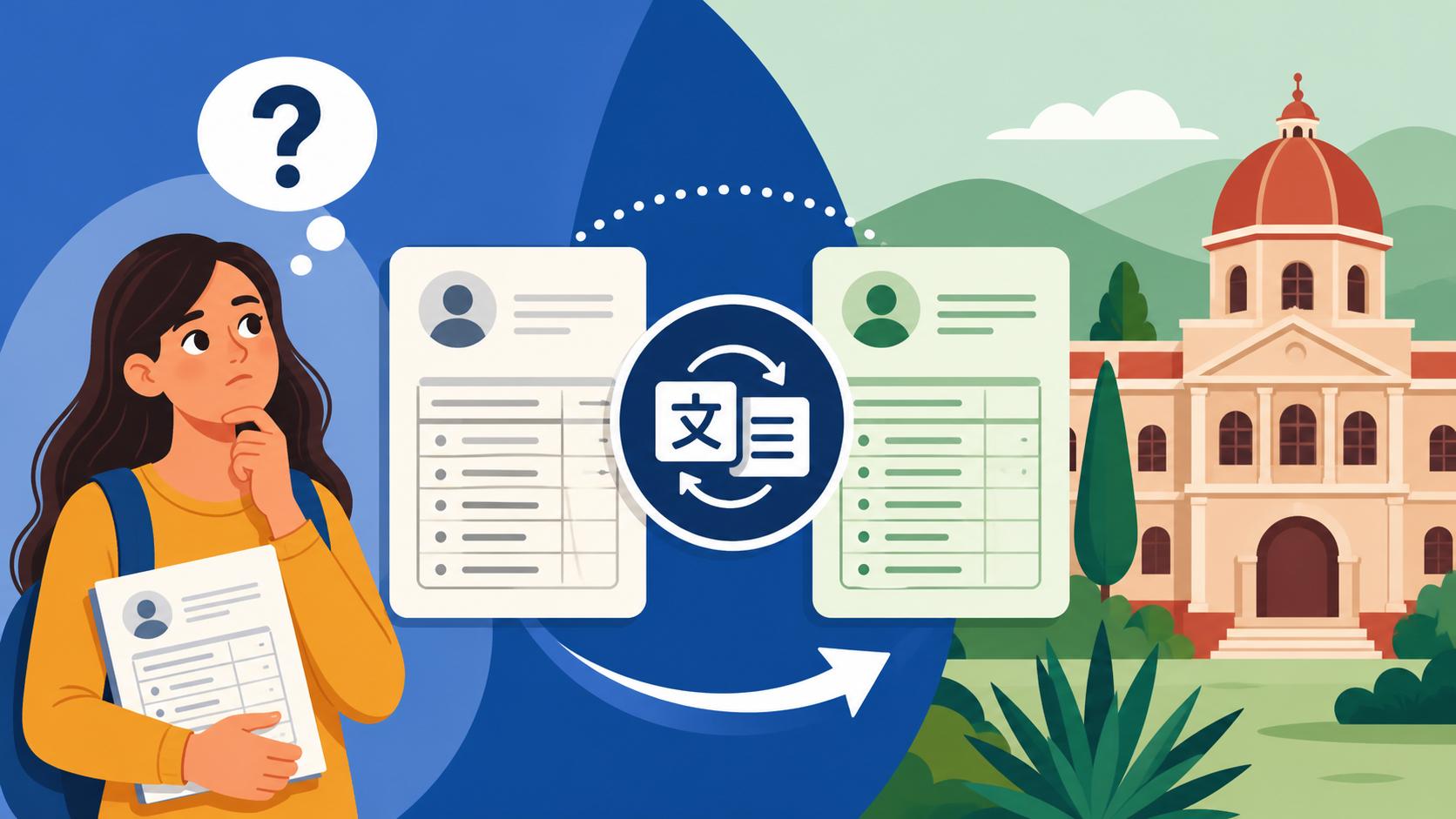
When you receive your documents back from a Perito Traductor, they will usually be stapled to a copy of the original, with a seal on every page and a concluding statement in Spanish declaring that the translation is faithful to the original. This is the only version that the University Admissions in Mexico: How International Students Can Apply process will accept. If you submit a standard translation from a freelance site or a non-certified agency, your application will likely be rejected or stalled indefinitely.
Finding a Perito can be its own challenge. Most major cities like Mexico City, Guadalajara, and Monterrey have directories of authorized translators. I always recommend finding someone local to the state where your university is located if possible, though many translators now work digitally. You will send them high-quality scans of your documents, and they will mail you the physical copies with the wet-ink seals. To better communicate with these professionals about deadlines and costs, practicing your formal Spanish through SpanishPod101 is an excellent way to ensure nothing gets lost in translation.
The Apostille and the Revalidación Process
Translation is actually only the second half of the battle. Before your transcripts can even be translated, they must be "legalized" for use abroad. For most expats, this means getting an Apostille. An Apostille is an international certification that verifies the authenticity of the signature on your document. It must be obtained in the country where the document was issued. For example, if you graduated from a high school in California, you must get the Apostille from the California Secretary of State.
Once you have the original transcript and the Apostille, you then have both of them translated by the Perito Traductor. Yes, even the Apostille itself—which is often a small square stamp or a separate page—must be translated into Spanish. This complete package is what allows the Mexican government to perform a "Revalidación de Estudios." This is the formal process where the SEP evaluates your foreign education and determines its equivalent in the Mexican system.
| Document Type | Needs Apostille? | Needs Certified Translation? | Purpose in Mexico |
|---|---|---|---|
| High School Transcript | Yes | Yes | Undergraduate Admission |
| University Diploma | Yes | Yes | Graduate Admission / Professional Title |
| Course Syllabus | No (Usually) | Sometimes | Credit Transfer / Equivalency |
| Birth Certificate | Yes | Yes | Mexico Student Visa: Application Requirements for 2026 |
The revalidación process is notoriously slow. It can take anywhere from a few weeks to several months. Some private universities have internal departments that handle this for you, but if you are applying to a public institution, you might have to navigate the SEP offices yourself. This is where Dealing with Bureaucracy in Mexico: Tips for Handling Paperwork and Appointments becomes your most valuable skill set. Showing up with a smile, all your original documents, and three photocopies of everything is the "expat pro-tip" for surviving these encounters.
Common Pitfalls and How to Avoid Them
The biggest mistake I see expats make is waiting until they are physically in Mexico to start this process. Because the Apostille must come from your home country, trying to secure it while you are already living in a beach town in Oaxaca is a nightmare involving expensive international couriers and potentially months of delay. Always get your documents apostilled before you leave your home country.
Another common issue is the "Translation of the Translation." Some students get their documents translated in their home country by a certified translator there. While this might seem logical, Mexican authorities often insist on a translation performed by a Mexican Perito. Save your money and wait until you have the documents in hand (or send the scans to a Mexican translator) to ensure the seal is local and recognized.
While you wait for your paperwork to clear, you should focus on the academic side of things. Many people ask, Do You Need to Speak Spanish to Study at a Mexican University? and the answer is almost always yes, for both the classroom and the administration. Even if your program is "international," your interactions with the registrar will be in Spanish. Using SpanishPod101 to build a foundation in "Office Spanish" will save you hours of frustration when you are trying to track down your student ID or a missing transcript.
Practical Steps for Your Application Timeline
To ensure you don't miss the enrollment deadline for Top Universities in Mexico for International Students (and What They Offer, you should follow a strict timeline. Start at least six months before the application deadline.
- Request official transcripts from your previous schools. Ask for multiple copies in sealed envelopes.
- Send the original documents to the appropriate government office in your home country for the Apostille.
- Once the Apostilled documents are returned, scan them in high resolution (both sides).
- Contact a Mexican Perito Traductor. Ask for a quote and a timeline.
- Send the scans to the translator and arrange for the physical delivery of the certified Spanish versions.
- Submit the complete "Expediente" (file) to the university.
During this time, you should also be looking into your living situation. Many students find that Student Housing in Mexico: Dorms vs Apartments for International Students varies wildly depending on the city. Having your academic paperwork sorted early allows you to focus on the fun parts of moving, like finding the best taco stand near your new campus or enrolling in Spanish Language Schools: Best Immersion Programs for Expats to sharpen your skills before the semester starts.
Remember that Mexico operates on a "physical paper" culture. While digital scans are becoming more common, you will likely be asked to present the original documents with the physical stamps and seals at some point. Keep these in a safe, waterproof folder and never give away your only original without getting a signed receipt or knowing exactly when you will get it back.
Navigating the Language Barrier in Higher Education
Even with your transcripts perfectly translated, the transition to a Mexican academic environment involves a steep learning curve. The way professors interact with students and the specific terminology used in exams can be quite different from what you may be used to in the US, Canada, or Europe. It is not just about the technical words; it is about understanding the cultural nuances of "respeto" and formality in a Mexican classroom.
If you are worried about your language level, you can look for Learning Spanish in Mexico: Top Tips and Resources for Expats to find local tutors or language exchange groups. Supplementing this with a consistent routine on SpanishPod101 can help you move from basic conversational Spanish to the "Academic Spanish" required for writing essays and participating in seminars.
Ultimately, the effort you put into translating your academic transcripts and getting them properly legalized is your "entry fee" to an incredible cultural and educational experience. Mexico offers a vibrant, world-class university system that is becoming increasingly popular with foreigners. By handling the bureaucracy with patience and preparation, you can ensure that your move to Mexico is defined by your studies and adventures, not by a missing stamp at the registrar's office.
Disclaimer
This guide is for informational purposes only and does not constitute legal or professional advice. Immigration and educational regulations in Mexico are subject to frequent changes. Always verify requirements with your specific university and the official website of the Secretaría de Educación Pública (SEP) or the Mexican consulate before proceeding with your application.