Employing Domestic Help Legally: Paying Social Security for Maids/Gardeners
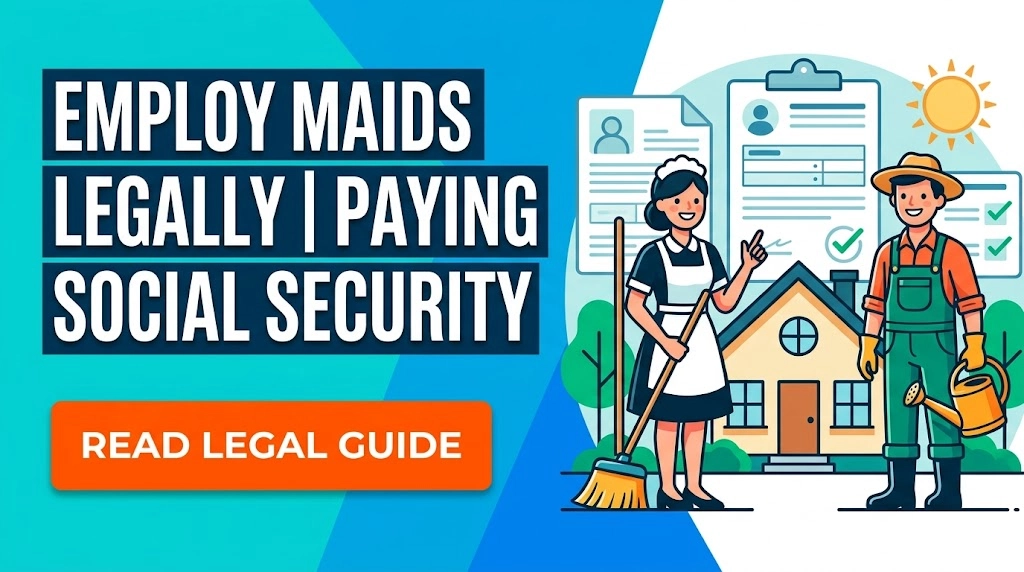
You hire a wonderful housekeeper, hand them cash every Friday, and assume you are helping the local economy. I nearly faced a devastating labor lawsuit my second year because I didn’t realize that “casual” cash arrangements violate strict Mexican labor laws. This guide explains how to legally register, pay, and provide Social Security for your domestic help to protect you both.
Disclosure: This post may contain affiliate links. We may earn a commission at no extra cost to you if you make a purchase through these links. Read full disclosure.
The Danger of Informal Employment in Mexico
When expatriates move to Mexico from the United States, Canada, or Europe, they often bring their home-country biases with them. Back home, paying someone to clean your house for four hours a week is usually viewed as a casual, gig-economy transaction. In Mexico, domestic labor is a highly protected class of employment, and ignoring the legal framework is one of the most dangerous financial risks an expat can take.
The Myth of the Cash Only Arrangement
Many expats believe that paying their maid, gardener, or nanny in cash “under the table” is doing them a favor by helping them avoid taxes. In reality, this arrangement leaves you entirely exposed to massive legal liabilities. The Federal Labor Law explicitly covers domestic workers, known formally as Personas Trabajadoras del Hogar.
Under Mexican labor law, an employer-employee relationship is established the moment there is a dynamic of subordination—meaning they clean your home, follow your specific instructions, and receive a regular wage. This legal relationship exists regardless of whether a formal contract was signed. If you pay in cash without any written receipts, you have no paper trail. If a disgruntled employee goes to the local labor board and claims they worked for you five days a week instead of one, and that you never paid them their legally mandated bonuses, the burden of proof rests entirely on you, the employer. Without formal documentation, the labor courts will almost universally side with the worker. To understand the broader context of these regulations, you must review Labor Laws in Mexico: Understanding Employee Rights and Benefits.
Justified Dismissal Versus Severance
Another massive cultural shock for expats is the realization that “at-will” employment does not exist in Mexico. You cannot simply fire your gardener because you decided you want to mow the lawn yourself, or because you no longer like their attitude.
If you terminate the relationship without a legally justified cause (which is incredibly difficult to prove and usually requires documented evidence of theft, violence, or repeated absence), you are legally executing an unjustified dismissal. When this happens, you owe the employee Constitutional Severance. This severance penalty is massive: you must pay them 90 days of their daily salary, plus 20 days of salary for every year they worked for you, a seniority premium, and all their prorated annual bonuses.
Because a sudden termination can easily cost thousands of dollars, holding onto this capital securely is crucial. I keep my severance reserve fund parked safely in Interactive Brokers so it isn’t eaten by local Mexican inflation. By holding my emergency employment reserves in Interactive Brokers, the capital is protected from peso devaluation and earns interest in USD until it is legally required by the labor courts.
Enrolling Domestic Workers in IMSS
Historically, domestic workers in Mexico operated in the shadows without access to healthcare or pensions. That changed definitively when the Mexican Supreme Court ruled that domestic workers have a constitutional right to social security, making their enrollment absolutely mandatory for employers.
The Legal Mandate for Social Security
As an employer, you are legally mandated to register your domestic help with the Instituto Mexicano del Seguro Social (IMSS). This federal institution provides your employee with comprehensive medical care, workplace injury protection, paid maternity leave, and access to a retirement pension.
Registering them is not just a moral obligation; it is your ultimate financial shield. If your housekeeper slips on a wet floor and breaks an arm in your kitchen, and they are not registered with IMSS, you are personally liable for their private medical bills, their physical rehabilitation, and their full salary while they recover. Registering them transfers this massive financial liability from you to the state. Navigating this system is critical, much like navigating your own personal healthcare coverage outlined in Healthcare in Mexico: Complete Guide for Expats Public vs Private.
Step by Step Registration Process
The Mexican government has modernized this process by creating a dedicated microsite on the IMSS portal specifically for domestic workers. However, the bureaucratic prerequisites can still be daunting for a newly arrived expat.
To begin, you need your employee’s Social Security Number and their CURP. Equally important, you need your own RFC and your own CURP as the employer. If you haven’t secured these foundational documents yet, you must review How to Get a CURP as a Foreigner: The Mexican ID Number Explained before proceeding.
Once logged into the IMSS portal, you will input the specific days your employee works for you (for example, every Monday and Wednesday) and their daily salary. Be aware that the daily salary you declare cannot be lower than the federally mandated minimum wage for domestic workers. The system will then automatically calculate your monthly quota. You must generate a specific payment code and pay the quota in advance by the 20th of each month. If you fail to pay the generated code on time, the coverage lapses immediately, leaving you exposed to labor liabilities. For a broader look at the overall enrollment mechanics, read How to Enroll in IMSS: Step-by-Step Guide for Foreign Residents.
Calculating the Monthly Contributions
The IMSS fee is calculated as a percentage of the worker’s integrated daily wage. While the exact peso amount fluctuates based on their specific salary and how many days a month they work, the premium covers several distinct branches of social insurance.
Legally, the contribution is split between the employer and the employee. However, culturally and practically, almost all expats absorb the entire cost of the IMSS premium themselves to ensure the domestic worker’s take-home pay doesn’t drop, which fosters immense goodwill and loyalty.
Here is a general breakdown of how the IMSS premium is distributed across the social safety net:
| IMSS Insurance Branch | Purpose of the Coverage | Primary Payer |
| Sickness and Maternity | General medical care, surgeries, and paid maternity leave. | Shared (Employer pays majority) |
| Occupational Risks | Total coverage for accidents occurring inside your home. | Employer (100%) |
| Disability and Life | Pensions for non-work-related severe disability or death. | Shared |
| Retirement | Long-term pension funds and senior housing contributions. | Shared (Employer pays majority) |
| Daycare and Social Benefits | Access to IMSS childcare facilities and recreational centers. | Employer (100%) |
Managing Payroll and Mandatory Benefits
Providing Social Security is only half of your legal obligation as an employer in Mexico. You must also manage their direct payroll and provide the statutory benefits mandated by the Federal Labor Law.
The Aguinaldo and Paid Vacation Time
The most famous and strictly enforced labor benefit in Mexico is the Aguinaldo. This is a mandatory annual Christmas bonus that is equivalent to at least 15 days of the worker’s daily salary. By law, it must be paid directly to the employee before December 20th every year. If they worked for you for less than a full calendar year, the Aguinaldo must be prorated based on the exact number of days they were employed.
When it is time to pay the massive annual Aguinaldo bonus, I convert the necessary capital through Interactive Brokers at the institutional spot rate to ensure I don’t lose hundreds of dollars to hidden bank spreads. Accurately projecting these bonuses is an essential part of managing your Cost of Living in Mexico: A Realistic Budget Breakdown.
Additionally, under recent labor reforms, domestic workers are entitled to 12 days of paid vacation after completing their first year of employment. Furthermore, when they take this vacation, you must pay them a vacation premium, which is an extra 25% bonus paid on top of their normal salary while they rest.
How to Pay Safely and Keep Records
As mentioned earlier, you should never pay your domestic help in cash without a signed paper receipt. If a dispute arises, cash leaves zero evidence. The safest and most professional method is to pay your employees via a direct interbank transfer to their local Mexican bank account. This creates an unarguable, time-stamped digital paper trail proving exactly what you paid and when. To understand how to execute these localized transfers seamlessly, read What Is a CLABE? Understanding Mexican Bank Account Numbers.
To accurately fund my Mexican bank account for these weekly payroll runs, I use Wise. By utilizing Wise, I completely bypass the awful SWIFT wire fees and predatory exchange rates my US bank tries to charge for international transfers. Keeping your domestic payroll budget predictable is essential for your peace of mind. The real mid-market exchange rate on Wise ensures my monthly budget stays perfectly flat, allowing me to transfer the exact peso amount needed to cover wages and IMSS quotas without overpaying. For additional strategies on keeping your overhead low, review Bank Fees in Mexico: Tips to Avoid Unnecessary Charges.
If you are employing full-time staff, navigating these payments correctly is just as critical as managing your own personal reporting outlined in Taxes in Mexico for Expats: A Complete Guide to Income Tax and More. Moving those reserves via Interactive Brokers or Wise ensures you keep the maximum amount of your own money while remaining fully, legally compliant with Mexican labor courts. Finally, if you haven’t set up the local financial infrastructure to handle these payments, be sure to complete the steps in Opening a Bank Account in Mexico before you make your first hire.
References
Primary sources (official)
- Secretaría del Trabajo y Previsión Social (STPS): The federal labor secretariat governing the enforcement of the Federal Labor Law (LFT), overseeing the mandatory Aguinaldo requirements, and managing the recent Vacaciones Dignas reforms. https://www.gob.mx/stps
Other helpful sources
- Procuraduría Federal de la Defensa del Trabajo (PROFEDET): The federal agency that represents workers in labor disputes, offering deep clarity on the legal differences between justified dismissals, voluntary resignations (finiquito), and constitutional severance (liquidación). https://www.gob.mx/profedet
Disclaimer
The information provided in this guide is for educational, logistical, and informational purposes only and does not constitute formal legal, labor, tax, or HR advice. However, Mexican labor laws (Ley Federal del Trabajo), IMSS quota calculations, minimum wage mandates, and Aguinaldo obligations are strictly enforced by the government and are subject to frequent, sudden legislative changes. Failure to properly register domestic employees or pay statutory severance can result in severe financial penalties and devastating labor lawsuits at the Junta de Conciliación y Arbitraje. Always consult directly with a certified Mexican labor attorney (Abogado Laboral) and a registered accountant (Contador Público) to draft legal employment contracts and ensure your payroll practices are fully compliant with federal law.