How to Bring Children to Mexico as Residents
Navigating the Mexican immigration system while clutching a toddler’s hand and a mountain of paperwork is enough to make any parent question their sanity. I remember standing in a humid government office with my own children, wondering if I’d missed one single, tiny stamp that would send us back to square one. This guide solves the mystery of securing legal residency for your children so you can focus on your new life.
Disclosure: This post may contain affiliate links. We may earn a commission at no extra cost to you if you make a purchase through these links. Read full disclosure.
The Legal Path to Family Unity in Mexico
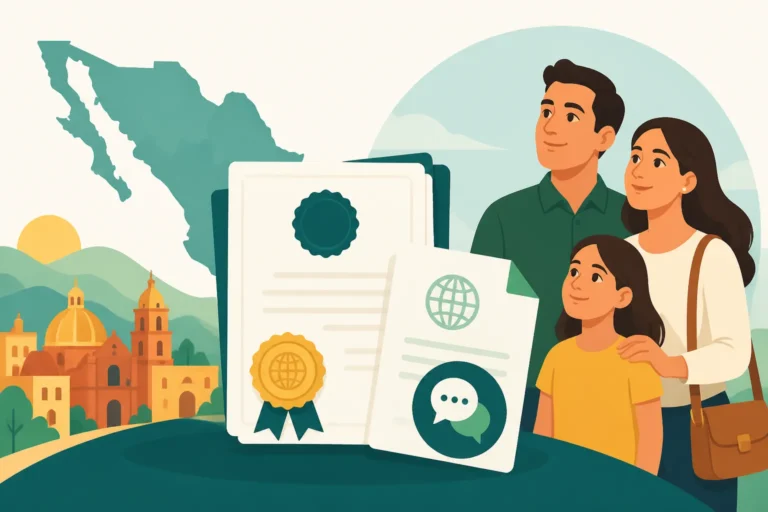
When you decide to move your family to Mexico, the most common and logical route is the Family Unity Visa: Bringing Your Spouse and Kids to Mexico. The Mexican government recognizes the fundamental right to family preservation, which simplifies the process compared to some other visa categories. However, "simplified" is a relative term in the world of Mexican bureaucracy. The core concept you need to understand is that your children’s residency status is generally tethered to your own. If you are applying for a Temporary Resident visa, your children will typically receive the same.
The process is generally split into two scenarios: applying at a Mexican consulate abroad alongside the parent, or applying for a "Regularization" or "Change of Status" once the parent already has residency. For most families, it is highly recommended to start the process at a consulate in your home country. This ensures that everyone enters Mexico with the correct "Canje" (exchange) visa in their passport. Applying this way avoids the stress of Living in Mexico on a Tourist Permit: Risks and Limitations in 2027, which can be particularly precarious when children are involved and need to be enrolled in school or healthcare.
It is important to note that the definition of "children" for these purposes typically refers to unmarried minors under the age of 18. If you have adult children, even if they are still financially dependent or living at home, the rules change significantly. They will often need to qualify for residency based on their own economic solvency or specific ties, rather than the automatic family unity link. You can find more nuance on this in our guide on Residency in Mexico for Families: Visas for Spouses and Children.
The Essential Document Checklist for Minors
The success of your application hinges entirely on your "expediente"—your folder of documents. Mexican immigration officials are meticulous, and a single missing apostille or an uncertified translation can lead to an immediate rejection. For children, the primary document is the long-form birth certificate. This must be the official version issued by the government, not the decorative one from the hospital.
Every foreign document must undergo two critical steps: authentication and translation. If your home country is part of the Hague Convention (like the US, Canada, or the UK), your documents must be apostilled. If not, they must be legalized. Once you have the apostille, the document must be translated into Spanish. This is where precision is non-negotiable. Using a professional service like RushTranslate ensures that the legal terminology is handled correctly, which is vital because Mexican consulates can be very picky about the wording.
In my experience, having a "certified" translation is the gold standard. When you use RushTranslate, you receive a document that carries the weight of professional accountability, which often smooths over the skepticism of a stern immigration officer. Beyond the birth certificate, you will need:
- Valid passports for each child with at least six months of validity.
- The parents' valid passports and residency cards (if already held).
- Proof of economic solvency (bank statements or pay stubs) showing you can support the additional dependents.
- Marriage certificate for the parents (also apostilled and translated).
If only one parent is moving to Mexico with the children, or if the parents are divorced, you will need a notarized letter of consent from the non-appearing parent. This document must specifically state that the parent allows the child to obtain residency in Mexico. Like everything else, this letter needs an apostille and a professional translation. I have seen families turned away at the window because the consent letter didn't explicitly mention "Mexican residency," so be specific. Services like RushTranslate are particularly helpful here to ensure the legal nuance of the consent isn't lost in translation.
Navigating the Financial Requirements for Dependents
One of the most common questions I get is, "How much more money do I need to show for my kids?" The financial requirements for Mexican residency are updated annually and are tied to the Mexican minimum wage or the UMA (Unidad de Medida y Actualización). When you add children to an application, the "solvency" bar is raised. Generally, for each dependent, you must show an additional amount of monthly income or savings beyond what is required for the primary applicant.
For 2026, these figures have shifted slightly due to inflation. You can check the current exact numbers in our breakdown of Mexico Temporary Residency Financial Requirements (2026). Usually, the additional amount for a child is roughly equivalent to 100 days of the minimum wage in savings or a specific percentage of monthly income. It is crucial to have your bank statements organized chronologically. If your bank is not in a Spanish-speaking country, translating the summary page of your financial documents through RushTranslate can help the consulate officer quickly verify that you meet the thresholds without them having to hunt through your transactions.
| Visa Type | Primary Applicant Requirement (Approx) | Additional Per Child (Approx) | Document Needed |
|---|---|---|---|
| Temporary Resident (Savings) | $60,000 USD | $10,000 – $15,000 USD | Bank Statements (12 months) |
| Temporary Resident (Income) | $3,500 USD / month | $800 – $1,000 USD / month | Pay Stubs (6 months) |
| Permanent Resident (Savings) | $200,000 USD | $20,000+ USD | Bank Statements (12 months) |
| Family Unity (In-Country) | Parent's Resident Card | Proving Relationship | Birth Certificate |
Please keep in mind that these figures are estimates and vary wildly between different Mexican consulates. Some consulates are "family-friendly" and might be more lenient, while others in high-demand areas like Los Angeles or New York follow the letter of the law to the centavo. Always email your specific consulate beforehand to ask for their current "hoja de requisitos" (requirement sheet).
The Consulate Interview and the Canje Process
Once your paperwork is in order and your translations from RushTranslate are tucked safely into your folder, you’ll head to the consulate for the interview. Yes, the children usually need to be present. Don’t panic—the "interview" for a five-year-old isn't a grilling about their intentions in Mexico. The officer mainly needs to verify their identity and ensure they match the photos in the passports.
If the interview goes well, the officer will place a visa sticker in each child's passport. This is NOT their residency card. It is a single-entry visa valid for 180 days that gives them the right to apply for the actual card once they are in Mexico. When you cross the border or land at the airport, make sure the immigration officer marks their entry correctly. In the past, this was done on a paper FMM, but now it is increasingly digital. You must ensure they are marked as "Canje" and not as "Turista."
Within 30 days of arriving in Mexico, you must visit the local INM (Instituto Nacional de Migración) office to complete the "Canje." This is where you trade that passport sticker for a plastic residency card. This stage involves more forms, more fees, and the taking of fingerprints and photos. It’s also the time when your children will be assigned a CURP. You can read more about why this is the most important number you'll ever have in How to Get a CURP as a Foreigner: The Mexican ID Number Explained.
Settling In: Schools, Healthcare, and Integration
Getting the residency card is a massive milestone, but it’s just the beginning of your journey. One of the first things you will need that card for is Schooling in Mexico: Education Options for Expat Children. Whether you choose a private international school or a local "colegio," they will require the child’s residency card and their CURP. Most schools will also ask for previous academic records. Just like your immigration documents, these transcripts need to be translated. I’ve found that using RushTranslate for school records is a smart move because their format is clean and professional, which helps school administrators understand your child’s grade level and credits.
Healthcare is another immediate priority. While you can use private pediatricians out-of-pocket, having residency allows you to look into Pediatric Care in Mexico: Healthcare for Expat Children and even enroll in public options if you qualify. You should also carry a copy of your child's residency card and birth certificate translation whenever you travel within the country.
Finally, remember that the "Temporary" residency for children often needs to be renewed. For the first year, it’s usually valid for one year, and then you can renew it for another three years. After four years of temporary status, children are eligible to transition to permanent residency. This transition is much easier than the initial application, but it still requires keeping your documents up to date. For a deeper look at the long-term plan, check out Moving to Mexico with Children: Do Kids Need Separate Residency Visas?.
Disclaimer
This guide is for informational purposes only and does not constitute legal advice. Mexican immigration laws and financial requirements are subject to frequent changes. Always verify current requirements with the official website of the Secretaría de Relaciones Exteriores (SRE) or the Instituto Nacional de Migración (INM) before starting your application.