Accessing Your Pension or 401(k) in Mexico: What Retirees Should Know
Waking up to an email stating your retirement account has been frozen due to a foreign address is a terrifying expat reality. I will never forget the panic of realizing my US brokerage suspended my access simply because I moved to Puerto Vallarta. This guide solves the administrative nightmare of accessing your 401k and pension securely while living in Mexico, ensuring your hard-earned nest egg remains fully accessible and protected from predatory fees.
Disclosure: This post may contain affiliate links. We may earn a commission at no extra cost to you if you make a purchase through these links. Read full disclosure.
The Logistics of Cross Border Retirement Accounts
Why Your Brokerage Might Freeze Your Account
The single most shocking hurdle for new retirees moving to Mexico is discovering that their lifelong financial institution no longer wants their business. In the post-Patriot Act era, US and Canadian brokerages are bound by incredibly strict “Know Your Customer” (KYC) regulations and anti-money laundering compliance laws. These institutions actively monitor the IP addresses of where you log in, and they routinely audit mailing addresses. Once they realize your permanent residence is outside of your home country, they often restrict your account to “liquidation only” status or force you to close it entirely.
Many expats attempt to bypass this by using a relative’s address or a virtual mail-forwarding service back home. This is a highly risky strategy that borders on financial fraud. If the brokerage catches on—and their algorithms are increasingly sophisticated at flagging commercial mail drops—they will freeze your assets without warning. Being unable to execute a trade or initiate a withdrawal while you are sitting thousands of miles away in Mexico is a completely avoidable crisis that causes immense emotional and financial distress.
Instead of playing a cat-and-mouse game with a domestic bank, the legal and stress-free solution is to migrate your assets to a brokerage that actually caters to international residents. By transferring your retirement accounts to Interactive Brokers, you can legally update your residential address to your Mexican home. Because Interactive Brokers is designed for a global clientele, they fully support expats, ensuring you never have to lie about where you live just to access your own life savings.
The Mechanics of Receiving Direct Deposits in Mexico
Once your accounts are secure, the next logistical hurdle is determining exactly how your monthly pension or Social Security checks will reach you. The US government, through the Federal Benefits Unit at the embassy in Mexico City, does allow you to have your Social Security payments direct-deposited into a local Mexican bank account. However, while this sounds incredibly convenient on paper, it is almost always a terrible financial decision in practice.
When the US Treasury routes your payment directly to a Mexican institution like BBVA or Banorte, the funds are converted from dollars to pesos using the institutional exchange rate determined by the receiving bank. This rate is notoriously poor. You will lose a significant percentage of your monthly income to this hidden “spread.” For a retiree living on a fixed income, giving up three to five percent of your pension every month to bank conversion fees translates to thousands of dollars lost over the course of a year.
The much smarter strategy favored by veteran expats is to maintain a US-based checking account to receive your direct deposits in dollars. Once the funds clear in your home country, you can use Wise to transfer your monthly living allowance to your Mexican bank account as needed. This allows you to completely control the currency conversion process. For a complete breakdown of how to establish this dual-country banking pipeline, see our guide on Banking in Mexico: Complete Guide for Foreigners.
Navigating Mandatory Minimum Distributions Abroad
If you hold a traditional IRA or a 401k, reaching the age of 73 triggers Required Minimum Distributions (RMDs). The IRS does not care that you live in Mexico; you are still legally obligated to withdraw a specific percentage of your tax-deferred accounts annually. Managing this sudden influx of cash while living abroad requires careful logistical planning, as failing to take your RMD results in a catastrophic 25% tax penalty.
When you take an RMD, your brokerage will typically withhold default federal taxes (often 10% to 20%) before dispersing the net funds to you. If your 401k administrator issues this distribution as a physical paper check rather than a direct electronic deposit, cashing a US treasury or corporate check in Mexico is nearly impossible. Mexican banks will often hold foreign checks for up to six weeks to clear, and they apply exorbitant fees for the privilege.
To manage your RMDs efficiently, you should instruct your brokerage to electronically transfer the net funds to your domestic US checking account. If you do not need the entirety of your RMD to fund your lifestyle in Mexico, you can immediately transfer the excess into a taxable global investment account at Interactive Brokers. This ensures your mandatory withdrawal goes right back to work in the market, rather than sitting idle in a low-yield checking account while inflation eats away at your purchasing power.
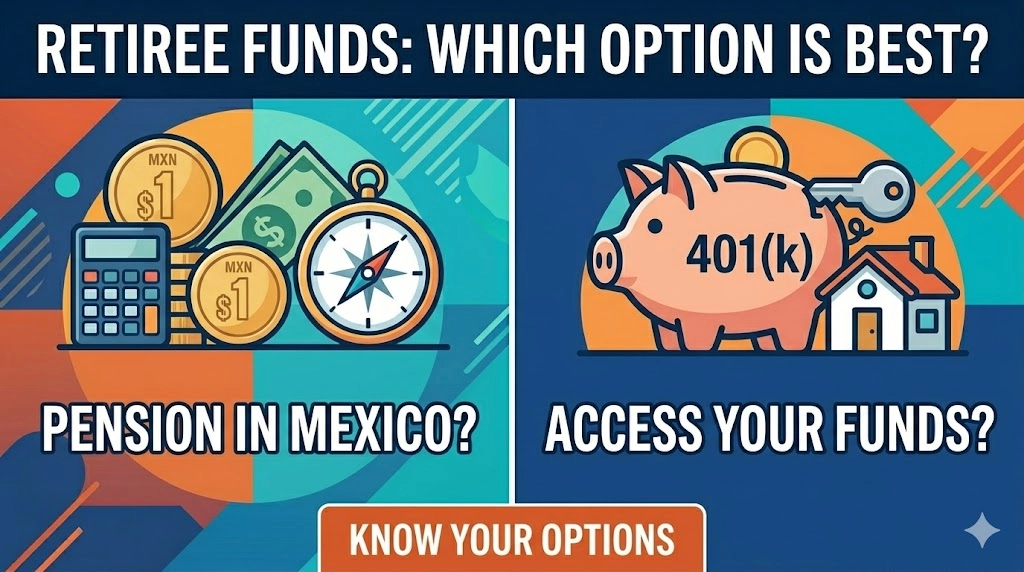
Tax Implications for US and Canadian Retirees
Understanding IRS and CRA Withholding Rules
One of the harshest realities of expat life is that crossing the border does not sever your ties with your home country’s tax authority. The United States is almost entirely unique in that it taxes its citizens based on citizenship, not geography. Whether you live in Ohio or Oaxaca, the IRS considers your 401k withdrawals and traditional pension payouts as ordinary taxable income.
When you initiate a withdrawal from your retirement account, the plan administrator acts as a withholding agent. If they suspect you are a non-resident alien, they might default to a flat 30% withholding tax. As a US citizen living abroad, you must ensure your brokerage has a current W-9 form on file so that you are taxed according to your actual income bracket, not the punitive default rate. Managing these forms from abroad can be tedious, but it is necessary to prevent severe over-withholding on your retirement income.
For Canadian retirees, the Canada Revenue Agency (CRA) generally applies a 25% non-resident withholding tax on RRSP or RRIF withdrawals. However, this rate can often be reduced if you formally declare your non-residency status and invoke the tax treaty. Navigating the exact forms required to lower your withholding rate is a complex process that demands professional guidance, a topic we cover extensively in Taxes in Mexico for Expats: A Complete Guide to Income Tax and More.
The Double Taxation Treaty Exemption Process
The greatest fear for any retiree moving abroad is the prospect of being taxed twice on the exact same dollar of income. Fortunately, both the US and Canada have robust Double Taxation Agreements (DTAs) with Mexico. These treaties are specifically designed to prevent the IRS or CRA and the Mexican government from double-dipping into your retirement funds.
However, interpreting these treaties requires understanding the “Saving Clause.” In the US-Mexico tax treaty, the saving clause explicitly states that the US reserves the right to tax its citizens exactly as if the treaty did not exist. This means that while the treaty dictates that pension income is generally taxable only in the country of residence (Mexico), the IRS will still demand its share.
To resolve this and avoid paying twice, expats rely on the Foreign Tax Credit (FTC). If Mexico levies a tax on your pension, you report that tax paid on IRS Form 1116. The IRS then gives you a dollar-for-dollar credit against your US tax liability. You never pay double; you simply pay whichever country has the higher effective tax rate. We break down the exact mechanics of this filing process in Double Taxation Treaties: How Expats Can Avoid Paying Taxes Twice.
How the SAT Views Your Foreign Retirement Income
The Mexican tax authority, known as the SAT (Servicio de Administración Tributaria), considers anyone who spends more than 183 days a year in Mexico to be a tax resident. As a Mexican tax resident, you are legally required to report your worldwide income, which absolutely includes your foreign pensions, Social Security, and 401k disbursements. Attempting to hide this income is incredibly dangerous in the era of automated global banking data exchanges like FATCA.
Here is the incredibly good news that most expats miss: Mexican tax law is phenomenally generous to retirees. Under Article 93 of the Mexican Income Tax Law, pension and retirement income is entirely exempt from Mexican income tax up to a limit of 15 times the daily UMA (Unidad de Medida y Actualización). In 2026, this exemption translates to roughly $43,000 USD per year.
If your total annual pension and Social Security income falls below this massive threshold, you owe zero income tax to the Mexican government on those distributions. If your pension exceeds this limit, Mexico only taxes the excess amount. However, to claim this legal exemption, you must officially register with the SAT, obtain an RFC tax ID number, and file an annual return declaring the income. You cannot simply ignore the SAT and assume the exemption applies automatically.
Currency Exchange and Maximizing Your Payouts
The Hidden Costs of Bank Wire Conversions
When you are living on a fixed retirement income, every dollar counts. The traditional method of moving money from a US bank to a Mexican bank involves an international SWIFT wire transfer. Your home bank will charge an outgoing wire fee (usually $35 to $50 USD), the intermediary banks may take a cut, and the receiving Mexican bank will apply a highly unfavorable currency exchange rate.
If you are transferring $3,000 a month to cover your rent and groceries in Mexico, these combined wire fees and exchange rate markups can easily skim $150 to $200 off the top of every single transfer. Over a ten-year retirement, you are essentially handing tens of thousands of dollars of your hard-earned pension directly to corporate banking executives for a service that can be entirely automated.
This predatory system is exactly why modern retirees exclusively use Wise to manage their monthly transfers. By initiating a transfer through Wise, you guarantee that your dollars or Canadian dollars are converted at the true, mid-market exchange rate. The funds are then deposited directly into your Mexican account via the local SPEI network, bypassing the SWIFT system entirely. It is a mandatory financial upgrade for anyone serious about Transferring Money Internationally: Best Ways to Send Money to/from Mexico.
Timing the Market Against the Volatile Peso
The Mexican Peso is one of the most heavily traded and volatile emerging market currencies in the world. When the peso strengthens against the dollar—a phenomenon frequently referred to as the “Super Peso”—the cost of living for expats skyrockets overnight. Your $3,000 pension, which used to provide a luxurious lifestyle, suddenly barely covers a middle-class existence because your dollars buy 20% fewer pesos.
To survive this volatility, you cannot passively transfer money on the first of every month regardless of the rate. Seasoned retirees use a “peso buffer” strategy. When the exchange rate is highly favorable to the dollar, they use Wise to transfer three to six months’ worth of living expenses into a high-yield Mexican savings account. This locks in their purchasing power and creates a financial moat against sudden currency swings.
Conversely, the bulk of your retirement savings should remain safely denominated in your home currency. Keeping your primary life savings in a Mexican bank exposes you to massive devaluation risks if the local economy falters. By keeping your nest egg abroad and only converting what you need, you maintain absolute control over your financial destiny, a concept we expand upon in Managing Your Money in Mexico: Budgeting, Saving, and Currency Tips.
Utilizing Global Platforms for Wealth Preservation
If you ever decide to take a massive lump-sum withdrawal from your 401k—perhaps to buy a beachfront home outright—you need institutional-grade financial tools. Pushing $300,000 USD through a standard retail bank to buy a house in Mexico will result in catastrophic exchange rate losses. Retail banks simply do not offer fair rates for six-figure conversions.
For large-scale wealth preservation and massive capital transfers, the elite expat strategy is to use Interactive Brokers. Within the Interactive Brokers platform, you can convert hundreds of thousands of dollars into Mexican pesos at absolute spot-market rates. You are trading currency on the same interbank market that massive hedge funds use, for a commission of just a few dollars.
Once the currency is converted inside your brokerage account, you can wire the pesos directly to the Mexican notary to close on your property. This ensures that you retain maximum equity from your retirement payout. Combining the daily agility of a service like Wise with the heavy-lifting power of an institutional brokerage is the ultimate financial strategy for expats.
Healthcare and Emergency Liquidity for Retirees
Why Medicare Does Not Cross the Border
One of the most terrifying realizations for an American retiree is that the Medicare benefits they paid into for 40 years are completely void the moment they step foot in Mexico. Medicare Parts A and B do not provide coverage for medical services, hospital stays, or prescription drugs outside of the United States. If you suffer a heart attack in Cabo San Lucas, presenting your red, white, and blue Medicare card will not get you past the admissions desk.
Because of this, expats must fundamentally restructure how they budget their pension income for healthcare. You have two realistic options: self-insure by keeping a massive liquid cash reserve, or purchase a comprehensive international health insurance policy. While routine medical care and generic prescriptions in Mexico are highly affordable out-of-pocket, major surgeries or intensive care stays in premium private hospitals can easily exceed $50,000 USD.
Budgeting for a premium international health insurance policy should be the very first line item you deduct from your monthly pension calculations. These policies ensure that a catastrophic illness does not completely wipe out your 401k. To understand how these global policies interact with local hospital networks, be sure to read our comprehensive comparison in Choosing Private Health Insurance: Local Mexican Plans vs International Coverage.
Balancing Liquid Cash for Mexican Hospital Deposits
Even if you hold a phenomenal international health insurance policy, you must understand the aggressive billing culture of the Mexican private healthcare system. Unlike hospitals in the US or Canada that treat you first and bill you later, private Mexican hospitals operate strictly on a “pay before you play” model. They demand massive upfront cash deposits or credit card holds before they will admit you to an emergency room or administer pain medication.
If you have all your wealth tied up in a traditional 401k or IRA, it might take three to five business days to execute a trade, wait for settlement, and wire the funds down to Mexico. In a medical crisis, you do not have three days to wait. Attempting to swipe a foreign credit card for a $10,000 hospital deposit often triggers an international fraud alert, leaving you financially stranded while bleeding in the lobby.
To prevent this nightmare scenario, retirees must keep an emergency fund of localized, liquid cash. Having an emergency stash of pesos in a Mexican bank account, or holding funds in a multi-currency account with a physical debit card provided by Wise, ensures you can instantly pay the admission desk deposit without alerting fraud departments. We discuss the harsh realities of these billing practices in Do Mexican Hospitals Require Payment Upfront? How Billing Works for Expats.
Repatriating Funds in the Event of an Emergency
Life is unpredictable, and occasionally expats face a family emergency that requires them to temporarily or permanently return to their home country. When an emergency strikes, you need the ability to repatriate your liquid cash immediately. If you have tied up all your cash in local Mexican real estate or convoluted local banking investment products, you will find it incredibly difficult to access your money quickly.
Maintaining the majority of your retirement portfolio in a global platform like Interactive Brokers ensures absolute liquidity. Because these platforms offer integrated debit cards and instantaneous global wire capabilities, you can access your wealth anywhere in the world at a moment’s notice. You are never trapped by the slow bureaucracy of the Mexican retail banking system.
| Disbursement Method | Transfer Fees | Exchange Rate Quality | Best Use Case for Retirees |
| Direct to Mexican Bank (FBU) | None (usually) | Poor (Bank’s Retail Rate) | Those unable to maintain a US bank account. |
| US Bank + SWIFT Wire | High ($35 – $50) | Poor (Retail Rate + Markup) | Emergency transfers only; not recommended. |
| US Bank + Wise Transfer | Low (Transparent) | Excellent (Mid-Market Rate) | Monthly living expenses and rent payments. |
| ATM Withdrawals (US Card) | High (Foreign + ATM fee) | Moderate (Network Rate) | Pulling small amounts of daily walking-around cash. |
| Interactive Brokers FX Trade | Microscopic | The Best (Institutional Spot Rate) | Converting lump sums for buying real estate or cars. |
Restructuring Your Portfolio for Expat Life
Moving Away from Domestic Mutual Funds
Before you move to Mexico, you must deeply audit the specific assets held within your retirement accounts. If your 401k or IRA is heavily invested in traditional US mutual funds, you are sitting on a compliance landmine. Because mutual funds are strictly regulated domestic securities, brokerages are legally prohibited from selling them to non-US residents.
If your brokerage realizes you live in Mexico, they will freeze your ability to purchase new shares of your favorite mutual funds, and they may even force you to liquidate your existing holdings, triggering massive, unexpected capital gains taxes if held outside a tax-advantaged account. The solution is to transition your portfolio away from mutual funds and into Exchange Traded Funds (ETFs) before you establish foreign residency.
ETFs trade exactly like stocks on the open exchange, and holding them as an expat is perfectly legal and compliant. Making this transition while you still have a domestic address saves you from the panic of forced liquidations later. Consulting a cross-border financial planner to execute this shift is a vital step in your relocation process.
The Importance of a Diversified Global Brokerage
The overarching theme of retiring abroad is that your financial infrastructure must match your new global lifestyle. Relying on a small, regional credit union or a domestic-only brokerage will result in constant administrative friction. You need institutions that understand international wire protocols, multi-currency holding, and non-resident tax treaty documentation.
This is precisely why migrating to Interactive Brokers is considered the gold standard for expats. They do not just tolerate foreign residents; they explicitly cater to them. You can securely upload your Mexican residency card, file your W-9 forms digitally, and trade on global markets without ever fearing that your account will be shut down in a sudden compliance sweep. It grants you the absolute peace of mind needed to actually enjoy your retirement.
Estate Planning and Beneficiaries Across Borders
Finally, you must confront the uncomfortable reality of estate planning. What happens to your 401k or IRA if you pass away while living in Mexico? If your accounts are held in the US or Canada, they are governed by the probate laws of those jurisdictions, not by the Mexican legal system. However, if you die in Mexico, your heirs will have to navigate a complex, bilingual bureaucracy to secure your death certificate and prove their rights to your foreign brokerages.
Cross-border probate is a grueling nightmare. The most effective way to protect your family is to ensure that every single retirement account has strictly updated, iron-clad “Transfer on Death” (TOD) beneficiaries designated. If a beneficiary is named, the 401k or IRA completely bypasses the probate courts, and the assets transfer directly to your heirs upon presentation of a death certificate, regardless of where you passed away.
You must also work with a local Mexican Notario to draft a specific Mexican will covering any assets you hold south of the border, such as local bank accounts, cars, or real estate. Your US or Canadian will is effectively useless in Mexico without an incredibly expensive and lengthy translation and apostille process. Proper estate planning is the ultimate act of love for your family, ensuring your legacy is preserved rather than consumed by international legal fees. For more on navigating these final logistical costs, review our Cost of Living in Mexico: 2026 Comprehensive Guide.
References
Primary sources (official)
- Internal Revenue Service (IRS) – Guidelines on withholding for US citizens living abroad and Foreign Tax Credit rules: https://www.irs.gov/individuals/international-taxpayers/us-citizens-and-resident-aliens-abroad
Other helpful sources
- Interactive Brokers – Documentation on maintaining global investment accounts and tax reporting for non-US residents: https://www.interactivebrokers.com/
- Wise – Transparent guides on mid-market currency exchange rates and international SPEI transfers: https://wise.com/
Disclaimer
The information provided in this article is for educational and informational purposes only and does not constitute financial, investment, legal, or tax advice. Cross-border tax laws, double taxation treaties, and brokerage compliance regulations are highly complex and subject to frequent changes. Always consult with a certified cross-border financial planner and a qualified tax professional specializing in expat affairs before making significant financial decisions or moving retirement assets. Ensure that any financial platforms or services mentioned meet your specific individual legal residency and compliance requirements.