Cancer Screenings and Preventive Care: Staying Proactive with Health in Mexico
Relocating to Mexico often brings a wave of relaxation, a slower pace of life, and a highly anticipated escape from the stressful grind of your home country. However, this relaxed “mañana” mindset can become incredibly dangerous when applied to your baseline medical maintenance. I remember putting off my annual physical during my first two years in Mexico simply because the thought of navigating a foreign medical system for a “non-emergency” felt exhausting. This comprehensive guide explains how to actively manage your preventive care, decode the local terminology for vital cancer screenings, and build a proactive health strategy that keeps you thriving abroad.
Disclosure: This post may contain affiliate links. We may earn a commission at no extra cost to you if you make a purchase through these links. Read full disclosure.
The Mexican Approach to Preventive Medicine
To successfully manage your health in Mexico, you must understand how the local system approaches preventative care. Unlike systems in the UK or Canada, where your assigned general practitioner automatically calls you in for your age-bracketed screenings, the Mexican private system requires you to be the aggressive project manager of your own health.
The Culture of the “Check-Up Ejecutivo”
In the Mexican private healthcare sector, preventive medicine is heavily commercialized and incredibly efficient. Almost all major private hospitals (such as Hospital Ángeles, Star Médica, or Centro Médico ABC) offer comprehensive preventative packages known as Check-ups Ejecutivos (Executive Check-ups).
Instead of scheduling five different appointments over three months, you book a single morning at the hospital. Over the course of four to six hours, you undergo a massive battery of tests: comprehensive blood panels, resting electrocardiograms (EKG), chest X-rays, spirometry, and a physical consultation with an internist to review the results before you leave.
These packages are often tiered by age and gender (e.g., “Check-up Integral Femenino Mayor de 40 años”) and are astonishingly affordable compared to North American out-of-pocket pricing, generally ranging from $300 to $800 USD depending on the depth of the imaging. For expats looking to establish a medical baseline in their new country, booking an annual check-up ejecutivo is the most efficient strategy. To understand the broader costs associated with these private facilities, review Healthcare Costs in Mexico: Doctor Visits, Hospital Stays, and Surgery Expenses.
Independent Diagnostic Laboratories
If you do not want to pay for a full hospital package, Mexico offers an incredibly convenient alternative: the independent diagnostic laboratory. Chains like Laboratorios Chopo, Lister, Olab, and the budget-friendly Salud Digna are located on almost every major commercial street.
In Mexico, you do not always need a doctor’s physical prescription to get basic screenings. You can simply walk into a Chopo clinic, request a prostate-specific antigen (PSA) test or a comprehensive metabolic panel, pay cash at the counter, and have your results emailed to you by that evening. This unbureaucratic access to diagnostics empowers expats to monitor their own health metrics effortlessly. To learn exactly how to utilize these incredible resources, read Lab Tests and Blood Work in Mexico: Using Local Laboratories.
Essential Cancer Screenings: Local Terminology and Protocols
When scheduling your standalone preventative screenings, knowing the exact clinical Spanish terminology is vital to ensure you book the correct imaging or lab work.
Breast Cancer (Cáncer de Mama)
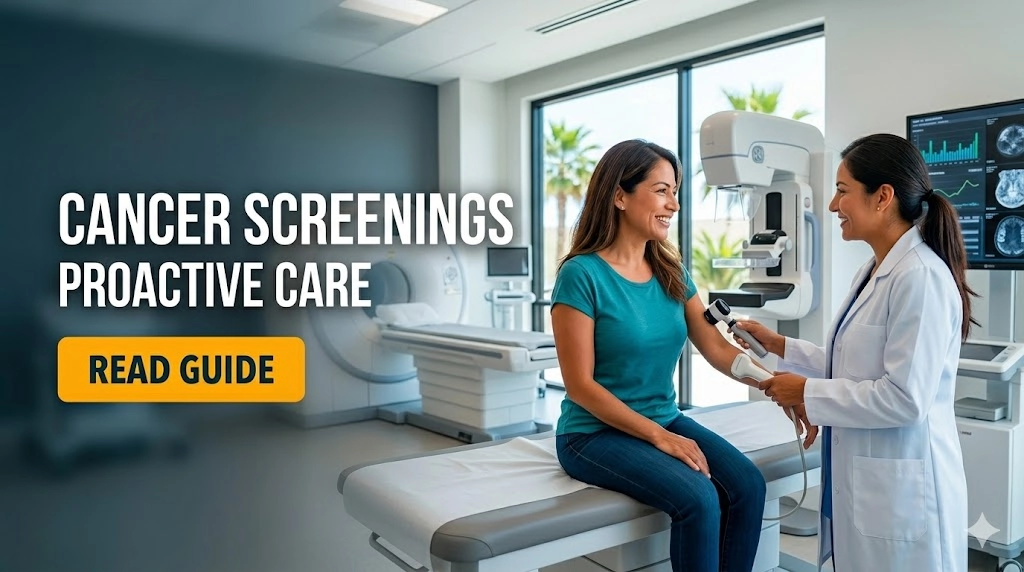
Breast cancer screening is highly accessible in Mexico. The Mexican Secretariat of Health recommends biennial screenings starting at age 40, and annual screenings for those with high risk factors.
- The Terminology: A mammogram is called a Mastografía or Mamografía. A breast ultrasound is an Ultrasonido Mamario.
- The Process: You can book these directly at independent labs or private women’s health clinics. Many labs offer discounted “women’s wellness” packages during October (Breast Cancer Awareness Month). If an anomaly is found, you will be referred to an Oncólogo (Oncologist) or a Ginecólogo Oncólogo for a biopsy.
Cervical Cancer (Cáncer Cervicouterino)
Routine cervical screenings are the absolute standard of care in Mexican gynecological clinics.
- The Terminology: A Pap smear is universally referred to as a Papanicolaou or simply el Pap. A colposcopy is a Colposcopía.
- The Process: A standard visit to a private gynecologist (Ginecólogo) usually costs between $800 and $1,500 MXN ($40 to $80 USD) and frequently includes a transvaginal ultrasound and a Papanicolaou in the base consultation fee. You walk out with immediate peace of mind. To find a vetted, bilingual women’s health specialist, consult Finding English-Speaking Doctors and Specialists in Mexico.
Prostate Cancer (Cáncer de Próstata)
For expat men over 40, proactive prostate monitoring is essential, yet it is often the most neglected screening.
- The Terminology: The PSA blood test is the Antígeno Prostático Específico. A physical exam is performed by a Urólogo (Urologist).
- The Process: You can walk into any local lab and request an Antígeno Prostático blood test for under $20 USD. If your numbers are elevated, you take those printed results directly to a private urologist for further evaluation and an ultrasound (Ultrasonido Prostático).
Colon Cancer (Cáncer de Colon)
Colonoscopies require slightly more logistical coordination than a simple blood draw or X-ray, as they involve sedation and specialized facility use.
- The Terminology: A colonoscopy is a Colonoscopia. The specialist required is a Gastroenterólogo or an Endoscopista.
- The Process: You must first schedule a consultation with a gastroenterologist. They will prescribe the bowel prep medication (which you purchase at a standard pharmacy) and book an outpatient suite at a private hospital or specialized ambulatory clinic. Out-of-pocket costs for a private colonoscopy with an anesthesiologist present typically range from $600 to $1,200 USD.
Skin Cancer (Cáncer de Piel)
Many expats move to Mexico specifically for the endless sunshine, retiring in coastal areas like Puerto Vallarta or Los Cabos. This drastically increases your lifetime UV exposure. Skin cancer (Melanoma and Carcinoma) is a severe threat for fair-skinned foreigners living near the equator.
- The Terminology: A skin check or mole mapping is a Revisión de lunares. The specialist is a Dermatólogo.
- The Process: You should schedule an annual full-body skin check. Mexican dermatologists are highly skilled at identifying sun damage. If they spot a suspicious lesion, they can often perform an excision biopsy (biopsia escisional) right in their office during the same visit.
The Financial Reality: When a Screening Finds Something
The beauty of the Mexican healthcare system is that preventative diagnostic testing—the blood work, the mammograms, the ultrasounds—is incredibly cheap to pay out of pocket. Many expats assume that because the diagnosis is cheap, the treatment will be cheap too. This is the most dangerous financial fallacy you can make.
The Cost of Oncology in Mexico
Paying $40 USD for a mammogram is easy. Paying $150,000 USD for aggressive chemotherapy, targeted radiation, and complex oncology surgeries in a private Mexican hospital is financially devastating. Private hospitals do not subsidize cancer treatments; they charge international market rates for imported chemotherapy drugs and specialized surgical suites.
If you rely on the public IMSS system, you will face agonizingly long wait lists to see an oncologist, massive supply chain shortages for specific chemotherapy drugs, and shared, crowded recovery wards. To fully understand the structural limitations of relying on the public tier for catastrophic illnesses, you must read Healthcare in Mexico: Complete Guide for Expats (Public vs Private).
Securing Your Catastrophic Safety Net
This is exactly why securing a premium international health insurance policy from Cigna Global is a non-negotiable requirement for long-term expats. A robust Cigna Global policy completely changes your posture when facing a terrifying cancer diagnosis.
Instead of liquidating your retirement portfolio to pay for life-saving private treatments, your Cigna Global policy grants you immediate, VIP access to Mexico’s premier, JCI-accredited oncology centers. Furthermore, many comprehensive Cigna Global plans include high-tier preventative care benefits, meaning you can often claim back the costs of your routine mammograms, colonoscopies, and executive check-ups. Most importantly, if your specific type of cancer requires a highly specialized treatment not readily available in Mexico, Cigna Global international portability allows you to seek treatment in Europe or return to your home country without losing your coverage. For a detailed breakdown of how to structure this protection, review Choosing Private Health Insurance: Local Mexican Plans vs International Coverage.
Holistic Prevention: Nutrition, Sun Protection, and Wellness
While clinical screenings are vital for catching diseases early, your day-to-day lifestyle is the frontline of actual prevention. Living in Mexico requires adapting your wellness routine to a new environment.
Bridging the Local Supply Gap
Mexico offers incredible access to fresh, whole foods and vibrant local produce markets. However, expats dedicated to aggressive, holistic preventive care often discover that local Mexican commercial pharmacies severely lack high-grade nutritional supplements and specialized preventative skincare.
Finding clinical-strength Vitamin D3, high-absorption Curcumin (a powerful anti-inflammatory), or specialized antioxidant complexes in a local Farmacia del Ahorro is often an exercise in frustration. Furthermore, while the Mexican sun is relentless, finding clean, reef-safe, high-zinc mineral sunscreens without harsh chemical endocrine disruptors is nearly impossible outside of high-end, overpriced resort boutiques.
Building Your Preventative Toolkit
To bridge this critical supply gap, veteran health-conscious expats bypass the local retail chains entirely and rely on iHerb. By ordering directly through iHerb, you gain access to a massive, globally vetted catalog of premium preventative wellness products.
You can have specialized, bioavailable multivitamins, pharmaceutical-grade Omega-3 fish oils (crucial for cardiovascular and cellular health), and premium, dermatologist-recommended mineral sunscreens shipped reliably and directly to your Mexican residential address. Utilizing iHerb allows you to maintain the exact same rigorous standard of holistic preventive care you utilized in your home country. You do not have to compromise your cellular health or risk severe sun damage simply because the local supermarket lacks inventory. Maintaining your body’s baseline defenses with iHerb is the most effective way to ensure your annual clinical screenings remain clear.
Making Preventative Care a Habit
When you move abroad, the onus of maintaining your health falls entirely on your shoulders. You must proactively translate your medical needs, navigate new hospital systems, and budget for your own diagnostics.
Do not let the relaxed Mexican lifestyle lull you into medical complacency. Schedule your Check-up Ejecutivo, track your routine lab work, protect your daily wellness with premium supplements from iHerb, and absolutely secure your long-term financial survival with a comprehensive Cigna Global policy. By staying fiercely proactive, you ensure that your Mexican residency remains the vibrant, healthy adventure it was meant to be.
References
Primary sources (official)
- Secretaría de Salud: The Mexican federal health portal outlining national guidelines for breast, cervical, and prostate cancer screenings. https://www.gob.mx/salud
Other helpful sources
- World Health Organization (WHO): Mexico: Detailed epidemiological data on the most prevalent forms of cancer affecting populations living in Mexico. https://www.who.int/publications/m/item/cancer-mex-2020
Disclaimer
The information provided in this guide is for educational, logistical, and informational purposes only and does not constitute formal medical or oncology advice. Screening guidelines, out-of-pocket hospital costs, and insurance coverage policies are highly variable and subject to change. Always consult with a licensed, board-certified physician in Mexico regarding your specific risk factors, genetic history, and appropriate diagnostic schedule, and rigorously verify preventive care and catastrophic oncology coverage limits directly with your health insurance provider.