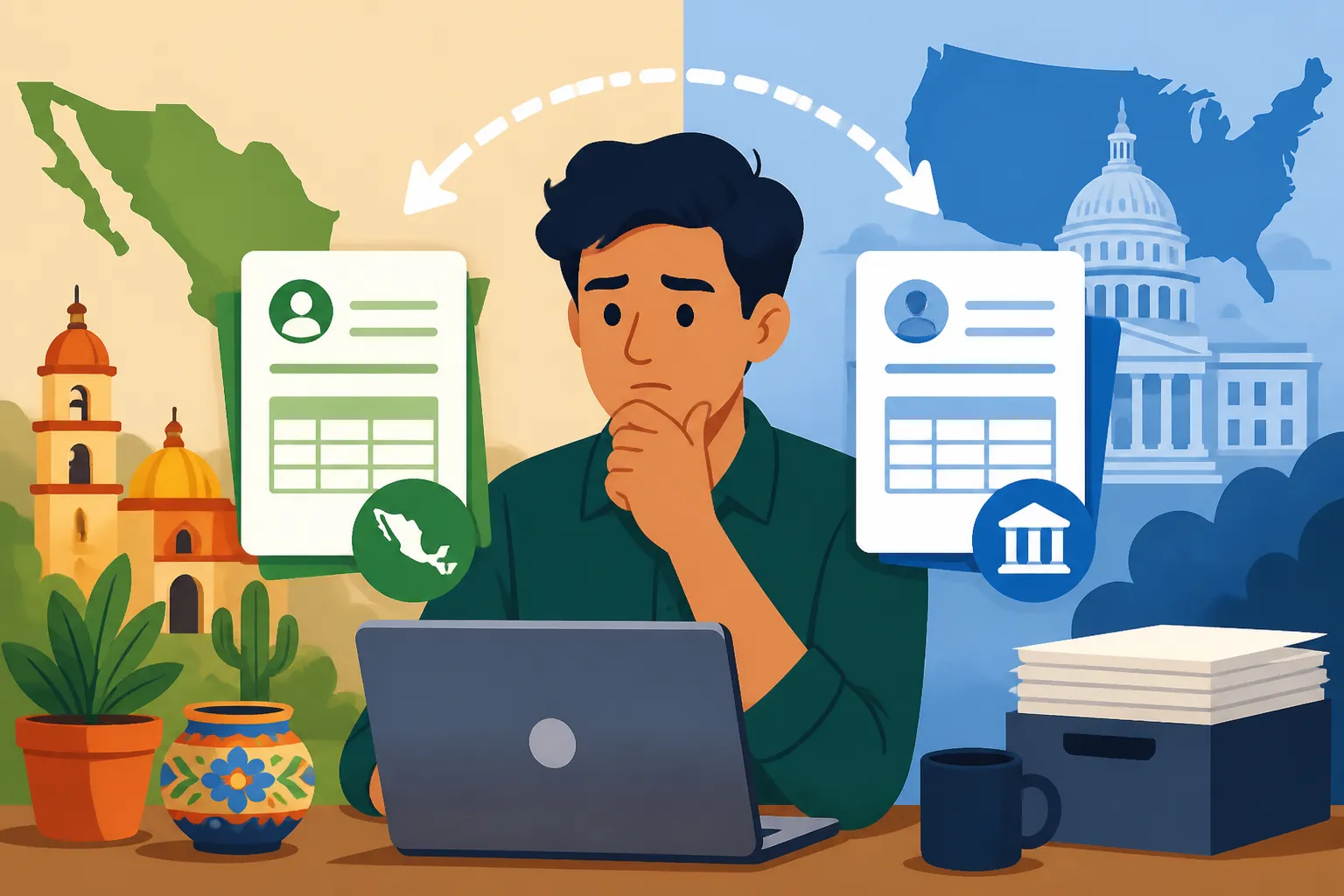
Self-Employed in Mexico, American on Paper: SE Tax and the Double Filing Problem
So, you’ve decided to take the leap, embracing the vibrant expat life in Mexico and carving out your own path as a self-employed individual. It’s an incredibly exciting prospect, filled with the promise of more freedom and a better work-life balance south of the border. But let's be real: as an American living and working for yourself here, that dream can quickly turn into a headache when tax season rolls around. Trying to figure out the labyrinthine tax systems of two countries, especially with the added layer of self-employment, can feel like you’re trying to solve a Rubik’s Cube while blindfolded. This guide is here to untangle that knot for you, focusing on the specific challenges of self-employment tax and the infamous "double filing problem" so you can navigate your taxes for expats with confidence.
Disclosure: This post may contain affiliate links. We may earn a commission at no extra cost to you if you make a purchase through these links. Read full disclosure.
The Allure of Self-Employment in Mexico and Its Inherent Tax Complexities
Many of us came to Mexico dreaming of being our own boss. Maybe you’re a freelance writer sipping a café con leche in a charming Oaxaca plaza, a web developer coding from a co-working space in Guadalajara, or a consultant meeting clients in Mexico City. The flexibility, the lower cost of living, the incredible culture – it’s all part of the appeal. You can work for clients anywhere in the world, often for dollar-denominated rates, while enjoying peso-denominated expenses. It sounds idyllic, right?
But then the reality of taxes hits. When you're self-employed, you're not just dealing with income tax; you're also responsible for things like social security and Medicare contributions, which the IRS calls "Self-Employment Tax." And if you’re an American, Uncle Sam doesn't care if you're living in Mexico, Timbuktu, or on the moon – he still expects his share. This dual obligation, coupled with Mexico’s own burgeoning tax framework for small businesses and freelancers, creates a very unique and often overwhelming situation. It's a journey that demands careful planning and a solid understanding of how both systems interact, or rather, clash.
The Dream Meets Reality: Why Self-Employment Taxes Are Different
When you were an employee in your home country, taxes were largely handled by your employer. They withheld income tax, half of your social security, and Medicare contributions directly from your paycheck. You just got a net amount. As a self-employed individual, you become the employer and the employee. This means you're now responsible for the full 15.3% Self-Employment (SE) tax (Social Security and Medicare), in addition to your regular income tax. This isn't just an administrative burden; it’s a significant financial commitment that many new freelancers don't fully anticipate, especially when they’re also trying to understand Mexico's tax structure.
This is where the dream of freedom can start to feel a bit like a bureaucratic cage. The beautiful colonial architecture suddenly seems less charming when you’re wrestling with online tax forms in a language you’re still learning. Many expats mistakenly believe that if they're earning money from foreign clients, they don't have to report it back home, or that Mexico's lower cost of living magically translates to lower tax obligations without any effort. Unfortunately, that's rarely the case. Properly understanding and managing your taxes for expats is not just about compliance; it's about protecting your financial future and ensuring your continued legal residency in Mexico.
Common Misconceptions About Expat Self-Employment Taxes
One of the biggest misconceptions is the belief that if you earn under a certain threshold from non-Mexican clients, you're off the hook for Mexican taxes. This isn't accurate. If you are a tax resident in Mexico (which is usually determined by where your center of vital interests lies, i.e., where you spend most of your time, where your family lives, where your home is, etc.), you are generally taxable on your worldwide income in Mexico. The same goes for the U.S. – regardless of where you live, if you're a U.S. citizen or green card holder, you're subject to U.S. taxation on your worldwide income.
Another common myth is that if you declare income in Mexico, you don't need to declare it in the U.S., or vice versa. This leads directly to the "double filing problem" we’ll delve into. The reality is that both countries have a claim to your income, and it's up to you to navigate the mechanisms in place (like tax treaties, exclusions, and credits) to avoid paying tax twice on the same income. Ignoring one side of the equation can lead to significant penalties, both from the IRS and the SAT (Mexico's tax authority). Getting proactive expert help with taxes for expats is your best defense against these pitfalls.
Understanding Your Dual Tax Obligations: US and Mexico
For American expats running their own show in Mexico, the phrase "dual tax obligations" isn't just a catchy term; it's a stark reality. You're effectively a taxpayer in two different jurisdictions, each with its own set of rules, deadlines, and demands. This isn't inherently bad, but it requires a strategic approach. Your income, wherever it's earned, is generally under the scrutiny of both the Mexican Servicio de Administración Tributaria (SAT) and the U.S. Internal Revenue Service (IRS).
The goal here isn't to pay double tax, but to understand how to comply with both while minimizing your overall tax burden. This is precisely why specialized advice on taxes for expats is so valuable, as it helps you apply the correct rules and mechanisms to prevent undue financial strain.
What Does it Mean to Be a Tax Resident in Mexico?
Becoming a tax resident in Mexico is a crucial first step in understanding your obligations. Generally, if you establish your casa here, you live here for more than 183 days in a calendar year (even if not consecutive), and your principal center of vital interests (where your primary economic activities or family are located) is in Mexico, then you are likely considered a tax resident by the SAT. This means that, in principle, Mexico expects you to declare your worldwide income to them.
This can be a significant shift for many expats who might have initially come on a tourist visa or a non-lucrative temporary residency, not realizing the implications once they started earning income. Once you have a temporary or permanent residency visa, it often signals to the Mexican authorities that you intend to make Mexico your home, further solidifying your tax residency status. Failing to register with the SAT or report income when you are a tax resident can lead to penalties and complicate future immigration processes. This is a common area where many self-employed expats inadvertently run into trouble.
The Ever-Present Hand of the IRS: Worldwide Taxation for Americans
Now, let's talk about the U.S. The U.S. is one of only two countries in the world (the other being Eritrea) that taxes its citizens and green card holders on their worldwide income, regardless of where they live. This means even if you’re happily settled in Cancún and meticulously paying your Mexican taxes, the IRS still expects you to file an annual U.S. tax return. This is non-negotiable.
This applies to all types of income: wages, investment income, and yes, your self-employment earnings. For self-employed individuals, this also includes the dreaded U.S. Self-Employment (SE) tax, which covers Social Security and Medicare. Many expats are shocked to learn that even if their foreign earned income is excluded from income tax using mechanisms like the Foreign Earned Income Exclusion (FEIE), it is generally not excluded from the U.S. Self-Employment tax. This distinction is critical and often overlooked, leading to unexpected tax bills. Navigating these unique U.S. expat tax rules is a core part of managing your taxes for expats.
Navigating Mexican Tax Requirements for Self-Employed Expats
Alright, let's zoom in on the Mexican side of things. Once you're considered a tax resident and you're running your own show, you absolutely need to get familiar with the SAT. They’re Mexico’s tax authority, and while they might seem intimidating, understanding their processes is key to smooth sailing. The good news is that Mexico has made strides in simplifying the tax regime for small businesses and freelancers, but it still requires diligence.
Dealing with the SAT can feel like a riddle wrapped in an enigma, especially if your Spanish isn’t top-notch. Many expats find themselves staring blankly at online portals or trying to decipher acronyms. This is precisely where investing in expert help with taxes for expats can literally save you hours of frustration and potential penalties.
Registering with the SAT and Obtaining an RFC
The very first step for any self-employed individual in Mexico is to register with the SAT and obtain your Registro Federal de Contribuyentes (RFC). Think of the RFC as your tax ID number, similar to a U.S. Social Security Number for individuals, but specifically for tax purposes. Without an RFC, you cannot legally operate as a self-employed person, issue facturas (electronic invoices), or receive payments from Mexican clients.
The process of getting your RFC generally involves an appointment at a local SAT office. You’ll need your residency card, passport, and potentially other documents. The SAT will issue you a provisional RFC, and you’ll then need to complete a process to get your Firma Electrónica Avanzada (e.Firma) and access to the online portal. This e.Firma is critical as it allows you to sign documents and file taxes electronically. Many expats find the initial registration and e.Firma process daunting due to language barriers and the detailed requirements. Don't underestimate this step; it's the foundation of your legal financial life in Mexico. How to Get an RFC in Mexico is a great resource if you're tackling this.
Understanding the RESICO Regime for Simplified Taxation
For many self-employed expats, the Régimen Simplificado de Confianza (RESICO) is a game-changer. Introduced to simplify taxation for small taxpayers, RESICO offers a highly attractive, simplified tax calculation based on gross income, with very low tax rates that can range from 1% to 2.5% for individuals. This is a significant advantage compared to the previous regimes, which involved more complex deductions and calculations.
To qualify for RESICO, you typically need to be an individual operating a business or providing professional services, and your annual income cannot exceed a certain threshold (which is subject to change, so always check the current figures). You also cannot have certain other types of income (like owning a business with other partners) or exceed a specific income from other activities. If you meet the criteria, enrolling in RESICO can dramatically reduce your Mexican income tax burden and simplify your monthly and annual filings. It's a key piece of the puzzle when managing your taxes for expats here. Learning how to navigate it, however, still requires some expertise. You can find more details in The RESICO Tax Regime in Mexico Explained.
Monthly Filings and Facturas
As a self-employed individual under RESICO (or other regimes), you'll typically be required to file monthly declarations. This involves reporting your income and any relevant Value Added Tax (IVA) collected. Even if you're only working with foreign clients and not charging Mexican IVA, you still need to file these monthly declarations, often reporting zero IVA if applicable.
A crucial aspect of self-employment in Mexico is the factura electrónica, or e-invoice. If you have Mexican clients, you are legally required to issue these electronic invoices for your services. The SAT has a robust system for generating and validating these facturas, and they're essential for your clients to deduct your services as an expense. Even if all your clients are outside Mexico, you might need to generate facturas for foreign transactions to properly report your income to the SAT. This is another area where many expats rely on a local contador (accountant) who specializes in taxes for expats to ensure compliance. How to Issue a Factura (CFDI) in Mexico can give you a head start.
The American Side: Self-Employment Tax and the FEIE/FTC
Now we switch gears back to the U.S. tax landscape. Just because you're living your best life in Mexico doesn't mean the IRS forgets about you. As mentioned, U.S. citizens and green card holders are taxed on their worldwide income. For the self-employed, this brings two major considerations: the U.S. Self-Employment tax and the tools designed to prevent double taxation, primarily the Foreign Earned Income Exclusion (FEIE) and the Foreign Tax Credit (FTC).
Understanding how these mechanisms work together – or sometimes, conflict – is crucial for minimizing your overall tax liability. This is truly where expert guidance on taxes for expats becomes indispensable, as messing this up can be costly.
Understanding U.S. Self-Employment Tax
The U.S. Self-Employment (SE) tax is essentially your contribution to Social Security and Medicare, which you'd normally have withheld from an employee paycheck. When you’re self-employed, you pay both the employer and employee portions, totaling 15.3% on your net earnings up to a certain income threshold (for Social Security) and an unlimited amount for Medicare. This tax is applied to your net self-employment earnings, meaning your gross income minus your legitimate business expenses.
This is where it gets tricky for expats: unlike regular U.S. income tax, the SE tax is generally not covered by the Foreign Earned Income Exclusion (FEIE). This means that even if you exclude a large portion of your income from U.S. income tax, you'll likely still owe the full 15.3% SE tax on your self-employment earnings, provided you meet the minimum income thresholds. This often comes as a surprise to self-employed expats and can be a significant portion of their U.S. tax bill. It’s a bitter pill to swallow when you're already contributing to Mexico's social security system (if you've chosen to do so).
Foreign Earned Income Exclusion (FEIE) vs. Foreign Tax Credit (FTC)
These are the IRS's primary tools to prevent Americans from paying income tax twice on the same income.
The Foreign Earned Income Exclusion (FEIE):
The FEIE allows you to exclude a significant portion of your foreign earned income from U.S. income tax. To qualify, you must meet either the Physical Presence Test (be outside the U.S. for 330 full days in a 12-month period) or the Bona Fide Residence Test (be a bona fide resident of a foreign country for an uninterrupted period that includes an entire tax year). This can be a huge benefit, especially for those with moderate to high incomes. However, remember the caveat: FEIE does not exclude your income from U.S. Self-Employment tax. It also impacts how your remaining, non-excluded income (if any) is taxed, pushing it into higher tax brackets.
The Foreign Tax Credit (FTC):
The FTC allows you to claim a dollar-for-dollar credit against your U.S. income tax liability for income taxes you’ve paid to a foreign government. This is often a better option for self-employed individuals with higher incomes or those paying significant foreign income taxes, because unlike the FEIE, the FTC can offset your U.S. Self-Employment tax indirectly if structured correctly. When you use the FTC, you don't exclude the income; instead, you take credit for taxes paid to Mexico. This is often more beneficial if your Mexican income tax rate is similar to or higher than your U.S. rate, allowing you to reduce or even eliminate your U.S. income tax liability.
Deciding between FEIE and FTC is one of the most critical decisions for a self-employed expat, and it depends heavily on your specific income, expenses, and Mexican tax liability. There isn't a one-size-fits-all answer, and choosing incorrectly can cost you. This is a prime example of why getting specialized help with taxes for expats is an investment, not an expense. You can learn more about this by consulting US Taxes for Americans Living in Mexico or Declaring Foreign Income in Mexico: Tax Rules for Expats.
The Dreaded Double Filing Problem and How to Mitigate It
Here's where the rubber meets the road. The "double filing problem" isn't necessarily about paying double tax (though it can feel that way with the SE tax), but about the complexity of having to report and comply with two different tax authorities. It's the mental and administrative burden of navigating parallel systems, each with its own language, deadlines, and required documentation.
For many Americans self-employed in Mexico, the stress of this dual obligation is a major pain point. It requires not just understanding the rules of both countries but also knowing how to make them "talk" to each other effectively so you can avoid penalties and keep more of your hard-earned money. Tackling the double filing problem effectively is a hallmark of good taxes for expats management.
The Impact of U.S. Self-Employment Tax on Your Overall Burden
As we discussed, the U.S. Self-Employment tax is a significant component of your tax bill as a freelancer, independent contractor, or business owner. This 15.3% tax on your net self-employment earnings (for Social Security and Medicare) is generally applied regardless of whether you're using the FEIE for your U.S. income tax. This can feel like a "double tax" in spirit, even if not explicitly by definition, especially if you're also contributing to the Mexican social security system (IMSS) through voluntary enrollment or as a formal employer of staff.
Many expats find themselves grappling with this specific burden, as it means a sizable portion of their income is earmarked for U.S. social programs, even as they participate in or benefit from Mexican ones. It underlines the importance of accurate income and expense tracking, as reducing your net self-employment income through legitimate business deductions can directly lower your SE tax liability. Every dollar in valid business expense reduces your taxable income, and consequently, your SE tax, which is why meticulous record-keeping is so important.
Mexico-U.S. Tax Treaty: What It Covers and What It Doesn’t
Mexico and the U.S. do have an income tax treaty in place. This treaty is designed to prevent double taxation of income and to clarify which country has the primary right to tax certain types of income. For self-employed individuals, the treaty generally states that if you are a resident of one country and earn income from self-employment activities, the other country (your home country) can only tax that income if you have a "permanent establishment" in that other country.
However, it's crucial to understand that tax treaties primarily address income tax and usually do not cover social security or self-employment taxes. This is why the U.S. SE tax remains a persistent obligation for American expats, even with a tax treaty in place. While the treaty helps ensure you don't pay U.S. income tax on income already taxed in Mexico (by allowing you to apply the Foreign Tax Credit effectively), it doesn’t eliminate the distinct U.S. social security and Medicare obligations. Understanding the nuances of the treaty, and its limitations regarding SE tax, is vital for managing your overall taxes for expats.
Strategies to Minimize the Double Filing Burden
So, how do you mitigate this complex situation? Here are some key strategies:
- Work with Specialized Accountants: This is non-negotiable. You need a U.S. expat tax specialist who understands both U.S. and Mexican tax principles, or at the very least, a U.S. expat tax expert and a Mexican contador who can work together. They can help you determine whether the FEIE or FTC is best for your situation, ensure proper classification of income and expenses, and correctly apply treaty benefits.
- Meticulous Record-Keeping: Keep detailed records of all your income and expenses for both countries. This means invoices, bank statements, receipts (especially facturas for Mexico), and expense logs. Good records are your best friend for maximizing deductions and proving compliance to both the IRS and the SAT.
- Strategic Use of Deductions: Understand what deductions are available in both countries. In Mexico, legitimate business expenses reduce your RESICO taxable income. In the U.S., business expenses reduce your net self-employment income, thereby lowering your SE tax liability.
- Consider Voluntary IMSS Enrollment: If you’re self-employed in Mexico, you may consider voluntary enrollment in IMSS (the Mexican social security system). While this doesn't directly eliminate your U.S. SE tax, it provides access to healthcare and other benefits in Mexico. It also adds a layer of formal employment that sometimes simplifies things, though it's not a substitute for U.S. SE tax.
- Estimated Tax Payments: The U.S. expects quarterly estimated tax payments, and Mexico monthly provisional payments, from self-employed individuals. Failing to make these can result in penalties. Your tax advisor can help you calculate and schedule these payments.
- Understand Your Residency Status: Clearly define your tax residency in both countries. This impacts where certain income is primarily taxed and how treaty benefits apply.
By employing these strategies, you can turn a potentially chaotic "double filing problem" into a manageable, albeit complex, annual process.
Essential Strategies for Tax Compliance: Why Expert Help is Key
Successfully navigating the self-employment tax landscape for American expats in Mexico is a marathon, not a sprint. It requires foresight, accurate record-keeping, and a willingness to engage with both tax systems. While it might seem like a daunting task, approaching it systematically and leveraging the right resources can make all the difference. The ultimate goal is not just to file your taxes, but to ensure you're doing so efficiently and legally, minimizing your overall tax burden, and enjoying your expat life to the fullest without financial surprises.
This is precisely why one piece of advice stands above all others: don't go it alone. The complexities of dual taxation for self-employed individuals are significant enough that professional guidance is almost always a worthwhile investment. This isn't just about handing over your receipts; it's about strategic planning and ensuring long-term compliance.
The Indispensable Role of a Specialized Tax Professional
Let’s be honest: trying to parse the intricacies of U.S. expat tax law, particularly Self-Employment tax, alongside Mexico's SAT regulations like RESICO, is enough to make anyone’s head spin. That’s why the most crucial strategy for self-employed expats is to engage a tax professional specializing in taxes for expats. These experts understand the nuances of both systems and, critically, how they interact (or don’t).
A good expat tax accountant can:
- Determine Your Optimal Strategy: They will analyze your income, expenses, and residency status to advise whether the FEIE or FTC (or a combination) is most beneficial for your U.S. return, especially concerning the SE tax.
- Ensure Mexican Compliance: If they also have expertise in Mexican tax law, or work in conjunction with a local contador, they can guide you through SAT registration, RESICO enrollment, monthly filings, and factura generation.
- Maximize Deductions: They know the allowable business deductions in both countries, helping you legally reduce your taxable income and, therefore, your tax liability.
- Prevent Penalties: They keep up-to-date with changing tax laws and deadlines, ensuring you avoid costly penalties from both the IRS and the SAT.
- Provide Peace of Mind: Knowing your taxes are handled correctly by someone who understands the unique expat situation is invaluable for your mental well-being.
Consider this not just an expense, but an investment in your financial security and your precious time. How to Find an English-Speaking Accountant (Contador) in Mexico is a good place to start your search.
Building Your Financial Toolkit: Systems and Habits
Beyond professional help, successful tax management for self-employed expats relies heavily on building good habits and utilizing the right tools.
- Dedicated Bank Accounts: Keep your personal and business finances separate. This simplifies tracking income and expenses immensely. Consider opening a Mexican bank account for your local transactions and potentially another account (or maintaining your home country account) for your international income. How to Open a Bank Account in Mexico: Requirements and Tips provides guidance.
- Digital Record-Keeping: Implement a system for digitizing all your receipts and invoices. Cloud storage, accounting software (like QuickBooks, Xero, or even simple spreadsheets), or expense tracking apps can save you countless hours during tax season. Mexico's SAT system is very digital, so embracing this will serve you well.
- Regular Review: Don't wait until April to think about taxes. Set aside time quarterly or monthly to review your income and expenses, make estimated tax payments, and check in with your tax professional. This proactive approach prevents last-minute scrambles and helps you identify potential issues early.
- Understand Your Benefits: As a self-employed individual, you might be eligible for various deductions that others are not, such as home office expenses, professional development, and travel for business. Make sure you understand these and keep records to substantiate them.
| Feature | U.S. Income Tax (Worldwide) | U.S. Self-Employment Tax (Worldwide) | Mexican Income Tax (RESICO for individuals) |
|---|---|---|---|
| Applies To | U.S. Citizens/Green Card Holders | U.S. Self-Employed Individuals | Mexican Tax Residents (on worldwide income) |
| Covers | Income from all sources | Social Security & Medicare | Income from all sources |
| Rate Structure | Progressive Tax Brackets | Flat 15.3% (up to thresholds) | Simplified 1-2.5% on gross income for RESICO |
| FEIE Impact | Can exclude up to a certain amount | Generally NO exclusion | Not directly applicable |
| FTC Impact | Can credit foreign taxes paid against U.S. tax | Can indirectly offset U.S. income tax, freeing up credit for SE tax | Not directly applicable |
| Treaty Impact | Prevents double income taxation | Generally NOT covered by treaty | Prevents double income taxation |
| Compliance Body | IRS | IRS | SAT |
| Annual Filing | Mandatory | Mandatory | Monthly & Annual Filings (for self-employed) |
Looking Ahead: Strategic Planning for the Future
Living as a self-employed expat in Mexico is an amazing adventure, but like any adventure, it comes with challenges. Being proactive about your taxes for expats is not just about avoiding trouble; it’s about empowering yourself to truly enjoy your life here. As your income grows, or as your business evolves, your tax situation might change. What worked well for a few years might not be the most optimal strategy down the line.
Therefore, make tax planning an ongoing conversation with your specialist. They can help you with long-term financial strategies, such as understanding how your tax residency might impact future investments, retirement planning, or even the process of Moving Money Out of Mexico: How to Repatriate Funds from Property Sales. Staying informed, keeping excellent records, and having trusted experts by your side will ensure that the dream of self-employment in Mexico remains just that: a dream come true, rather than a tax nightmare.
Disclaimer
This article is for general informational purposes only and does not constitute professional advice. Laws, prices and regulations vary by location and change over time. Consult a qualified professional for guidance on your specific situation.