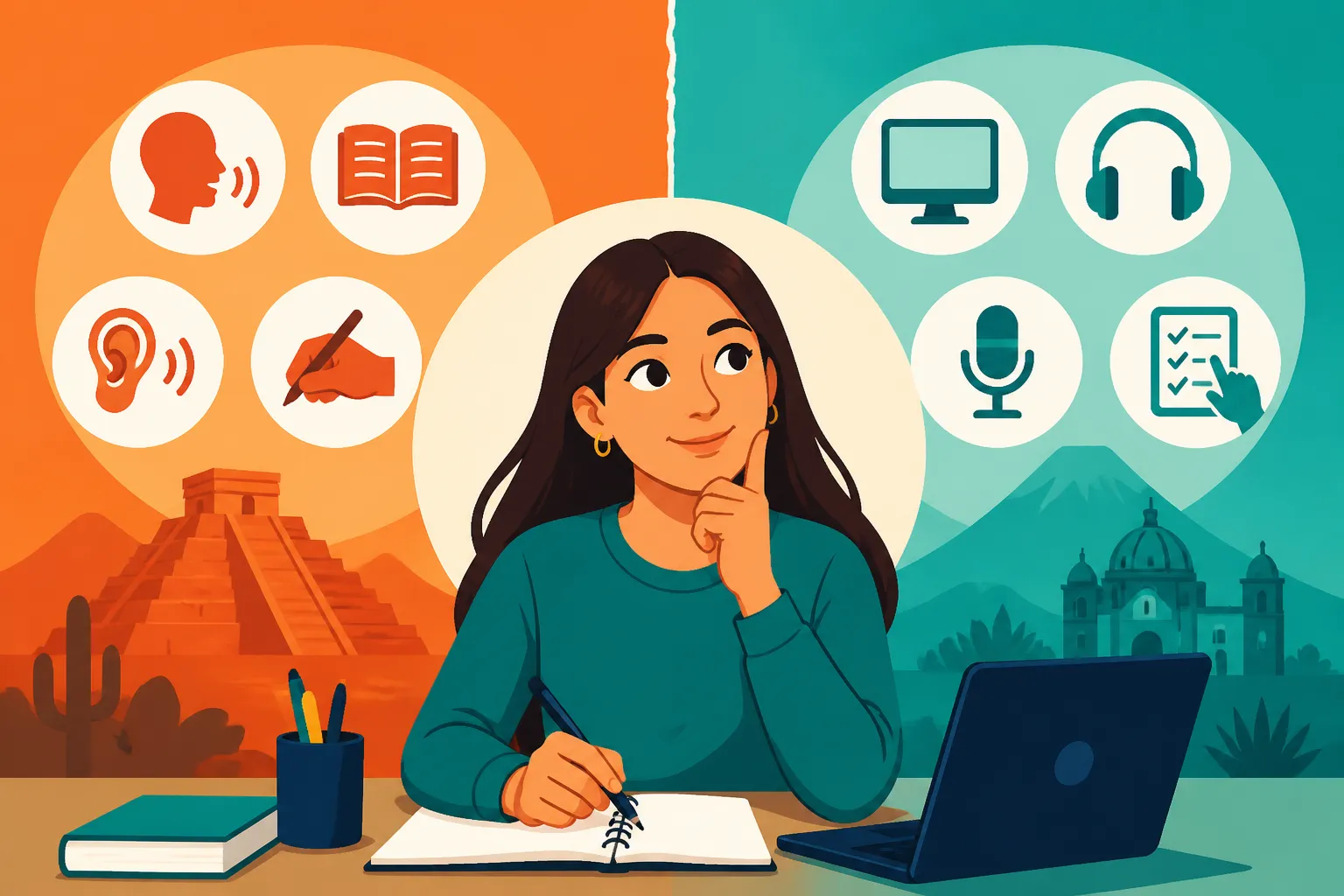
SIELE and CELA Prep: Format Differences and How to Practise Each
Navigating life as an expat in Mexico is an incredible adventure, but let's be honest, the administrative hurdles and language demands can sometimes feel like climbing a volcano in flip-flops. One common challenge many of us face is proving our Spanish proficiency, whether for work, residency, or just to genuinely feel more at home. This comprehensive guide is here to demystify the two most common Spanish proficiency exams you'll encounter in Mexico – SIELE and CELA – by breaking down their formats, scoring, and most importantly, how to practice effectively for each, with a special focus on how personalized language platforms like iTalki can be your secret weapon.
Disclosure: This post may contain affiliate links. We may earn a commission at no extra cost to you if you make a purchase through these links. Read full disclosure.
Understanding the Landscape of Spanish Proficiency Exams in Mexico
When you first arrive in Mexico, you might think "I'll just pick up Spanish as I go!" And while that's part of the journey, sometimes you hit a wall where formal recognition of your language skills becomes essential. These exams aren't just for academics; they can be real game-changers for your expat life.
Why Take a Spanish Proficiency Exam in Mexico?
It's easy to dismiss formal exams when you're already communicating day-to-day, but trust me, there are tangible benefits that go beyond simply ordering tacos. Many expats find themselves needing to prove their Spanish for very practical reasons. For instance, some companies, especially those with local Mexican management or client bases, might require a certain level of Spanish proficiency, even if your daily work is in English. This isn't about doubting your skills, but about ensuring you can integrate seamlessly into the local business culture.
Beyond the workplace, official language certification can streamline certain administrative processes. While not always explicitly mandated for all visas, demonstrating proficiency can certainly smooth interactions with government agencies like INM (Mexico's immigration institute) or SAT (the tax authority). It shows a proactive effort to integrate and understand the local system, which is always looked upon favorably. More than that, passing one of these exams is a massive confidence booster. It validates all those hours you’ve spent wrestling with conjugations and trying to grasp rapid-fire conversations. It’s a tangible marker of your progress on this incredible journey of Learning Spanish in Mexico: Top Tips and Resources for Expats. It can open doors to deeper friendships, richer cultural experiences, and a greater sense of belonging beyond just the expat bubble. You'll move from merely surviving to genuinely thriving, understanding local humor and nuances that often get lost in translation.
The Big Two: SIELE vs CELA – A Quick Overview
When we talk about Spanish proficiency exams for expats in Mexico, two names typically come up: SIELE and CELA. They both aim to assess your Spanish skills, but they do so with different philosophies, formats, and target audiences. Understanding these core differences from the outset is crucial for choosing the right path for your specific goals.
SIELE, or the Servicio Internacional de Evaluación de la Lengua Española, is a globally recognized, technologically-driven exam. Think of it as the more internationally minded, flexible option, often taken online. It measures your ability across a wide spectrum of Spanish-speaking situations, not just those specific to Mexico. CELA, on the other hand, stands for Certificación de la Lengua Española en México, and as its name suggests, it’s specifically designed to evaluate proficiency within the context of Mexican Spanish and culture. It's often the exam of choice if your primary goal is deeper integration into Mexican academic or professional environments, as it assesses cultural understanding and regional linguistic nuances that SIELE might not emphasize as much. One is a broader, international passport; the other is a more focused, local key.
Diving Deep into SIELE: Format, Scoring, and Practice Strategies
The SIELE exam has gained significant traction worldwide due to its flexibility and comprehensive assessment. It’s a fantastic option if you need internationally recognized proof of your Spanish, or if you prefer a modern, digital testing experience.
The Flexible Friend: Understanding the SIELE Format
What makes SIELE particularly attractive is its modular nature and fully digital format. Unlike some traditional paper-based exams, you take SIELE on a computer, and the results are typically available much faster. It's recognized by many universities and companies globally, making it a versatile credential.
The exam is divided into four main tests, corresponding to the four key language competencies:
- Reading Comprehension (CL): This section assesses your ability to understand written texts of varying difficulty, from everyday notices to more complex articles. You'll encounter multiple-choice questions, matching exercises, and tasks that require you to extract specific information.
- Listening Comprehension (CA): Here, you'll listen to audio recordings, such as conversations, news reports, or lectures, and answer questions based on what you hear. The accents can vary, reflecting the diversity of the Spanish-speaking world, which is great for general proficiency but might be a slight curveball if you've only practiced one accent.
- Written Expression and Interaction (EIE): This test requires you to produce written texts, such as emails, essays, or summaries, following specific prompts. You're evaluated on your grammar, vocabulary, coherence, and ability to fulfill the communicative task.
- Oral Expression and Interaction (EOI): This is often the most daunting part for many expats. You'll complete several spoken tasks, which are recorded and later evaluated by certified examiners. These tasks might include describing an image, answering questions about a topic, or role-playing a conversation. This is where your ability to articulate thoughts spontaneously and interact verbally comes into play.
A unique feature of SIELE is that you can choose to take the Global SIELE (which includes all four tests) or specific modalities (e.g., just the speaking and writing tests if that's what you need to certify). This flexibility is a huge advantage, allowing you to tailor the exam to your specific requirements, whether it's for Studying in Mexico: Guide for International Students (Universities and Programs) or a job application.
Scoring and What it Means for You
SIELE uses a comprehensive scoring system that is aligned with the Common European Framework of Reference for Languages (CEFR) levels (A1, A2, B1, B2, C1). Each of the four tests is scored on a scale from 0 to 250 points, for a total maximum score of 1000 points for the Global SIELE.
Your overall score, and the individual scores for each section, directly correlate to a specific CEFR level. For example, to achieve a B2 level, you'll need a certain cumulative score across all sections, along with minimum scores in each component. This breakdown is incredibly useful because it clearly shows your strengths and weaknesses. If you score highly in Reading but lower in Oral Expression, you know exactly where to focus your future study efforts. The digital nature of the exam also means results are usually quite fast, often within three weeks, which is a blessing if you're on a tight deadline for a visa application or a job offer. The certificate you receive is valid for five years, giving you a good window before needing to recertify.
Practicing for SIELE: Your Digital Path to Success
Given SIELE's digital and globally-focused format, your practice strategies should leverage online resources and aim for broad applicability. The official SIELE website offers model exams and guides, which are a great starting point to familiarize yourself with the interface and question types. Look for online platforms that offer timed practice tests to simulate exam conditions, helping you manage your time effectively in each section.
For reading and listening comprehension, expose yourself to a wide variety of Spanish content from different regions. Read newspapers from Spain, listen to podcasts from Argentina, and watch documentaries from Mexico. This broad exposure will sharpen your understanding of diverse accents and writing styles. However, the biggest challenge for many is often the spoken and written components. This is where personalized platforms truly shine. Using a tool like iTalki can be a game-changer. On iTalki, you can find native Spanish tutors from all over the world who specialize in exam preparation. You can specifically request a tutor to simulate the SIELE speaking tasks, recording your responses and providing immediate, constructive feedback on pronunciation, grammar, fluency, and coherence. They can also review your written assignments, pointing out areas for improvement in structure, vocabulary, and grammar. The beauty of iTalki is that it allows for flexible scheduling and one-on-one attention, something that a large classroom setting simply cannot offer for targeted exam prep. This individualized feedback is invaluable for honing the precise skills needed to excel in SIELE's production tasks.
Decoding CELA: Structure, Evaluation, and Effective Preparation
While SIELE is your global passport, CELA is your key to truly unlocking the nuances of Spanish here in Mexico. If your life in Mexico is deeply embedded in local culture, work, or academics, understanding CELA is paramount.
The Mexican Standard: Understanding the CELA Format
The CELA exam, specifically developed to certify proficiency in Mexican Spanish, focuses heavily on the cultural and linguistic context unique to this country. It's generally taken in-person at designated institutions throughout Mexico, making it a less flexible but more locally relevant option. Unlike SIELE's modularity, CELA often presents as a more integrated exam, demanding not just linguistic skill but also cultural awareness.
While the exact structure can vary slightly between different certifying bodies or specific CELA versions (some institutions like UNAM or specific language schools might have their own CELA-like assessments), common components usually include:
- Reading and Cultural Comprehension: This section goes beyond general Spanish texts, often featuring articles, literature excerpts, or public notices with a strong Mexican context. You might need to interpret idiomatic expressions or cultural references specific to Mexico.
- Listening Comprehension: Here, you'll predominantly hear Mexican accents and dialogues. This is where your ear for local nuances, common phrases, and regional speech patterns will be tested. Conversations might revolve around typical Mexican scenarios, from market interactions to discussions about national holidays.
- Grammar and Vocabulary in Context: This section often includes fill-in-the-blank exercises, sentence transformation, and error correction, all within the framework of standard Mexican Spanish usage. It’s less about abstract grammar rules and more about how they apply in real Mexican conversations.
- Written Expression and Interaction: You'll be asked to write emails, formal letters, or essays on topics relevant to Mexican society or current events. This tests your ability to express yourself appropriately and accurately within a Mexican communicative context.
- Oral Expression and Interaction: Often conducted as a direct interview or a series of interactive tasks with an examiner, this part of CELA assesses your fluency, pronunciation, and ability to engage in natural conversation using Mexican Spanish. You might discuss Mexican traditions, social issues, or personal experiences living in the country. This is where demonstrating your understanding of Mexican Etiquette and Customs: Do's and Don'ts for New Expats truly matters.
The key takeaway is that CELA is not just testing your Spanish; it's testing your Mexican Spanish, including an implicit understanding of cultural norms.
Evaluation: More Than Just Grammar
The evaluation for CELA goes beyond just grammatical accuracy or vocabulary breadth. Examiners are keenly looking for your ability to communicate effectively and appropriately within a Mexican cultural framework. This means:
- Cultural Nuances: Do you understand implicit meanings, common jokes, or specific historical references? Can you use polite forms (like usted) correctly and when appropriate, without sounding stiff or unnatural?
- Practical Communication: The emphasis is often on real-world situations you’d encounter living here. Can you navigate a bureaucratic process? Can you explain a complex idea clearly to a local?
- Local Context: Your ability to use Mexican idioms, slang (when appropriate and understood), and common expressions demonstrates a deeper level of integration. It's about demonstrating that you’re not just speaking Spanish, but speaking Mexican.
This focus on local context can be a pleasant surprise for those who have immersed themselves in Mexico, but a significant challenge for those who have primarily studied Castilian or other Latin American dialects. It truly highlights your progress in Living in Mexico with Limited Spanish: Survival Tips for Language Barriers and your efforts to truly adapt.
Preparing for CELA: Embracing the Local Flavor
Preparing for CELA requires a more localized approach than SIELE. While general Spanish practice is always good, you need to immerse yourself specifically in Mexican Spanish. Start by consuming Mexican media: watch telenovelas, listen to Mexican radio and podcasts (e.g., La Corneta, Relatos de la Noche), and read Mexican newspapers like El Universal or Reforma. This will attune your ear and eye to common expressions and cultural topics.
Taking classes at a local language school in Mexico can be incredibly beneficial, as they often teach Mexican Spanish and prepare students specifically for local certification exams. However, for that crucial one-on-one practice, platforms like iTalki are indispensable. When you search for a tutor on iTalki, you can filter by nationality. This allows you to find tutors who are native speakers from Mexico. These tutors can help you with specific CELA challenges:
- Local Idioms and Slang: They can teach you common phrases and expressions used daily in Mexico, and crucially, when it’s appropriate (and not appropriate!) to use them.
- Cultural Discussions: Engage in conversations about Mexican history, traditions, food, or current events. This not only builds vocabulary but also enhances your cultural understanding, which is vital for the exam.
- Pronunciation and Accent: A Mexican tutor can help you refine your accent to sound more natural to local ears, a factor that can positively influence your oral exam score.
- Role-Playing Scenarios: Practice typical Mexican interactions, like making an appointment, describing a local festival, or politely disagreeing in a professional setting. This targeted practice with a native Mexican speaker on iTalki will give you an edge by directly addressing the cultural and linguistic specifics CELA demands.
Choosing Your Path and Maximizing Your Study Time
Deciding which exam to take and how to prepare can feel overwhelming, but a clear understanding of your goals and a smart study plan will make all the difference.
Which Exam is Right for You?
The choice between SIELE and CELA really boils down to your personal goals and where you are in your expat journey. Think about what you need the certification for.
If you’re aiming for international academic programs, remote work for a global company, or simply want a widely recognized certification that validates your general Spanish proficiency, SIELE is probably your best bet. Its digital format and flexible modular options are incredibly convenient, especially if your schedule is packed. It’s also great if you prefer to take an exam that isn’t tied to a specific regional dialect.
However, if your life is rooted in Mexico – you're pursuing higher education at a Mexican university, looking to climb the ladder in a local company, applying for residency (where demonstrating local integration is a plus), or simply want to prove your deep understanding of Mexican culture and language – then CELA is the more appropriate choice. It's tailor-made for the Mexican context and will showcase your commitment to living and thriving here.
Here’s a quick comparison to help you weigh your options:
| Feature | SIELE (Servicio Internacional de Evaluación de la Lengua Española) | CELA (Certificación de la Lengua Española en México) |
|---|---|---|
| Focus | General, international Spanish proficiency | Mexican Spanish, culture, and context |
| Format | Fully digital, online at authorized centers | Typically in-person, paper-based or local digital |
| Delivery | Online, flexible scheduling | Fixed dates, specific test centers in Mexico |
| Recognition | International (universities, companies globally) | Primarily within Mexico (universities, local employers) |
| Modules | Flexible (Global SIELE or independent tests for skills) | Generally integrated, less modular |
| Accent/Dialect Focus | Pan-Hispanic (various accents) | Predominantly Mexican Spanish |
| Results | Fast (often within 3 weeks) | Varies by institution, potentially longer |
| Validity | 5 years | Varies, often similar to SIELE |
Consider your long-term plans in Mexico. Are you here temporarily, or do you envision making this your permanent home? Your answer will often guide you to the more suitable exam.
The Power of Personalized Practice: How iTalki Transforms Your Prep
No matter which exam you choose, the key to success lies in consistent, targeted practice. While self-study and group classes have their place, nothing beats the power of personalized, one-on-one sessions, and that's precisely where iTalki shines as an unparalleled resource for SIELE and CELA prep.
Think about it: in a traditional classroom, you might get a few minutes of speaking time or general feedback on a written assignment. With iTalki, you have dedicated time with a native speaker, often an experienced tutor, who can focus solely on your needs. For SIELE, your iTalki tutor can conduct mock oral exams, challenging you with prompts, timing your responses, and then dissecting your performance – pointing out specific grammatical errors, suggesting better vocabulary, and helping you improve your fluency and coherence. They can also review your written essays in detail, explaining why certain phrases work better or how to structure your arguments more effectively for the exam.
For CELA, iTalki becomes even more critical because you can specifically choose tutors from Mexico. These tutors are intimately familiar with the local expressions, cultural nuances, and communicative styles that CELA assesses. They can engage you in conversations about Mexican current events, explain complex idioms, or even role-play scenarios like dealing with Mexican bureaucracy or navigating local markets. This localized expertise on iTalki is invaluable for cracking the cultural code that CELA requires.
The flexibility of iTalki is another huge advantage. You can schedule lessons around your work or family commitments, practice early mornings or late evenings, and even switch tutors if you want exposure to different teaching styles or accents. Plus, the investment is often far more affordable than traditional private tutoring, making high-quality, personalized instruction accessible to more expats. By making iTalki a central part of your study plan, you're not just practicing Spanish; you're receiving tailored coaching that directly addresses the specific demands of your chosen exam.
Beyond the Books: Immersion and Consistency
Beyond formal lessons and targeted exam practice, true proficiency comes from living the language. For those of us living in Mexico, we have an incredible advantage – constant immersion! Make it a point to:
- Speak daily: Engage with your neighbors, the cashier at OXXO, or the vendor at the mercado. Don't be afraid of making mistakes; they are part of the learning process.
- Consume local media: Watch Mexican TV shows and movies without subtitles, listen to Mexican music, and try to follow local news. This naturally introduces you to new vocabulary and cultural contexts.
- Join local groups: Find a book club, a hiking group, or a volunteer organization. This is a fantastic way to practice Spanish in a natural, social setting and build connections.
- Be patient with yourself: Learning a language takes time and dedication. Celebrate small victories and don't get discouraged by plateaus. Consistency is far more important than intensity.
Whether you're aiming for SIELE or CELA, remember that these exams are just benchmarks on your larger journey of integrating into life in Mexico. The real reward is the ability to connect, understand, and truly feel at home in this vibrant country.
Disclaimer
This article is for general informational purposes only and does not constitute professional advice. Laws, prices and regulations vary by location and change over time. Consult a qualified professional for guidance on your specific situation.