Tulum and Coba Ruins: Which Combined Tour Is Actually Worth Booking
If you’re in Cancún, Playa del Carmen or Tulum, you’ve probably seen dozens of “Tulum and Coba in one day” listings that look the same. Some days are great. Others put you on a minibus for most of the daylight hours with only short stops at the ruins. This guide explains how these combined tours actually work and which version suits your trip.
Disclosure: This post may contain affiliate links. We may earn a commission at no extra cost to you if you make a purchase through these links. Read full disclosure.
Why Tulum and Coba Pair So Well and Where They Clash
I’ve done this combination more times than I can count. Some of those were with visiting friends, some with my in-laws, and once with a cousin who insisted on seeing “the pyramid you can see from space” (you can’t). The pairing makes sense on paper. You get two of the most famous Maya sites on the eastern Yucatán Peninsula in one outing, with a cenote swim fitted in somewhere. In practice the two sites are so different that a badly planned tour leaves you rushed at one and bored at the other.
Before you look at a single listing, it helps to know what each site offers. Then you can tell whether a tour respects that or just ticks boxes. For the wider picture of how these sites fit into Maya history, see Maya Ruins in Mexico: Chichén Itzá, Tulum, and Palenque.
Two Very Different Maya Sites
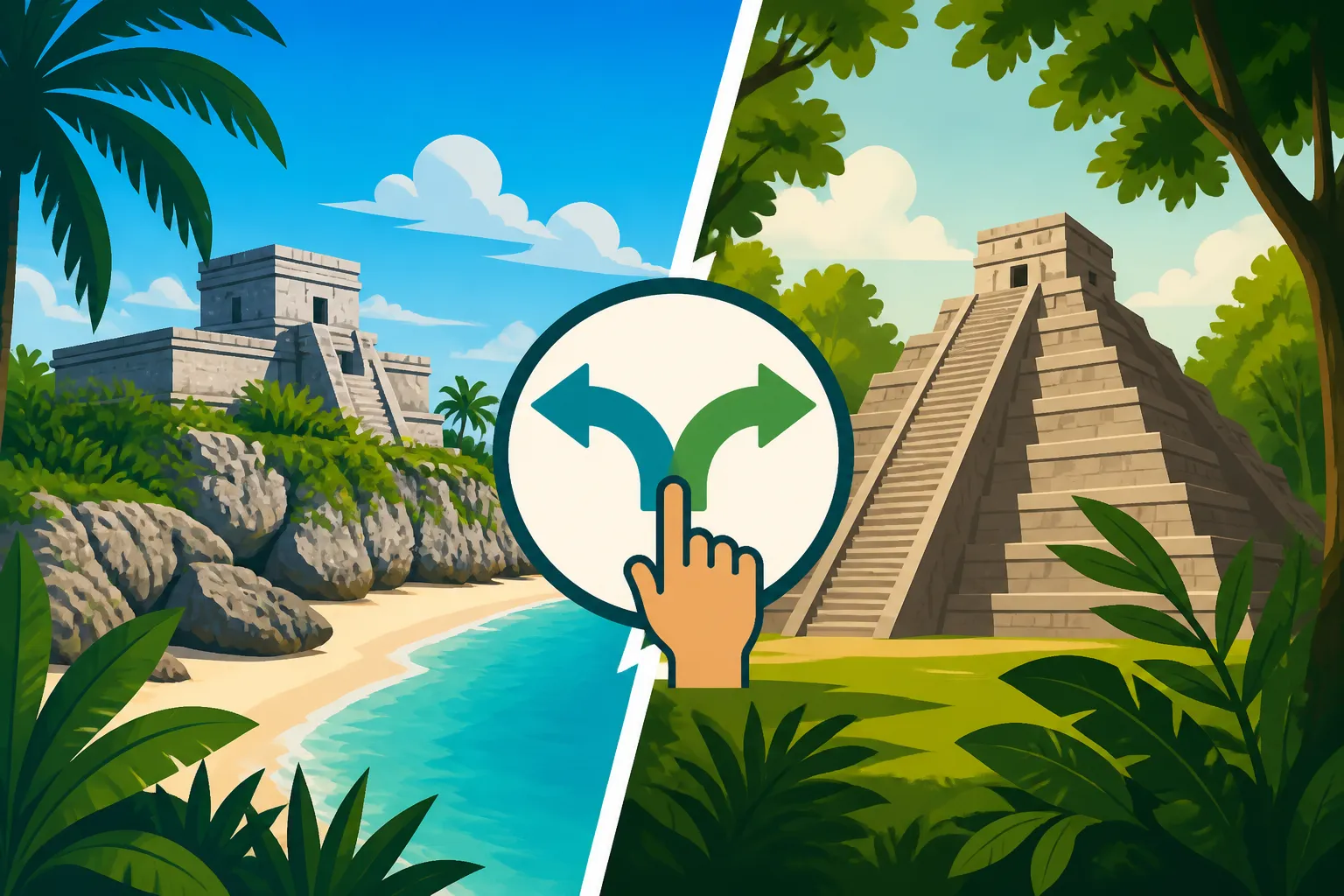
Tulum is the postcard site. It is a walled coastal city on a limestone cliff above turquoise Caribbean water, and El Castillo is the photo everyone wants. The Temple of the Frescoes and the Temple of the Descending God are there too, and iguanas sun themselves on every flat rock. It is compact. You can walk the whole site in an hour to ninety minutes, even if you stop to read every sign. You can’t climb the structures. Ropes keep visitors on set paths, and the experience is about the setting more than exploring.
Coba feels like the opposite. It is a huge, spread-out city in the jungle between two lagoons. Its ruins are linked by sacbeob, the raised white Maya roads. You’ll move between building groups on foot, on a rented bicycle, or in a bicitaxi, a pedal tricycle driven by a local who knows every root on the path. The main pyramid, Nohoch Mul, rises above the canopy and is one of the tallest structures in the northern Yucatán. The ball court, the carved stelae in the Macanxoc group and the shaded paths give Coba a sense of discovery that Tulum doesn’t have.
So a combined tour pairs a short, crowded, sun-exposed coastal site with a large, shaded inland site that needs time. A good tour gives Coba the larger share of the day. A poor one splits the time evenly, or gives Coba less because the bus is behind schedule.
The Geography Problem Nobody Puts on the Brochure
Tulum ruins sit on the coast just outside Tulum town. Coba is inland, roughly forty-five minutes’ drive northwest of Tulum along a two-lane road through small Maya villages. That leg is fine. The real cost of the day is the drive to Tulum from wherever you’re staying.
From Playa del Carmen, Tulum is roughly an hour’s drive. From the Cancún Hotel Zone it’s closer to two hours, before you count the pickup loop around other hotels. Add Coba and the return trip, and a Cancún-based traveler can easily spend five or more hours of a combined tour in a vehicle. That doesn’t make the tour bad. It does mean the advertised total time includes a lot of highway.
I learned this the hard way on my first visit, years before I moved here. I was collected at dawn from a hotel in the Hotel Zone, then spent nearly an hour touring other hotels collecting passengers. We reached Tulum mid-morning, just as the heat and the crowds peaked. I loved the ruins and hated the logistics. Choosing where you start makes a big difference. If you haven’t booked a room yet, Where to Stay in Tulum: Beach Road vs Pueblo on Price and Access covers which part of town makes early starts easiest.
The Main Types of Combined Tulum and Coba Tours
Search Viator for Tulum and Coba and you’ll see what looks like endless variety. Underneath, almost every listing falls into one of a few formats. Once you can spot which one you’re looking at, comparing them gets much easier.
The Classic Tulum, Coba, Cenote, and Village Lunch Day
This is the most common format by far. A typical day looks like this:
- Early hotel pickup in Cancún, Playa del Carmen, or along the Riviera Maya.
- A guided walk through Tulum ruins, followed by some free time for photos.
- A drive inland to Coba, with time to walk, cycle, or ride a bicitaxi to Nohoch Mul.
- A swim in a cenote, often one of the underground or semi-open cenotes near Coba such as Choo-Ha, Tamcach-Ha, or Multum-Ha.
- A buffet lunch in or near a Maya community, sometimes with a short cultural presentation.
- The return drive, often with a stop at a souvenir shop or tequila tasting along the way.
This format works well for first-timers who want to cover a lot in one go. It’s usually the best value per experience. The trade-off is pace. You’re on a group schedule, and the group moves at the speed of its slowest member and its longest pickup.
The village lunch varies a lot. Some are genuine community-run kitchens where local women make handmade tortillas and cochinita pibil, and your money supports families in the area. Others feel more like a canteen built for tour buses, with a performance that seems more for show than for sharing culture. The listing photos and recent reviews usually make clear which one you’re getting. For more on what the cenote stop is worth, see Cenote Tours in the Yucatan: What You Get for the Booking Fee.
Private Driver and Small-Group Itineraries
The second format is a private or small-group tour. You get your own vehicle, sometimes with a certified guide, and you set the pace within an agreed time window. These cost more than shared coach tours, but the difference shrinks a lot when split among four or more people.
What you’re really buying here is control over timing. A private driver can collect you before the coach crowds set off and have you at the Tulum gate when it opens. They can let you spend two full hours wandering Coba on a bicycle, then take you to a quieter cenote. You can skip the souvenir stop entirely, which always earns a cheer from my visiting friends.
Not every private listing includes a guide, though. Some include only a driver who drops you at the gate and waits in the car park. If you want someone to explain the Descending God or the meaning of the Coba stelae, make sure the listing says a licensed guide is included, not just transport. For a straight cost comparison of the two formats, see Private vs Group Tours in Mexico: The Real Price Difference.
Swim-Heavy Versions With Akumal, Xel-Há, or Extra Cenotes
The third format swaps part of the archaeology for water time. Some tours pair Tulum with a turtle snorkel in Akumal Bay instead of visiting Coba. Others pair Tulum or Coba with a full or half day at a park such as Xel-Há. There are also versions built around two or three cenotes, with the ruins as the side attraction.
These are great if your group cares more about swimming than stone. They’re the wrong choice if Coba is the reason you’re booking. Read the title carefully, because “Tulum, Coba and cenotes” and “Tulum, cenotes and Akumal” can look almost identical in a list of search results.
Here’s how the main formats compare on the things that actually affect your day.
| Tour Format | Typical Pace | Time at Coba | Best For | Main Drawback |
|---|---|---|---|---|
| Classic group combo with cenote and lunch | Fast, fixed schedule | Short to moderate | First-timers wanting maximum variety | Long pickup loops and group delays |
| Small-group combo | Moderate | Moderate to generous | Couples who want fewer people and better guiding | Fewer departure dates in low season |
| Private driver with guide | Flexible | As long as you want | Families, photographers, history lovers | Higher cost unless the group is larger |
| Private driver without guide | Flexible | As long as you want | Independent travelers who read up beforehand | No interpretation at the sites |
| Tulum plus Akumal or a park | Relaxed on land, busy in water | None or very brief | Swimmers and snorkelers | Little or no time at Coba |
| Cenote-heavy itinerary | Relaxed | Brief | Hot-weather swimmers, younger groups | Ruins feel like a quick photo stop |
How to Read a Viator Listing for This Tour Without Getting Burned
Viator lists a wide range of operators for this route. There are large established companies with modern air-conditioned coaches, and small family-run outfits with one van and a very proud owner. That range is useful, because you can compare formats, read verified reviews and filter by your hotel area in one place. It also means some reading is needed. These are the details I check every time I book for visitors.
Pickup Zones, Start Times, and the Real Length of Your Day
The first detail to check is where pickup happens. Many listings cover a wide pickup area, from Cancún all the way to Tulum, and the duration shown on the listing is an average. If you’re in Cancún, expect to be at the long end of that range. If you’re in Playa del Carmen or Tulum, you may be picked up later or dropped off earlier.
Look for the meeting point section and the pickup details. Some tours collect you from your hotel lobby. Others ask you to walk to a nearby landmark, such as a convenience store or a main avenue corner, because large coaches can’t get into gated resorts or narrow streets. In Playa del Carmen especially, operators often use meeting points along the main highway or near Quinta Avenida. Knowing this in advance saves a panicked early-morning walk.
Then look at the order of stops. If the itinerary visits Tulum first, check that the start time gets you there reasonably early. Tulum has very little shade, and by late morning the stone reflects heat like an oven. Coba’s jungle canopy is much easier to cope with in the afternoon. The best itineraries do Tulum early and Coba later, and I’d treat that order as a sign the operator understands the route.
What Is Included and What Gets Paid in Cash on the Day
This is where combined tours most often surprise people. The headline price on a listing may or may not include:
- Entrance tickets to Tulum archaeological zone
- Entrance tickets to Coba archaeological zone
- Any additional park or conservation fee charged on the approach to Tulum ruins
- Cenote entry
- Bicycle rental or bicitaxi at Coba
- Lunch and drinks
- Life jackets and snorkel gear at the cenote
- A certified guide versus a driver only
The “What’s included” and “What’s not included” sections on Viator are usually clear if you take a minute to read them. When entrance fees are excluded, the listing normally says so, and you pay at the gate yourself, sometimes only in pesos. Bicycle rental and bicitaxis at Coba are almost always paid on site, directly to local vendors. Bring small peso notes for these, plus tips for your guide and driver. On how much to give at the end of the day, see Tipping Guides and Drivers in Mexico: What’s Expected on a Booked Tour.
Fee structures at Mexican archaeological zones change from time to time. Tulum in particular has had changes to how visitors are charged at the surrounding national park. Rather than relying on an old forum post, check the listing’s inclusions on the day you book. If anything is unclear, use the message function to ask the operator directly.
Reviews That Actually Tell You Something
The star rating on Viator is a starting point, not the deciding factor. A tour with thousands of reviews and a high average has clearly done well for years. What I look for is in the written reviews, filtered to the most recent. I check for:
- Mentions of the guide by name, which usually means a consistent, quality guide team
- Comments about how long the group spent at Coba specifically
- Complaints about long pickup loops or late arrivals
- Notes on the lunch quality and whether the village stop felt genuine
- Whether the cenote was crowded or quiet
- Comments about vehicle condition and air conditioning
A single angry review about traffic doesn’t worry me. Five recent reviews saying the group only had a short stop at Coba do. If you want a more systematic way to vet operators, see Tour Safety in Mexico: Vetting Operators and Reading Reviews Properly.
Language is the other thing to confirm. Many group tours on this route run bilingual Spanish and English, which means your guide explains everything twice and you get half the depth. That may be fine for you, but if you want a full English commentary, look for English-only departures. English-Speaking Guides in Mexico: How to Confirm Before Booking walks through the questions to ask.
Which Combined Tour Is Worth It for Your Situation
There is no single best Tulum and Coba tour. There is a best one for your base, your group and your tolerance for early alarms. These are the recommendations I give friends, depending on who’s asking.
First-Timers Staying in Cancún
If you’re staying in the Cancún Hotel Zone or downtown and this is your only trip south, the classic group combo is usually the most sensible choice. Doing it independently from Cancún means renting a car, driving two hours each way, finding parking at both sites and managing entrance fees yourself. That’s tiring on a holiday, especially if you aren’t used to Mexican highways and topes, the speed bumps that appear without warning in every village.
The key is to choose a group tour carefully. Look for one with a reasonable group size, an early Tulum arrival and Coba given a real share of the day. Accept that you’ll spend a lot of time in the coach and use it to rest. Many guides use the drive time well, explaining Maya cosmology, the Caste War or the history of the region’s cenotes on the way. Those drives can be some of the best parts of the day.
If your group has four or more adults, price a private option too. Split between a family, the difference is often smaller than you’d expect, and you skip the hour of hotel pickups. If you’ve been weighing a simpler day focused only on the coastal site, How to Visit Tulum and Its Ruins From Cancún compares that option.
Travelers Based in Playa del Carmen or Tulum
From Playa del Carmen or Tulum town, the calculation changes completely. You’re already close to both sites, so the driving penalty mostly disappears, and you have more options.
From Tulum, honestly, you may not need a combined tour at all. Tulum ruins are a short taxi or bike ride from town. Coba is reachable by colectivo, ADO bus, or a hired taxi for the day. Some of my visiting friends have happily done Tulum at opening on their own, then booked a separate half-day Coba and cenote tour in the afternoon. Splitting it that way gives you the early coastal light and a relaxed jungle visit without having to rush either.
From Playa del Carmen, a small-group or private combined tour is where I see the most value. You’re close enough that the day doesn’t become a marathon, and you can have a guide who actually walks you through both sites. On Viator, filter by pickup location, set the group size you’re comfortable with, and compare three or four small-group listings side by side. The differences in guide quality and time at Coba show up quickly in the reviews.
Families, Older Travelers, and Heat-Sensitive Visitors
When my in-laws visited, we chose a private tour without hesitation. The heat and walking at these sites catch visitors off guard. At Tulum there is very little shade. At Coba, the distances between building groups are long enough that walking them all in the heat isn’t realistic for everyone.
Coba is easier for older travelers and families than it looks, as long as you use the bicitaxis. My mother-in-law spent her whole visit chatting with the young driver who pedaled her through the jungle, and she still talks about it. Children usually love the bicycles, and the shaded paths make it much more comfortable than Tulum. Just confirm whether the tour includes bike or bicitaxi time or expects you to pay on site.
For families, the cenote stop can be the highlight or a problem, depending on the children. Underground cenotes with wooden stairs down into caverns are spectacular, but some steps are steep and slick. Life jackets are standard and generally required. If you’re traveling with a toddler or someone with mobility limits, message the operator before booking. Ask about stair access at the specific cenote, the walking distances and whether a vehicle can get close to the entrances. Viator’s messaging lets you get these answers in writing before you pay, which I find reassuring.
On the Day: Making the Most of Both Sites
You’ve booked. Now you want the day to be good. These are the small things that make a real difference once you’re on the ground.
Getting the Most From Tulum
Tulum is busiest when the large coaches and cruise passengers arrive, generally mid-morning. If your tour gets you there early, use that window. Head first toward El Castillo and the cliff edge viewpoints for the classic shots, then work back through the walled city while your guide explains the frescoes and the Temple of the Descending God.
There is a walk from the parking and arrival area to the entrance itself. Some visitors use the small trolley that sometimes runs along this stretch, paid separately. Wear proper walking sandals or trainers, not flip-flops. The limestone paths are uneven and surprisingly slippery when dusty.
Access to the small beach below the ruins varies depending on conditions and site rules on the day, so treat a swim there as a bonus, not a promise. If the tour includes timed or early-entry arrangements, see Skip-the-Line and Early-Entry Tickets at Mexican Archaeological Sites for what those tickets actually get you.
Getting the Most From Coba
At Coba, decide straight away how you’ll get around. When you arrive, you’ll pass vendors offering bicycles and bicitaxis near the entrance to the main path. If you’re reasonably fit and comfortable on a bike, cycling the sacbeob under the canopy is one of my favorite experiences in the whole Yucatán. If not, a bicitaxi costs more but lets you sit back and enjoy the jungle.
Don’t book a tour solely on the promise of climbing Nohoch Mul. Access rules at the pyramid have changed over the years for conservation and safety reasons. Ask your guide or the operator what’s currently permitted rather than relying on an old photo of someone waving from the top. Even without climbing, standing at the base and looking up through the trees is impressive.
Make time for the Macanxoc group if you can, where carved stelae show rulers and dates in Maya script. Look out for the ball court along the main route, with its stone rings and sloping walls. The lagoons near the entrance have warning signs about crocodiles, so take them seriously and keep children back from the water’s edge.
What to Pack for a Tulum and Coba Day
Your day pack should cover sun, sweat, swimming and cash. This is the list I give everyone:
- A wide-brimmed hat and sunglasses
- Biodegradable or reef-safe sunscreen, since many cenotes ask you to shower off regular sunscreen before swimming
- Mosquito repellent for Coba, applied before you enter the jungle, but keep it off before the cenote swim
- Plenty of water, even if the tour provides bottles
- Swimwear worn under your clothes to save time at the cenote
- A quick-dry towel
- Small peso notes for entrance fees if excluded, bicycles, bicitaxis, tips and snacks
- A light long-sleeved shirt for the coach, because air conditioning on these vehicles can be fierce
- A phone with your booking confirmation downloaded, since signal can drop around Coba
If you have a fixed dinner reservation or connecting plans, be cautious. Combined tours finish when traffic allows, not when the brochure says. Leave a buffer.
Booking Strategy and the Final Verdict
After years of doing this route with every kind of visitor, here’s how I’d approach booking and which tours I think are worth your money.
A Step-by-Step Way to Book the Right Tour on Viator
This is the process I use when friends message me asking which tour to book.
- Decide whether Coba matters to you. If it doesn’t, look at Tulum-only or Tulum and Akumal options instead and save yourself the extra driving.
- Search Viator for Tulum and Coba tours, then filter by your pickup area so you only see tours that actually collect from near your hotel.
- Choose your format: group, small-group, or private. If you’re four or more people, compare the private price per person before ruling it out.
- Open three or four listings and compare the itinerary order. Prefer tours that reach Tulum early and give Coba a real share of the day.
- Read the inclusions and exclusions line by line. Note which entrance fees, bike rentals and cenote fees you’ll need to pay in cash.
- Sort reviews by most recent and read at least ten. Look for comments on time at Coba, guide quality, pickup timing and the lunch stop.
- Confirm the language of the tour if you want a full English commentary rather than a bilingual one.
- Check the cancellation terms on the specific listing, since they vary by operator and by tour.
- Message the operator through the platform with any accessibility, dietary or child-related questions before you pay.
- Save the confirmation, the operator’s contact details and the meeting point offline on your phone.
Cancellation flexibility matters more on this coast than many visitors realize, especially in the rainy months and during hurricane season. Many listings on Viator offer free cancellation up to a set cutoff before departure, but the exact terms are on each listing, so read them rather than assuming. For a fuller breakdown, see Cancellation Policies on Mexican Tours: What You Get Back and When. If a storm is forecast, Hurricane and Weather Cancellations: How Tour Refunds Actually Work explains what happens when the operator cancels versus when you do.
If you’re comparing platforms before committing, Viator vs GetYourGuide for Mexico: Coverage, Price, and Cancellation looks at how the main options handle this kind of tour. For a Tulum and Coba combination specifically, I keep coming back to Viator. It has a wide selection of operators on this route, a large volume of verified reviews to read through, and clear inclusion and pickup details. Those are exactly the details that make or break this particular day.
When a Combined Tour Is Worth It and When to Skip It
Here’s my honest verdict, organized by situation.
| Your Situation | Is a Combined Tour Worth It? | My Recommendation |
|---|---|---|
| Staying in Cancún, first visit, no car | Yes | Small-group or well-reviewed group combo with an early Tulum arrival |
| Staying in Cancún, group of four or more | Yes, if private | Private driver with a licensed guide, priced per person |
| Staying in Playa del Carmen | Yes | Small-group or private combo for the best balance of time and depth |
| Staying in Tulum town or beach road | Often not | Visit Tulum ruins independently at opening, then book a separate Coba and cenote half day |
| Traveling with young children or older relatives | Yes, if private | Private tour with bicitaxi time at Coba and a cenote with manageable stairs |
| Mostly interested in swimming and snorkeling | Probably not | Tulum plus Akumal or a cenote-focused itinerary instead |
| Serious history or photography enthusiast | Yes, if private | Private guide, early start, and a long block of time at Coba |
The combined tour is worth booking when it saves you from difficult independent logistics without cutting your time at the sites. That’s usually the case for travelers based in Cancún or Playa del Carmen, and for families who would struggle with buses and rental cars. It’s less worth it when you’re already staying in Tulum, or when the listing treats Coba as a short add-on.
The tour I’d book myself, and the one I book for most visiting friends, is a small-group or private version. It should reach Tulum early, allow plenty of time at Coba, include a cenote close to Coba rather than a long detour, and have recent reviews that mention the guide by name. Find that on Viator, check the inclusions and cancellation terms, and you’ll have one of the best days on the Riviera Maya. If you’re still deciding, open Viator, filter by your hotel’s pickup area, shortlist three listings using the steps above, and read their latest reviews tonight. That is usually enough to make the right choice before the best departures fill up.
Disclaimer
This article is for general informational purposes only and does not constitute professional advice. Laws, prices and regulations vary by location and change over time. Consult a qualified professional for guidance on your specific situation.