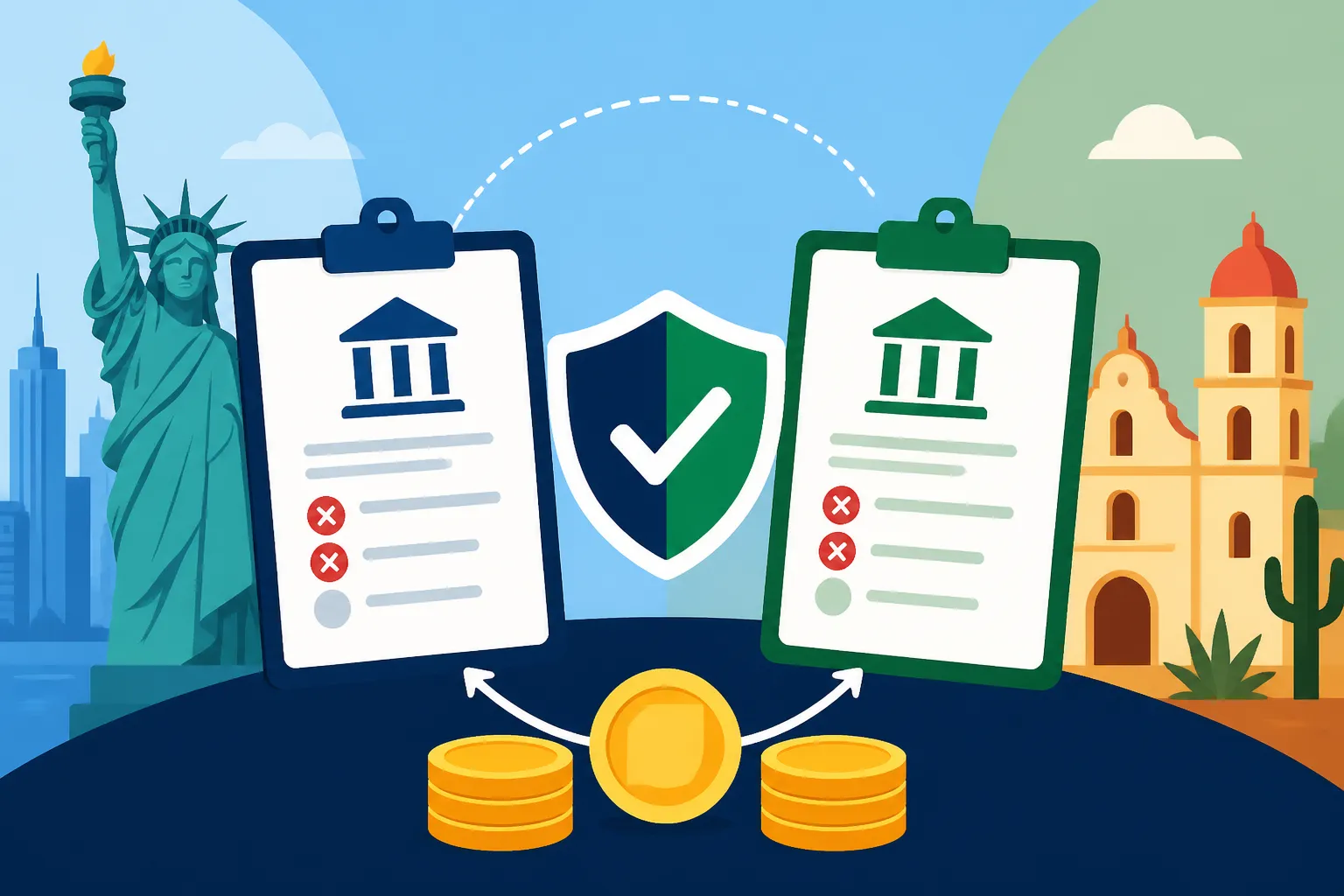
How to Avoid Double Taxation Between the US and Mexico
The moment you realize that moving to a sun-drenched patio in Ajijic or a sleek condo in Mexico City doesn't mean "goodbye" to the IRS is a gut-punch every American expat feels. I remember sitting in a dusty café my first year here, staring at my laptop in a cold sweat, wondering if I was about to pay 30% to Uncle Sam and another 30% to the SAT. This guide solves that specific anxiety by breaking down the mechanisms that prevent you from being taxed twice on the same dollar.
Disclosure: This post may contain affiliate links. We may earn a commission at no extra cost to you if you make a purchase through these links. Read full disclosure.
Understanding the Foundation: Tax Residency and the US-Mexico Tax Treaty
The first thing you need to wrap your head around is that the United States is one of the only countries in the world that taxes based on citizenship, not just where you live. This means if you hold a blue passport, the IRS expects a return every year, regardless of whether you’ve stepped foot on US soil. Meanwhile, Mexico taxes based on residency. If you spend more than 183 days in Mexico during a calendar year, or if your "center of vital interests" is in Mexico, the SAT (Servicio de Administración Tributaria) considers you a Mexican tax resident.
This creates a clear conflict: two different governments claiming a right to the same income. This is where the US-Mexico Income Tax Treaty comes into play. Signed decades ago, this treaty acts as the "referee" in the room. It establishes specific "tie-breaker" rules to determine which country gets the first bite of the apple. Navigating these rules can be overwhelming, which is why many of us rely on specialists like Taxes for Expats to ensure we aren't misinterpreting treaty benefits that could save us thousands.
The 183-Day Rule and Substantial Presence
In the world of Mexican tax law, the 183-day rule is the primary threshold. If you are living here on a Mexico Temporary Resident Visa: Comprehensive Guide for Expats (2026 Update), you are likely crossing this threshold. It isn't just about counting days, though; it’s about where your primary source of income is generated and where your professional or personal ties are strongest. If you have a house in Mexico, a local bank account, and your family is here, the SAT will likely claim you as a resident even if you travel frequently.
On the US side, you still have to file, but the treaty allows you to claim credits for taxes paid to Mexico. I've seen expats ignore this, thinking that since they are "legal" in Mexico, the US simply won't know. That is a dangerous game to play in the era of digital banking and information sharing. Understanding Income Tax Basics for Expats: Understanding Mexico’s Tax System is your first line of defense against an accidental audit.
How the Treaty Tie-Breaker Rules Work
When both countries claim you as a resident, the treaty looks at a hierarchy of factors. First is the "permanent home" test. If you have a home available to you in both countries, the treaty looks at your "center of vital interests"—essentially, where are your economic and personal relations closer? If that cannot be determined, it goes to "habitual abode," then "nationality," and finally, if you’re a dual citizen or somehow still tied, the two governments are supposed to settle it by mutual agreement.
Most retirees I know in places like San Miguel de Allende clearly fall into the "center of vital interests" in Mexico category. Their primary home is here, their social life is here, and their daily spending happens in pesos. When you reach this point, you are a Mexican tax resident first for treaty purposes. However, you must still file your 1040 in the US. This is why Do US Expats Living in Mexico Still Need to Pay US Taxes? is one of the most frequent questions in expat forums.
Essential IRS Tools for Expats: FEIE vs. FTC
To avoid double taxation, the US tax code provides two primary "hammers" to smash your tax bill: the Foreign Earned Income Exclusion (FEIE) and the Foreign Tax Credit (FTC). Choosing the wrong one can be a costly mistake. I’ve personally toggled between these depending on whether I was working as a freelancer or taking a local salary, and the math changes every year based on the exchange rate.
When you're moving money to pay these tax bills or just managing your daily life, using a transparent service like Wise is essential. I used to lose a fortune on "hidden" bank fees when transferring dollars to pesos for my quarterly SAT payments. Using Wise ensures that when you calculate your foreign taxes paid for IRS purposes, you are using the actual mid-market rate, making your reporting much more accurate.
When to Choose the Foreign Earned Income Exclusion
The FEIE (Form 2555) allows you to exclude a certain amount of your foreign-earned income from US taxation. For the 2026 tax year, this amount is adjusted for inflation and usually sits well north of $120,000. The catch? It only applies to earned income—wages, salaries, or professional fees. If you are a retiree living on Social Security, a pension, or dividends, the FEIE won't help you.
To qualify, you must pass either the Physical Presence Test (330 full days outside the US in a 12-month period) or the Bona Fide Residence Test. I often tell digital nomads that the Physical Presence Test is their best friend, but for long-term residents, the Bona Fide Residence Test is more sustainable. If you're unsure which applies to your specific situation, consulting with Taxes for Expats can prevent you from claiming an exclusion you aren't actually eligible for.
Maximizing the Foreign Tax Credit for Mexican Taxes Paid
For many expats, especially those with high Mexican tax liabilities or passive income, the Foreign Tax Credit (Form 1116) is the superior choice. Instead of excluding income, you take the taxes you paid to the SAT and apply them as a dollar-for-dollar credit against your US tax liability. Since Mexican income tax rates can often be higher than US rates for certain brackets, you frequently end up with a "zero" balance due to the IRS.
The beauty of the FTC is that it can be carried forward or backward, and it applies to more types of income than the FEIE. If you paid taxes on a property sale in Mexico, you can often use those credits. This is particularly relevant when navigating Taxes in Mexico for Expats: A Complete Guide to Income Tax and More. I once had a year where my Mexican tax bill was higher than my US one; I didn't owe the IRS a dime, and I actually "banked" credits for future years.
Navigating Mexican Tax Obligations (SAT)
You cannot avoid double taxation if you aren't actually paying the first country. In Mexico, that means getting your paperwork in order with the SAT. This starts with the RFC (Registro Federal de Contribuyentes). Without an RFC, you effectively don't exist in the Mexican financial system, and you won't be able to properly document the taxes you're paying to claim them on your US return.
The process of How to Get an RFC in Mexico has become a bit of a legendary hurdle among expats due to the difficulty of getting appointments. However, once you have it, it opens up the possibility of using more favorable tax regimes, such as RESICO. If you're earning income locally, you need to understand Do Expats Need to File Mexican Taxes on Foreign Income? because the SAT has become increasingly sophisticated in tracking bank movements.
Understanding the RESICO Regime for Expats
Introduced a few years ago, the Régimen Simplificado de Confianza (RESICO) has been a game-changer for many expat freelancers and small business owners. It offers incredibly low tax rates—ranging from 1.1% to 2.5% of gross income—provided your annual income stays below 3.5 million pesos. For an American, this is a double-edged sword. While you pay very little to Mexico, your US tax bill might go up because you have fewer foreign tax credits to apply.
This is a classic scenario where "cheaper isn't always better." If you pay 2% to Mexico under RESICO, but your US tax bracket is 22%, the IRS will simply collect the 20% difference. This is why The RESICO Tax Regime in Mexico Explained is essential reading. You need to look at your total global tax liability, not just the local rate. I’ve found that Taxes for Expats is particularly good at running these comparison scenarios to see if RESICO actually saves you money in the long run.
Reporting Foreign Income to the SAT
If you are a tax resident of Mexico, the SAT technically wants to know about your global income. This is a point of confusion for many. If you have a rental property in Florida or a 401(k) distribution in the US, the treaty usually dictates that the US has the "primary" right to tax that income, but you may still need to report it in Mexico and claim a credit for the US taxes paid.
This "reverse" credit works just like the US FTC. You tell the SAT: "I earned $50,000 in the US, I paid $8,000 in US taxes, so I'm deducting that $8,000 from what I owe you here." Keeping track of these cross-border payments is a headache. I use Wise to keep my US and Mexican funds separate but easily accessible, which makes the end-of-year accounting much cleaner. When you can show a clear trail of where money came from and where taxes were withheld, the SAT is much easier to deal with.
Practical Financial Logistics and Reporting
Beyond the actual income tax, there are several "informational" filings that can carry massive penalties if ignored. The most famous is the FBAR (Foreign Bank and Financial Accounts Report). If the total value of your Mexican bank accounts—or any other non-US accounts—exceeds $10,000 at any point during the year, you have to tell the Treasury Department.
Failure to file an FBAR can result in fines that make your actual tax bill look like pocket change. I've seen people lose half their life savings because they "forgot" to report a Mexican investment account. This is why Reporting Mexican Bank Accounts to the IRS: FATCA/FBAR for US Expats is a non-negotiable part of your yearly to-do list.
| Reporting Requirement | Threshold | Form | Due Date |
|---|---|---|---|
| FBAR (FinCEN 114) | $10,000 total in all foreign accounts | Online via FinCEN | April 15 (Auto-extension to Oct 15) |
| FATCA (Form 8938) | $200k+ (living abroad, single) | Attached to 1040 | With your tax return |
| Mexican Annual Declaration | Residency/Income based | SAT Portal | April 30 |
| Informative Return (Mexico) | Foreign investments/trusts | Multiple | Variable |
FBAR and FATCA: The "Other" US Tax Obligations
While the FBAR is a Treasury requirement, FATCA (Foreign Account Tax Compliance Act) is an IRS requirement. Form 8938 is required if your foreign assets exceed much higher thresholds (starting at $200,000 for single filers living abroad). The complexity here is that the definition of an "asset" is broad. It’s not just your checking account; it can include Mexican life insurance policies, certain types of trusts, and even interests in a Starting a Business in Mexico: Financial and Legal Basics for Foreigners.
I always recommend that expats keep their Mexican balances below these thresholds if they want to simplify their lives, but for many of us buying property, that isn't possible. If you find yourself needing to move large sums for a home purchase or a tax payment, Wise is often the most cost-effective way to do it without getting flagged for "unusual activity" by traditional banks that don't understand expat life.
Using Wise for Tax Payments and International Transfers
One of the practical frustrations of avoiding double taxation is the actual movement of money to pay the bills. If you owe the SAT 50,000 pesos, you need a way to get that money from your US source to your Mexican bank account without losing 3-5% in the exchange rate. Most US banks will give you a terrible rate and charge a $40 wire fee.
I’ve been using Wise for years to handle my quarterly payments. Because they use the mid-market rate, the "math" for my tax credits remains simple. If I tell the IRS I paid $2,500 USD in Mexican taxes, I want my bank statement to actually show a transfer of $2,500 USD, not $2,400 with a $100 "spread" hidden in the conversion. It’s about more than just saving money; it’s about having a clean audit trail. For more on managing your cash flow, check out Sending Money To and From Mexico: Transfers and Fees.
Final Thoughts on Staying Compliant
The secret to avoiding double taxation isn't some "magic trick" or offshore loophole; it's the disciplined application of the treaty and the diligent filing of both US and Mexican returns. It feels unfair to pay an accountant in two countries, but the cost of professional help is a fraction of the cost of a mistake. If you're just starting out, How to Find an English-Speaking Accountant (Contador) in Mexico is a great place to begin building your local team.
I know it’s tempting to stay under the radar, but with the Foreign Account Tax Compliance Act, those days are largely over. Banks in Mexico now report to the US, and vice versa. Being proactive, using tools like Taxes for Expats to stay ahead of IRS changes, and using Wise to manage your transfers will let you enjoy your life in Mexico without looking over your shoulder for the taxman.
Disclaimer
This article is for informational purposes only and does not constitute legal, financial, or tax advice. Tax laws in both the United States and Mexico are subject to frequent changes and vary significantly based on individual circumstances. You should always consult with a qualified tax professional who specializes in US-Mexico cross-border taxation before making any financial decisions or filing tax returns. The author and publisher are not responsible for any errors, omissions, or actions taken based on this information.