Do You Need to Speak Spanish to Work in Mexico? Language Requirements by Industry
Sitting in my first marketing meeting in Mexico City, the CEO abruptly switched from English to rapid-fire Spanish, leaving me completely lost and functionally useless for the next two hours. I learned the hard way that surviving the Mexican job market without Spanish is possible, but thriving requires a deeper linguistic commitment. This guide breaks down exactly which industries demand fluency and where you can safely rely on English.
Disclosure: This post may contain affiliate links. We may earn a commission at no extra cost to you if you make a purchase through these links. Read full disclosure.
The Reality of the Mexican Corporate Environment
Before diving into specific sectors, it is absolutely vital to understand the broader cultural and operational landscape of doing business in Mexico. The country is currently experiencing a massive economic boom, heavily driven by foreign direct investment and nearshoring. However, the way business is conducted here is deeply rooted in local traditions, relationship-building, and face-to-face trust, all of which are mediated through language.
English as the Language of Global Business vs. Local Execution
In major corporate hubs like Santa Fe in Mexico City or the corporate parks of Monterrey, English is undeniably the language of high-level, global business. If you are sitting in a boardroom pitching a multinational acquisition to a foreign holding company, the slide deck and the presentation will be in English. However, the execution of those global strategies happens on the ground, and that execution is entirely in Spanish.
This creates a sharp dichotomy for expats. You might be hired precisely because you possess native-level English and an understanding of the US or European markets. Your direct supervisor, who might be the regional VP, will likely speak flawless English. But the moment you need to coordinate with the local logistics team, request budget approvals from the local finance department, or instruct the warehouse staff, you will hit a massive communication wall. Relying constantly on a bilingual colleague to translate your emails or mediate your requests is a fast track to being perceived as a high-maintenance liability rather than a high-value asset.
For a deeper dive into the broader landscape of expat employment and which sectors are most welcoming, you should review our comprehensive breakdown on the Top Industries Hiring Expats in Mexico: Tech, Tourism, and More. Understanding this dynamic is the first step in assessing how much linguistic friction you are willing to tolerate in your daily work life.
The Social Dynamics of the Mexican Office
The Mexican workplace is highly social, much more so than the typical corporate environment in the United States or Canada. Business relationships are frequently built over long, extended lunches (comidas) that can last for two or three hours, or during informal after-work drinks. These social interactions are not optional; they are the bedrock of corporate trust and career advancement in Mexico.
When you do not speak Spanish, you are fundamentally excluded from this vital social fabric. You will miss the subtle office politics, the casual brainstorming sessions that happen by the coffee machine, and the personal check-ins that managers use to build loyalty. Your colleagues will likely be polite and accommodate you in English during formal meetings, but the moment the agenda is finished, the conversation will naturally revert to their native tongue.
Overcoming this isolation requires deliberate effort. You do not need to be a literary master of the language to participate; you just need to show a genuine effort to engage. Utilizing a targeted learning platform like SpanishPod101 to master casual office banter, appropriate greetings, and polite small talk can dramatically change how you are perceived by your Mexican peers, moving you from the “foreign outsider” to an integrated team member.
Legal and Administrative Hurdles for Foreigners
Beyond the daily social interactions, there is a harsh administrative reality: Mexican bureaucracy operates exclusively in Spanish. From the moment you receive a job offer, you will be dealing with complex legal documents, tax registrations, and immigration protocols. Your employment contract will be written in Spanish, as mandated by Mexican labor law. While your company might provide an English translation for your convenience, the Spanish version is the only legally binding document.
Furthermore, interacting with the Instituto Nacional de Migración (INM) to process your work visa, or visiting the Servicio de Administración Tributaria (SAT) to secure your tax ID (RFC), requires navigating dense, bureaucratic Spanish. Immigration officials rarely speak English, and if they do, they are under no obligation to use it. If you cannot understand the basic instructions given to you at a government office, you risk missing crucial deadlines or signing documents you do not fully comprehend.
Industries Where English-Only Can Actually Work
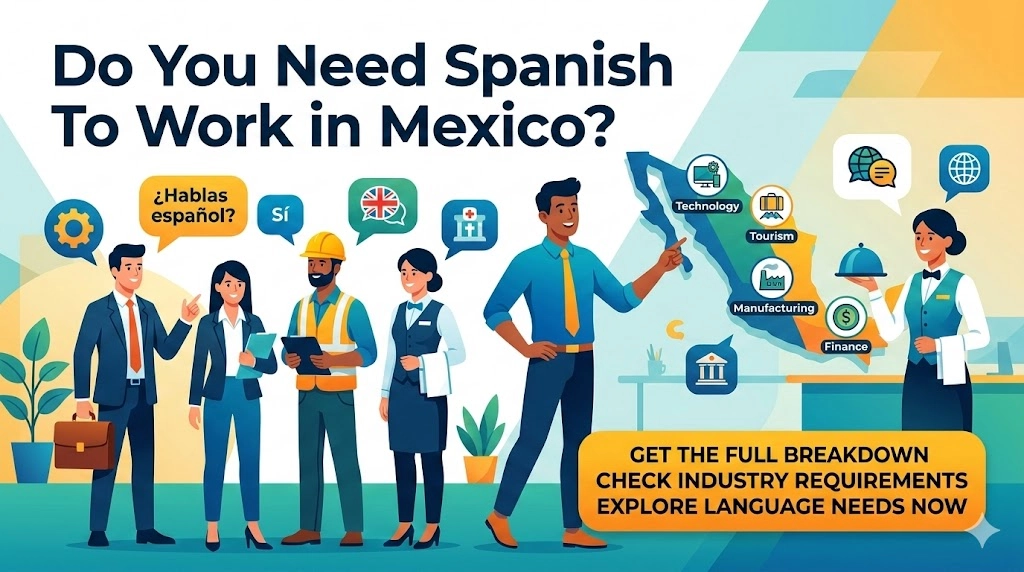
Despite the challenges outlined above, there are specific, highly lucrative sectors in Mexico where a lack of Spanish is not a dealbreaker, at least in the initial stages of your career. These industries are globally integrated and actively recruit foreign talent to bridge skill gaps.
Information Technology and Software Development
The tech sector is the most forgiving industry for non-Spanish speakers in Mexico. Guadalajara is widely recognized as the “Silicon Valley of Latin America,” hosting massive campuses for tech giants like IBM, Oracle, and Intel. Because the universal language of coding, software architecture, and technical documentation is English, your day-to-day deliverables do not require Spanish proficiency.
If you are hired as a Senior Cloud Architect or a Lead Backend Developer, your primary responsibility is the integrity of the code and the systems you build. Your global team standups, sprint planning sessions, and technical code reviews will almost certainly be conducted in English to accommodate offshore teams in India or the US. However, you will still need to manage your personal life outside the office. Committing to audio lessons on your daily commute using SpanishPod101 is the most efficient way to ensure you can actually order lunch or chat with the building security guard without relying on a translation app.
To understand the specific nuances of the capital’s tech scene, review our article on Working in Mexico City: Opportunities and Challenges for Foreign Professionals.
English Education and International Schools
Teaching English is the classic, time-tested entry point for expats moving to Mexico. By definition, your lack of Spanish is often viewed as a feature rather than a bug in the classroom. Many high-end language institutes and corporate training programs mandate a strict “English-only” immersion environment, strictly forbidding teachers from using Spanish to explain concepts.
If you possess formal teaching credentials (a teaching license from your home country, not just a weekend TEFL certificate), you can apply to elite international schools in major cities. These schools teach the American or British curriculum to the children of diplomats and wealthy locals. The entire administrative staff, the faculty meetings, and the grading systems are conducted in English. You can easily spend years in this bubble without ever needing to conjugate a Spanish verb professionally. For a detailed breakdown of these lucrative roles, read Finding English Teaching Jobs: Best Schools and Institutes for ESL Teachers.
Specialized B2B Tech Startups and Remote Hubs
Mexico City is currently experiencing a massive venture capital boom, particularly in the FinTech and logistics sectors. Many of these heavily funded startups are actively trying to expand into the US market. Consequently, they aggressively recruit US or Canadian expats for roles in Growth Marketing, B2B Enterprise Sales, and Investor Relations.
In these roles, your target audience is entirely English-speaking. You are hired specifically to write English copy, pitch to English-speaking venture capitalists, and negotiate with US-based vendors. The internal startup culture in these companies often mimics Silicon Valley, with a heavy emphasis on English fluency among the local staff. However, to truly understand the product you are selling, you will eventually need to converse with the local product managers. Spending 20 minutes a day on SpanishPod101 to build a foundation of technical business vocabulary will make these internal alignments significantly smoother and less stressful.
Sectors Where Bilingualism is Absolutely Mandatory
Conversely, there are massive sectors of the Mexican economy where attempting to work without fluent Spanish is not just difficult; it is functionally impossible and borderline negligent.
Luxury Tourism and Hospitality Management
Mexico is a global tourism powerhouse, and resorts in Cancun, Los Cabos, and the Riviera Maya frequently hire foreign general managers, executive chefs, and guest experience directors to cater to affluent North American tourists. While the guests you interact with speak English, the operational reality of running a 500-room resort is entirely different.
Your entire staff—from the housekeeping team to the maintenance crew, groundskeepers, and line cooks—will communicate almost exclusively in Spanish. Attempting to manage a massive local workforce, conduct performance reviews, handle HR disputes, or give urgent safety instructions during a hurricane without speaking the local language is a recipe for operational disaster. You cannot lead a team you cannot speak to. If you are eyeing a management role on the coast, our guide on Working in Cancun: Jobs in Tourism for Expats is required reading.
To prepare for these intense leadership roles, utilizing the advanced, industry-specific modules on SpanishPod101 is highly recommended. You need to learn the specific vocabulary of hospitality management, conflict resolution, and labor relations, which standard language apps completely ignore.
Real Estate, Legal, and Property Management
The boom in foreign retirees and digital nomads buying property in Mexico has created a lucrative niche for expat real estate agents. Foreign buyers feel much more comfortable navigating a complex, six-figure transaction with someone from their own culture. However, to actually execute these deals, you must interact with the Mexican legal system.
Real estate in Mexico relies heavily on the Notario Público (Public Notary), a highly powerful legal figure whose administrative processes are dense, archaic, and entirely in Spanish. You must be able to read and interpret complex property deeds, navigate the fideicomiso (bank trust) paperwork for coastal properties, and negotiate with local contractors, plumbers, and electricians for property management. A mistranslated clause in a real estate contract can cost your client tens of thousands of dollars. Fluency here is not a luxury; it is a strict fiduciary duty.
Automotive, Manufacturing, and Plant Operations
The industrial heartland of Mexico, stretching from Monterrey down through the Bajío region (Querétaro, Guanajuato), is dominated by massive automotive and aerospace manufacturing plants. These maquiladoras and foreign-owned factories frequently bring in expat engineers and plant managers to oversee operations.
While the parent company in Detroit or Munich might communicate in English, the assembly line floor operates strictly in Spanish. If you are responsible for implementing complex Six Sigma quality controls, training local engineers on new robotics, or ensuring rigid safety protocols are followed on the factory floor, your Spanish must be precise and authoritative. Miscommunication in heavy manufacturing can lead to catastrophic supply chain delays or fatal accidents. For a closer look at this demanding environment, read Working in Monterrey: Expats in Mexico’s Industrial Capital.
Here is a summary comparing the language expectations across major Mexican industries:
| Industry Sector | English-Only Feasibility | Spanish Requirement Level | Typical Roles for Expats |
| Information Technology | Very High | Low (Social integration only) | Senior Developer, Cloud Architect |
| English Education | Very High | Low (Administrative needs only) | International School Teacher, Corporate Trainer |
| B2B Tech Startups | High | Medium (Internal team alignment) | Growth Marketing, US Enterprise Sales |
| Manufacturing/Auto | Low | High (Technical & safety protocols) | Plant Manager, Industrial Engineer |
| Luxury Hospitality | Very Low | Very High (Staff management) | General Manager, Executive Chef |
| Real Estate/Legal | Zero | Absolute Fluency (Legal contracts) | Real Estate Agent, Property Manager |
Strategies for Overcoming the Language Barrier at Work
If you find yourself employed in Mexico with a less-than-ideal grasp of the language, you must treat your language acquisition as a second, part-time job. Hoping that you will naturally absorb the language through osmosis by simply living in the country is a massive delusion that traps many expats in a state of permanent linguistic infancy.
Structuring Your Language Learning Around Your Industry
General vocabulary lists are useless when you are trying to navigate a corporate environment. Knowing how to order a beer or ask for directions to the beach will not help you when the finance director asks you to explain the quarterly churn rate. You must tailor your learning directly to your daily operational needs.
This is where a structured, comprehensive platform is vital. Instead of randomly swiping on basic vocabulary apps, signing up for SpanishPod101 allows you to access audio and video lessons specifically tailored to business Spanish, corporate negotiations, and industry-specific jargon. You can listen to these targeted lessons during your commute on the Metrobus or while waiting in line at the bank.
Managing Bilingual Teams and Delegation
When you are managing a team while still learning the language, you must be incredibly strategic about delegation. Identify the bilingual members of your team who possess strong technical skills and elevate them. They can act as your cultural and linguistic liaisons. However, you must be careful not to treat them merely as administrative translators, which can breed resentment.
Always ask for their input on cultural nuances. For example, a direct, blunt email that is perfectly acceptable in the US might be considered highly aggressive and rude in Mexican corporate culture, which heavily values polite preambles and warm greetings. Having a trusted bilingual colleague review your communications for tone, rather than just vocabulary, is essential for maintaining team morale.
Leveraging Digital Tools and Interpreters Safely
In the era of AI, tools like Google Translate, DeepL, and ChatGPT are lifesavers for writing emails or reading internal memos. However, you must use them with extreme caution. Do not use public translation tools for documents containing sensitive company data, client lists, or proprietary financial information, as this often violates corporate data security policies.
For critical meetings, such as annual performance reviews or major contract negotiations, do not rely on a smartphone app. Hire a professional, human interpreter. It shows respect for the gravity of the meeting and ensures that no crucial nuances are lost in a machine translation error. Furthermore, continue to practice the specific vocabulary of your upcoming meetings using SpanishPod101 so you can eventually reduce your reliance on external translators and demonstrate your commitment to the local team.
Assessing the True Cost of Not Learning Spanish
You can absolutely carve out a comfortable, well-paying niche in Mexico using only English, particularly in tech or education. But choosing to remain monolingual carries a hidden, long-term cost to your career trajectory and your personal experience in the country.
The Ceiling on Your Career Progression
Without Spanish, you effectively place a hard ceiling on your career advancement. You might be an exceptional Senior Developer, but if the company is looking to promote someone to Chief Technology Officer—a role that requires managing local vendor relationships, lobbying government regulators, and presenting to the local board of directors—you will be bypassed in favor of a bilingual candidate, even if their technical skills are inferior to yours.
Multinational companies value expats who can act as true bridges between the home office and the local Mexican branch. If you cannot communicate with the local branch effectively, your utility is severely limited. Investing in your language skills through a dedicated program like SpanishPod101 is quite literally an investment in your future earning potential and executive viability in Latin America.
The Isolation Factor in Professional Networking
Finally, the most significant cost of not speaking Spanish is professional isolation. Mexico City and Monterrey host massive, vibrant professional networking scenes, industry conferences, and trade shows. If you cannot comfortably converse in Spanish, you cannot participate in these events. You will be restricted to “expat-only” networking groups, which severely limits your exposure to new local opportunities, partnerships, and entrepreneurial ventures.
Learning the language is the ultimate sign of respect to your host country. It signals to your Mexican colleagues, bosses, and clients that you are not just a temporary corporate mercenary extracting a salary, but a committed professional who values their culture and is invested in the long-term success of the local operation.
References
Primary sources (official)
- EF English Proficiency Index – Mexico 2025 Report: https://www.ef.com/wwen/epi/regions/latin-america/mexico/
- Mexican Ministry of Economy – Foreign Direct Investment Statistics: https://www.economia.gob.mx/datamexico/en/profile/geo/mexico
Other helpful sources
- Mexico Business News – The Strategic Threat of the English Gap: https://mexicobusiness.news/talent/news/mexicos-english-gap-strategic-threat-nearshoring-success
- Pacific Prime – How Americans Can Find Jobs in Mexico: https://www.pacificprime.com/blog/jobs-in-mexico-for-americans.html
Disclaimer
The information provided in this guide is for educational and informational purposes only and does not constitute formal career, legal, or immigration advice. Language requirements and workplace expectations in Mexico vary wildly depending on the specific company, corporate culture, and region. Always research the specific linguistic requirements of a role before accepting an offer and consult with qualified Mexican immigration authorities regarding the legal constraints of your specific visa type.