Is $3000 a Month Enough for a Family in Mexico? Budget Breakdown
Moving a family to Mexico on a fixed budget is terrifying when hidden costs suddenly derail your financial planning. I almost depleted my savings during our first year because I severely underestimated international school fees and banking markups. This guide breaks down exactly if and how a family can comfortably survive on a $3000 monthly budget in Mexico.
Disclosure: This post may contain affiliate links. We may earn a commission at no extra cost to you if you make a purchase through these links. Read full disclosure.
The Financial Reality of Raising a Family Abroad
Is $3000 a month enough? The short answer is yes, but the brutal reality is that it requires abandoning the “expat bubble” entirely. Single digital nomads can easily live a life of luxury on this amount in popular coastal hubs. However, for a family of three or four, $3000 USD (roughly 50,000 to 60,000 MXN) is a standard middle-class local salary. It is not an endless vacation budget.
If you attempt to live in Roma Norte in Mexico City or a beachfront condo in Tulum, your rent alone for a family-sized apartment will consume 70% of this budget. To survive on $3000, you will need to target tier-two cities like Xalapa, Querétaro, or non-touristic, local neighborhoods in Mérida and Guadalajara. You must adopt a highly localized lifestyle, which requires integration, patience, and a willingness to learn Spanish quickly. If you want to understand how standard expenses scale based on your neighborhood, review Cost of Living in Mexico: A Realistic Budget Breakdown.
Breaking Down the Monthly Family Expenses
When budgeting for a family, your overhead operates on an entirely different scale than a solo traveler. You cannot simply crash in a cheap studio; you need space, education, and bulletproof healthcare.
Securing Family Sized Housing
You need space and security. A safe, comfortable three-bedroom home in a gated community (known as a privada) in a mid-tier city will cost between $800 and $1,200 USD a month. If you use English-language booking apps or global short-term rental platforms, you will pay the “gringo tax” and easily double that cost. To hit your budget, you must find long-term leases in peso-denominated contracts by walking the residential neighborhoods and calling the numbers on physical “Se Renta” signs.
Securing these apartments often requires paying your first month’s rent and a massive deposit in cash or via a direct domestic bank transfer. Because you are on a tight budget, losing money to international wire fees is unacceptable. I regularly use Wise to transfer exactly the amount needed for my rent deposit straight from my home bank to the landlord’s local account, entirely bypassing the SWIFT fees my traditional bank tried to charge me. For more tips on navigating this high-stress process without a local guarantor, review Finding an Apartment in Mexico: Renting Guide for Expats.
Navigating Private School Tuition
This is the category that completely shocks most expat parents. Public schools in Mexico are generally not a viable option for non-Spanish speaking foreigners due to vast curriculum differences, underfunding, and massive administrative hurdles regarding foreign transcripts. You will almost certainly need to enroll your children in private, bilingual schools.
Tuition averages $250 to $500 USD per child, per month. However, the hidden costs are where the budget breaks. Do not forget the massive annual inscription fee (which is often equal to one full month’s tuition), mandatory daily uniforms, sports uniforms, specialized school supplies, and bus transportation fees. If you have two children, basic education will immediately consume $800 of your $3000 budget before anyone has even eaten a meal.
Groceries and Household Logistics
Feeding a family of four on this budget means avoiding imported goods at premium supermarkets like City Market, Chedraui Selecto, or H-E-B. Buying imported American cereal, foreign cheeses, and craft beer will destroy your weekly grocery allowance. You must source your produce and proteins from the municipal mercados and local open-air tianguis.
Furthermore, you must account for localized utility quirks. You cannot drink the tap water, so you must budget for the weekly delivery of purified 20-liter jugs (garrafones). Most homes use LP gas cylinders for cooking and hot showers, requiring you to pay cash to the local gas truck when your tank runs dry. Electricity is subsidized for low usage, but if you run air conditioning constantly, your bill will skyrocket exponentially.
Transportation is another massive factor. Can you afford a car on this budget? Between local auto insurance, maintenance from aggressive potholes, annual taxes, and gas prices (which are often higher in Mexico than in the United States), a vehicle will drain your remaining funds instantly. Relying on highly subsidized public transit and occasional rideshare apps is vastly cheaper. Before you even consider bringing a family vehicle across the border, read Bringing Your Car vs Buying in Mexico: Pros and Cons for Expats to understand the devastating hidden costs.
Health Insurance and Medical Care
You cannot rely on out-of-pocket cash for pediatric emergencies. A catastrophic major medical policy for a family is absolutely non-negotiable and will cost roughly $150 to $250 USD a month, depending on your deductibles and age brackets. While basic doctor consultations at local pharmacy clinics cost merely $3 to $5 USD, treating a broken arm in an elite private hospital can easily rival United States pricing if you are uninsured. For a complete understanding of how to layer local clinic visits with major medical policies without going bankrupt, thoroughly review Healthcare in Mexico: Complete Guide for Expats Public vs Private.
Protecting Your Budget from Cross Border Fees
When your margin for error is razor-thin, you cannot afford to lose 5% of your $3000 to bank fees and terrible exchange rates. How you move your money is just as important as how you spend it.
Smart Monthly Transfers
Traditional banks will drain your budget through hidden SWIFT fees and predatory markup spreads. To understand these financial traps, read Bank Fees in Mexico: Tips to Avoid Unnecessary Charges.
To transfer our monthly living allowance safely, I rely on Wise. Wise gives you the true mid-market exchange rate with total transparency. By utilizing Wise for daily grocery cash and local rent payments, you ensure your money isn’t squandered on corporate bank margins. Setting up this localized infrastructure is crucial; read Opening a Bank Account in Mexico to understand how to legally receive these domestic transfers.
Managing Long Term Wealth
If you are living on $3000 a month but have a larger nest egg, retirement account, or emergency fund back home, you must protect it from local economic volatility. For the family emergency fund, keeping capital in Interactive Brokers is a lifesaver. Interactive Brokers allows us to convert large sums at institutional spot rates if a sudden medical or housing crisis arises.
Moving emergency capital using Interactive Brokers shields your life savings from peso devaluation while ensuring high liquidity. This strict separation of daily spending cash and long-term wealth is also vital for keeping your global tax reporting clean, a strategy covered deeply in Taxes in Mexico for Expats: A Complete Guide to Income Tax and More.
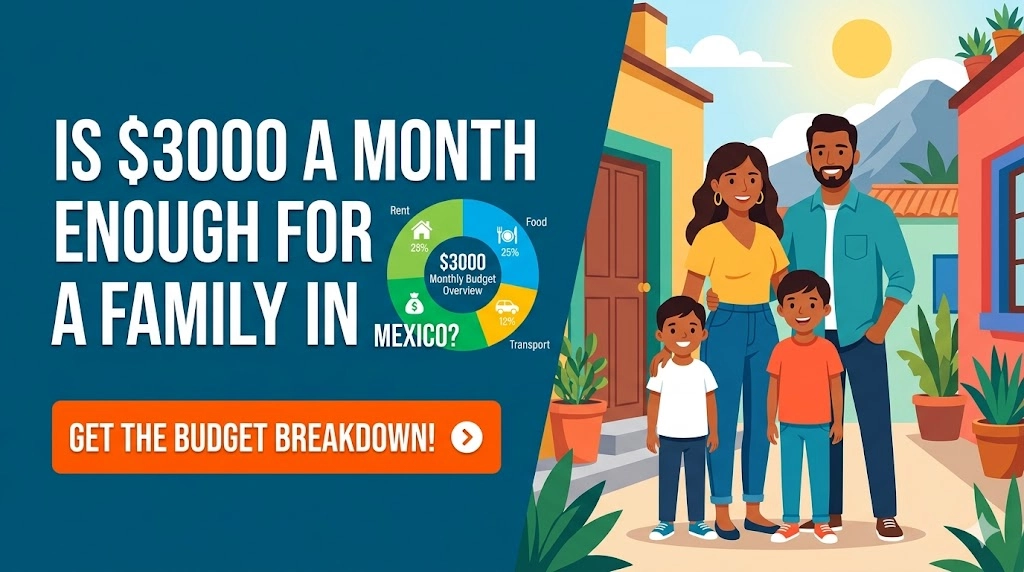
A Realistic Monthly Family Budget Breakdown
To visualize how tight this lifestyle actually is, here is a realistic breakdown for a family of four living in a tier-two, non-coastal Mexican city.
| Expense Category | Estimated Monthly Cost (USD) | Notes and Survival Strategy |
|---|---|---|
| Housing (Rent and Utilities) | $900 – $1,100 | 3-bedroom home in a local colonia; minimal A/C usage. |
| Education (2 Children) | $600 – $800 | Mid-tier bilingual private school tuition and materials. |
| Groceries and Household | $500 – $650 | Strict local market shopping; zero imported goods. |
| Healthcare and Insurance | $150 – $250 | Catastrophic high-deductible family policy. |
| Transportation | $100 – $150 | Public transit, walking, and occasional rideshares (No car). |
| Dining and Entertainment | $100 – $150 | Street food, local parks, and free municipal events. |
| Total | $2,400 – $3,100 | Leaves practically zero margin for international flights or emergencies. |
Immigration Hurdles for Families on a Budget
The absolute biggest roadblock to living in Mexico on $3000 a month is not the cost of groceries; it is the Mexican government. The National Institute of Migration (INM) enforces strict financial solvency requirements for temporary and permanent residency.
As of 2026, the primary applicant must mathematically prove a monthly income of roughly $4,000 USD to $4,500 USD, plus an additional $1,500 USD for each dependent. This means a family of four needs to show nearly $8,500 USD in monthly income just to legally qualify for the visa.
If your actual income is only $3000, your application will be instantly denied at the consulate. You must instead qualify via the savings route, which requires proving a massive, highly liquid balance in an investment or retirement account over the last twelve uninterrupted months. You must understand this bureaucratic wall before you pack your bags and promise your kids an adventure. Read Qualifying for Permanent Residency in Mexico: Paths and Requirements to navigate this exact legal hurdle.
References
Primary sources (official)
- Instituto Nacional de Migración (INM): The official government portal outlining the strict financial solvency requirements and dependent formulas needed to secure a Temporary or Permanent Resident visa. https://www.gob.mx/inm
Other helpful sources
- Western Union Cost of Living Guide: A trusted, simplified breakdown of median salaries, housing, and utility comparisons for foreign residents moving to Mexico. https://www.westernunion.com/blog/en/the-cost-of-living-in-mexico-vs-the-united-states/
Disclaimer
The information provided in this guide is for educational, logistical, and informational purposes only and does not constitute formal financial, immigration, or legal advice. I am a veteran expat sharing practical strategies, not a certified financial planner. However, international currency exchange rates, localized inflation, private school tuitions, and the cost of consumer goods in Mexico are subject to frequent and sudden macroeconomic fluctuations. Furthermore, the National Institute of Migration (INM) regularly updates the financial solvency minimums required to obtain legal residency, which generally far exceed a $3000 monthly income for a family. Digital transfer platforms and brokerage services operate under their own strict terms of service and fluctuating fee structures.