How to Get a CURP as a Foreigner: The Mexican ID Number Explained
Disclosure: This article contains affiliate links. If you buy through them, we may earn a commission at no extra cost to you. Read our full disclosure.
If you are planning to relocate to Mexico, you have likely spent months researching the financial requirements for residency, debating the merits of coastal living versus the central highlands, and mentally preparing for the notorious bureaucracy of the National Institute of Migration. This comprehensive guide is your definitive roadmap to the Clave Única de Registro de Población (CURP). We will break down exactly what this code is, how the government calculates it (and why foreign names break the algorithm), how to download your official certificate, the critical difference between the CURP and the RFC, and how to fix the devastating bureaucratic errors that occur when your name is spelled wrong in the federal database.
1. What Exactly is the CURP?
The Clave Única de Registro de Población (Unique Population Registry Code) is the fundamental identification number for citizens and legal residents of Mexico.
Think of it as the Mexican equivalent of a Social Security Number in the United States, a National Insurance Number in the UK, or a Social Insurance Number in Canada. However, unlike the US Social Security Number, which is primarily a tax and retirement tracking mechanism that morphed into a generic ID, the CURP was designed from the ground up by the Registro Nacional de Población (RENAPO) to be the master key for civil identity.
Every single Mexican citizen is assigned a CURP at birth. For foreigners, a CURP is generated and assigned to you the moment you are legally admitted into the national registry as a resident.
Why is it so Critical?
In 2026, the Mexican government uses the CURP as the central hub for its digital ecosystem. You literally cannot exist in the formal Mexican infrastructure without it. You need an active, certified CURP to:
- Open a Mexican Bank Account: Whether it’s BBVA, Santander, or Banorte, financial regulations prohibit opening an account for a resident without a validated CURP.
- Sign Utility Contracts: CFE (electricity) and major internet providers (like Telmex or Totalplay) require it for post-paid contracts.
- Obtain a Driver’s License: State transit authorities pull your identity directly from the RENAPO database using your CURP.
- Register for Healthcare: You cannot enroll in the public IMSS healthcare system without it.
- Get an RFC (Tax ID): The Mexican Tax Authority (SAT) requires a CURP to generate your federal tax ID. You cannot legally work or earn pesos without both.
- Buy or Sell a Car: The vehicular registry uses the CURP to tie the car’s title to your identity.
- Adopt a Pet: Even recognized animal shelters often require a CURP to process adoption paperwork.
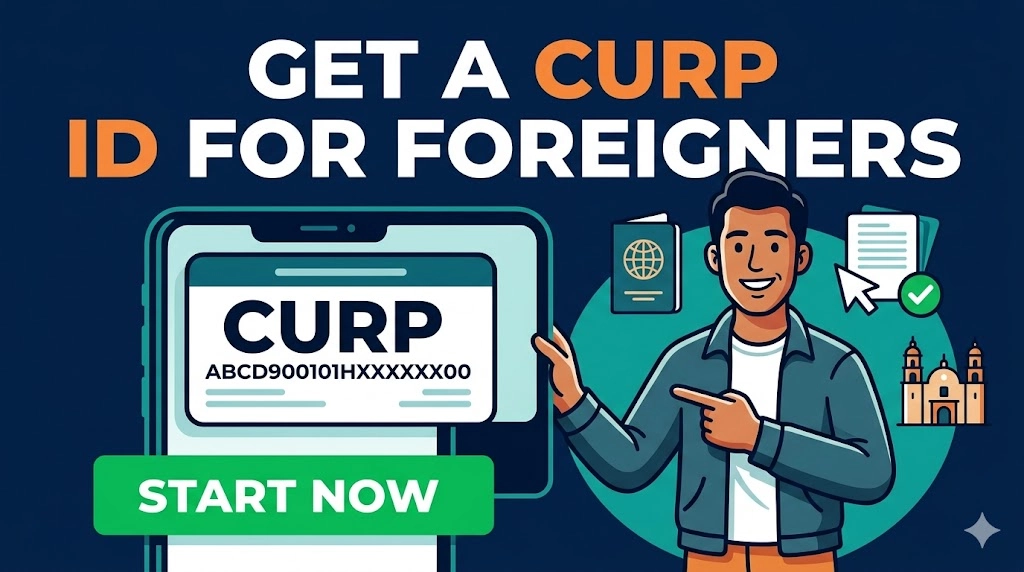
2. Decoding the Algorithm: How Your CURP is Generated
Unlike an American Social Security Number, which is a randomized 9-digit sequence, the CURP is a highly specific, 18-character alphanumeric code derived directly from your personal biographical data.
Understanding how this code is built is not just trivia; it is vital for expats. Because the algorithm was designed for Spanish naming conventions (which use two last names—a paternal and a maternal surname), foreign names frequently “break” the system, resulting in errors.
Let’s break down the 18 characters using a hypothetical expat named Robert William Smith Jones, born on August 15, 1982, in California, USA, male.
Positions 1-4: Your Name
- First Letter of First Paternal Last Name: ‘S’ (from Smith)
- First Internal Vowel of First Paternal Last Name: ‘I’ (from Smith)
- First Letter of Maternal Last Name: ‘J’ (from Jones). Note: If you only have one last name (like many Americans and Brits), the system assigns an ‘X’ here.
- First Letter of First Name: ‘R’ (from Robert)
- Result so far: SIJR
Positions 5-10: Your Date of Birth
The next six digits are your date of birth in YYMMDD format. 5. Year (82) 6. Month (08) 7. Day (15) * Result so far: SIJR820815
Position 11: Your Sex
- H for Hombre (Male) or M for Mujer (Female). In 2026, RENAPO is also introducing an X for non-binary individuals in certain jurisdictions, though this is still rolling out.
- Result so far: SIJR820815H
Positions 12-13: Your State of Birth
- For Mexican citizens, this is a two-letter abbreviation of their birth state (e.g., JC for Jalisco). For all foreigners, regardless of where you were born on earth, these two letters are always NE (Nacido en el Extranjero – Born Abroad).
- Result so far: SIJR820815HNE
Positions 14-16: Internal Consonants
- First Internal Consonant of First Paternal Last Name: ‘M’ (from Smith)
- First Internal Consonant of Maternal Last Name: ‘N’ (from Jones). (Again, if you only have one last name, this becomes an ‘X’).
- First Internal Consonant of First Name: ‘B’ (from Robert)
- Result so far: SIJR820815HNEMNB
Positions 17-18: Preventing Duplicates
- Position 17: A character to prevent duplicates. For people born before 2000, it is usually a number (0-9). For people born in 2000 or later, it is usually a letter (A-Z).
- Position 18: A verifying check digit generated by the algorithm.
- Final CURP Example: SIJR820815HNEMNB09
The “Maternal Last Name” Dilemma
As you can see, the Mexican algorithm demands a maternal last name. If your passport says “John Smith,” the INM agent generating your CURP might input your data incorrectly. They might put “Smith” as your first name, or assign “X”s randomly. If your CURP name does not perfectly match your passport and your residency card, your life in Mexico will become a bureaucratic nightmare. We will discuss how to fix this in Section 6.
3. CURP vs. RFC: Understanding the Difference
This is the most common point of confusion for new expats. You will frequently be asked for both your CURP and your RFC. They are not the same thing, though they are deeply connected.
- The CURP (Clave Única de Registro de Población): This is your Identity Number. It proves you exist in the national population registry. It is managed by RENAPO (under the Secretariat of the Interior). You need it to open a bank account or get a driver’s license.
- The RFC (Registro Federal de Contribuyentes): This is your Tax Number. It tracks your economic activity. It is managed by the SAT (the Mexican Tax Authority). You need it to legally work, earn pesos, buy real estate, or buy a car from a dealership.
The Crucial Link: In 2026, you cannot get an RFC unless you already have a validated CURP. The SAT uses your CURP as the foundational data point to generate your RFC. For a deep dive into the complex world of Mexican taxes and securing your RFC, please read our master guide: Taxes in Mexico for Expats: A Complete Guide to Income Tax and More.
4. How to Get a CURP as a Foreigner (The Legal Pathways)
You cannot simply log onto a website and request a CURP from your living room in Toronto or London. As a foreigner, your CURP is inextricably tied to your immigration status.
Pathway A: Temporary and Permanent Residents
If you have successfully navigated the consulate process and arrived in Mexico to finalize your residency (the Canje process), getting your CURP is automatic.
- When you go to the National Institute of Migration (INM) to provide your fingerprints and sign your paperwork, the INM officer inputs your biographical data into the federal system.
- The INM system “talks” to the RENAPO system in real-time.
- When your physical plastic Tarjeta de Residente Temporal or Residente Permanente is printed and handed to you, your newly generated 18-character CURP is physically printed right on the front of the card.
From that moment on, your CURP is active. You do not need to go to a separate RENAPO office to “apply” for it. It is baked into your residency.
Pathway B: The Temporary CURP for Foreigners (Tourists & Short-Term)
Historically, if you were a tourist in Mexico on a 180-day visitor stamp (FMM), you could not get a CURP. This made it impossible for snowbirds or digital nomads to buy a car, sign a long-term lease, or open a local bank account.
However, recognizing the massive influx of remote workers, the Mexican government recently expanded the CURP Temporal para Extranjeros (Temporary CURP for Foreigners).
This is a specific, limited-validity CURP granted to non-residents under certain conditions. It is typically valid for 180 to 365 days.
- Who gets it: It is most commonly issued to foreigners who are in Mexico initiating an immigration process (like applying for asylum or refugee status through COMAR) or those explicitly granted permission to remain in the country for specific legal or administrative reasons while on a visitor visa.
- The Limitation: A temporary CURP cannot be used to secure an RFC for formal employment, but it can often be used to open a basic bank account or sign a utility contract. If you leave Mexico or your authorized stay expires, this temporary CURP is deactivated.
5. How to Download Your Official “Constancia de CURP”
While your CURP is printed on your residency card, that is not enough for most Mexican institutions. When a bank, an employer, or the SAT asks for your CURP in 2026, they do not just want you to recite the 18 letters and numbers. They want the Constancia de CURP.
This is the official, downloadable PDF certificate issued by the Mexican government. It features a QR code, a barcode, and a federal watermark validating that your identity is officially registered.
The Step-by-Step Download Process
You can download your official certificate for free, 24/7, from anywhere in the world.
- Navigate to the official government portal: www.gob.mx/curp/
- You will see two tabs: Búsqueda por CURP (Search by CURP) and Búsqueda por Datos Personales (Search by Personal Data).
- If you know your CURP (it’s on your residency card): Enter the 18 characters, click the “No soy un robot” captcha, and hit Buscar (Search).
- If you don’t know your CURP: Click the personal data tab. You must enter your exact first name, last name(s), date of birth, sex, and state of birth (select “Nacido en el Extranjero” from the bottom of the dropdown list).
- If the system finds a match, it will display your data.
- Click the Descargar PDF (Download PDF) button.
Save this PDF to your phone and print several physical copies. You will need to hand a physical copy of this document to almost every bureaucrat you interact with in Mexico.
6. The Bureaucratic Nightmare: When Your CURP is Wrong
We must now address the most frustrating, tear-inducing administrative nightmare an expat can experience in Mexico: The Mismatched CURP.
Because foreign names do not conform to the Mexican paternal/maternal surname structure, INM agents frequently make data entry errors when generating your residency card.
- They might combine your middle name and your last name.
- They might drop a letter.
- They might incorrectly assign your gender or your birth year.
The Cascading Effect of an Error
If your CURP says “SMITH ROBERT” but your passport says “ROBERT WILLIAM SMITH”, you have a massive problem.
In 2026, Mexican databases are relentlessly cross-referenced.
- If you go to the SAT to get your tax ID, they will scan your passport and type in your CURP. The system will detect a name mismatch. The SAT will reject your application and refuse to issue you an RFC.
- If you try to open a bank account, the bank will run your CURP. If it doesn’t match your residency card perfectly, they will deny you an account.
- If you try to buy a car, the registry will block the title transfer.
How to Fix a Broken CURP
You cannot fix this online. You cannot simply call RENAPO. If your CURP is tied to your residency, the error originated at the INM. You must execute a formal Corrección de Datos (Data Correction).
- Return to the INM: You must go back to the INM office that issued your card.
- Submit the Request: You must submit a formal letter (signed in blue ink) demanding a correction of your biographical data in the national registry, explicitly detailing the error.
- Surrender Your Card: You will have to hand back your physical residency card. The INM will have to update the federal database, push the update to RENAPO, and print you a brand-new card with the correct CURP. This process can take weeks, during which you will not have your physical ID.
7. The Translation Mandate: Fixing Identity Errors
If the INM or RENAPO demands proof of your true legal name to fix a CURP error, your foreign passport is often not enough. They will demand the foundational document of your identity: Your original, foreign birth certificate.
Herein lies the trap that ruins countless administrative corrections. A US, Canadian, or UK birth certificate is legally meaningless to a Mexican federal clerk in its original form.
The Apostille and Translation Requirement
To prove your exact legal name to fix a CURP discrepancy, your foreign birth certificate must be internationally authenticated via an Apostille from the issuing government.
Once apostilled, Mexican law strictly mandates that any official foreign document must be accompanied by a certified Spanish translation.
You cannot use Google Translate. You cannot ask a bilingual friend to translate it. The Mexican government explicitly requires translations performed by a recognized, sworn translator embedded within the Mexican legal system (a Perito Traductor).
We strongly recommend utilizing RushTranslate for your vital records. They specialize in certified, sworn translations specifically formatted for highly sensitive, complex Mexican INM and RENAPO identity procedures. By sending your apostilled birth certificate or marriage license to RushTranslate prior to approaching the Mexican government for a data correction, you ensure your identity documents are legally flawless and universally accepted. Do not risk a rejection—and months of living in Mexico without a functional ID—over a translation technicality.
8. Integrating into Healthcare: The IMSS and Private Care
Once your CURP is validated and you have downloaded your Constancia, one of your first priorities should be utilizing it to secure your health safety net.
The Public System: Enrolling in IMSS
Your CURP is the absolute key to unlocking the Mexican public healthcare system. If you accept a corporate job offer in Mexico, your employer will use your CURP and your newly generated RFC to legally register you with the Instituto Mexicano del Seguro Social (IMSS).
Even if you are not formally employed (e.g., you are a retiree or a digital nomad on a Temporary Resident visa), you can use your CURP to voluntarily buy into the IMSS system for an annual fee. This grants you access to public clinics and hospitals for routine care and medications.
The Critical Need for Private Insurance
While having a CURP allows you to access IMSS, relying on the public system in 2026 is a significant logistical risk. The public system is chronically underfunded, heavily backlogged, and operates exclusively in Spanish. Waiting for a specialist appointment or non-emergency surgery can take agonizing months.
Mexico boasts exceptional, world-class private hospitals (such as Hospital Ángeles, Star Médica, and Hospital San Javier). These elite facilities offer clinical standards that rival the US and Canada. However, they are strict for-profit businesses. In the event of a severe emergency, hospital administrators will demand a massive, upfront credit card deposit (often ranging from $3,000 to $10,000 USD) before they will even admit you to the ER.
Attempting to self-insure against catastrophic trauma in a foreign country is financial suicide. You must secure robust international health coverage to guarantee VIP access to these private hospitals.
We highly recommend securing an expat-tailored policy through Cigna Global. Their international plans offer direct billing networks with Mexico’s top private hospitals. This means that in a crisis, the hospital coordinates the massive bills directly with Cigna Global, completely bypassing the need for you to drain your checking account or navigate complex reimbursement forms in Spanish while under duress. Securing this coverage ensures your life in Mexico is physically and financially protected. For a comprehensive comparison of how these hospital systems operate alongside your legal status, read Healthcare in Mexico: Complete Guide for Expats Public vs Private.
9. The Biometric Reality: The Future of the CURP
The Mexican government is currently undertaking a massive federal initiative to enhance the security of the CURP. In 2026, RENAPO is pushing toward the CURP Biométrica.
Historically, the CURP was just a string of text. Today, the government is linking the alphanumeric code directly to your physical biometrics. When you undergo the Canje process at the INM to get your residency card, the digital fingerprints and high-resolution facial photographs they capture are increasingly being tied directly to your RENAPO file.
The goal of this biometric integration is to eliminate identity theft, prevent foreigners from holding multiple conflicting residency profiles, and streamline access to government services. In the near future, authenticating your identity at a Mexican bank or a notary public will involve scanning your fingerprint, which will instantly pull your CURP and RFC from the federal cloud to verify your legal status.
Maintaining the absolute accuracy of your CURP data today ensures you will not be locked out of the digital economy of tomorrow.
10. Summary Checklist: Mastering Your Mexican Identity
Securing and maintaining your CURP is the foundational step to integrating into Mexican society. Use this rapid-fire checklist to ensure your bureaucratic foundation is rock solid:
- [ ] Get Your Residency: You must secure a Temporary or Permanent Resident visa to automatically generate a standard CURP. To understand the costs involved, review Mexico Immigration Fees and Costs: Budgeting for Your Residency.
- [ ] Verify the Spelling Immediately: The moment the INM hands you your residency card, scrutinize the printed name. If your middle name is missing or combined with your last name, demand a correction immediately before leaving the building.
- [ ] Download the PDF: Visit the
gob.mx/curpportal, enter your data, and download the official Constancia de CURP PDF. - [ ] Print Multiple Copies: Keep physical copies of your CURP certificate in your glovebox, your wallet, and your home filing cabinet.
- [ ] Translate Foundational Documents: If you need to fix an identity error, send your apostilled foreign birth certificate to RushTranslate for a legally sworn translation.
- [ ] Secure Your RFC: Once your CURP is validated, immediately book an appointment at the SAT to secure your tax ID. You need both to function in Mexico.
- [ ] Protect Your Health: Use your CURP to register for IMSS if eligible, but definitively secure a Cigna Global private health insurance policy to protect your life savings from private hospital deposits.
The Mexican administrative system is deeply traditional, highly digitized, and completely unforgiving of assumptions. Your CURP is the master key to this system. By understanding how the algorithm works, rigorously defending the exact spelling of your name, and keeping your digital certificates accessible, you transform from a confused outsider into a legally empowered, fully integrated resident of Mexico.
References
Primary Sources (Official)
- Registro Nacional de Población (RENAPO): The definitive federal portal where you can securely search, verify, and download your official Constancia de CURP PDF certificate. https://www.gob.mx/curp/
- Instituto Nacional de Migración (INM): The official agency responsible for assigning your initial CURP during the residency Canje process and the federal authority you must visit to execute a formal data correction if your name is misspelled on your card. https://www.inm.gob.mx/mpublic/publico/inm-tramites.html
Other Helpful Sources
- Mexperience: A highly trusted portal providing simplified explanations of the CURP algorithm, the difference between temporary and permanent resident CURPs, and the bureaucratic steps for correcting errors. https://www.mexperience.com/lifestyle/mexico-immigration-guide/
- ExpatDen Mexico: A detailed, firsthand resource offering granular breakdowns of navigating Mexican banking, setting up basic utilities, and why your CURP is the master key to integrating into the local economy. https://www.expatden.com/mexico/
Disclaimer
The information provided in this comprehensive guide is for educational, logistical, and informational purposes only and does not constitute formal immigration, legal, tax, or medical advice. The exact algorithm used to generate the CURP can sometimes produce unexpected results for foreign names, and correcting these errors is at the absolute discretion of the INM officers handling your specific case. Always verify the most current identity requirements directly with the INM or RENAPO. We strongly recommend consulting with a certified bilingual Mexican immigration attorney to help resolve complex identity mismatches, and a registered Mexican accountant (Contador Público) to ensure your CURP and RFC are correctly linked for tax purposes.