Sales Tax (IVA) in Mexico: How It Affects Your Purchases
Staring at a contractor’s quote that suddenly jumped 16% just because I asked for a receipt is an expat rite of passage that breeds serious financial frustration. I vividly remember feeling entirely scammed during my first major purchase here, completely misunderstanding how Mexican sales tax works. This guide demystifies IVA, explaining exactly how it impacts your daily and major purchases.
Disclosure: This post may contain affiliate links. We may earn a commission at no extra cost to you if you make a purchase through these links. Read full disclosure.
The Basics of Mexican IVA for Newcomers
What Exactly is IVA and the Standard 16% Rate?
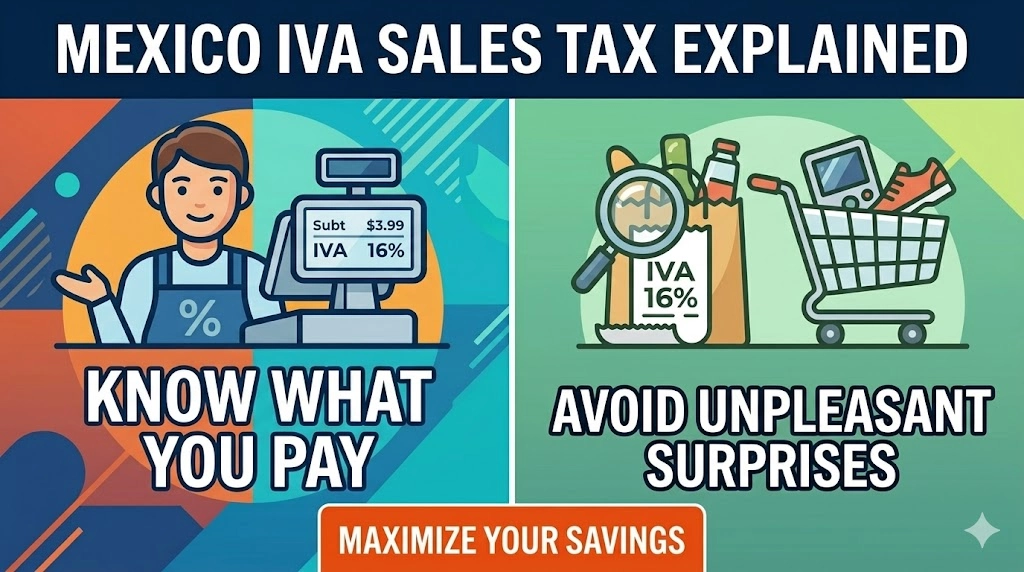
When you first move to Mexico, the sheer volume of acronyms thrown at you can be overwhelming, but none will affect your wallet as frequently as IVA (Impuesto al Valor Agregado). This translates to Value-Added Tax. Unlike the United States, where sales tax is added at the cash register and varies wildly from county to county, IVA in Mexico is a federal tax. The standard rate across the vast majority of the country in 2026 remains a flat 16%.
The most refreshing aspect of IVA for Americans and Canadians is how it is displayed. By federal law, the sticker price you see on an item in a store—whether it is a flat-screen TV at Walmart or a pair of shoes at a local boutique—already includes the 16% IVA. There is no mental math required while walking down the aisles. If the tag says 500 pesos, you hand the cashier exactly 500 pesos. This inclusive pricing model removes the frustrating “checkout shock” common in North America, allowing you to track your daily budget with absolute precision.
However, understanding that the tax is baked into the price is crucial when calculating your true purchasing power. When you wire money down to fund your life, 16% of almost every non-food peso you spend goes straight to the Mexican government. To ensure you aren’t losing even more money on the transfer itself, expats routinely use Wise to move their living expenses. Because Wise guarantees the mid-market exchange rate without hidden bank markups, it helps offset the hefty 16% tax burden you carry as a consumer. This strategic financial planning is a core component of our Cost of Living in Mexico: 2026 Comprehensive Guide.
The Border Zone Exception: Understanding the 8% Rate
If you live in a border city or are planning to move to one, the math changes completely. To keep Mexican businesses competitive with their American and Central American counterparts across the border, the federal government implemented a highly popular fiscal stimulus program. In designated municipalities along the Northern Border (Región Fronteriza Norte) and the Southern Border (Región Fronteriza Sur), the effective IVA rate is slashed in half, from 16% to 8%.
This border zone stimulus covers major expat hubs and bustling economic centers like Tijuana, Mexicali, Ciudad Juárez, and even down south in Chetumal near the Belize border. The decree, which was recently extended through 2026 and beyond, is a massive financial boon for expats residing in these areas. Everything from buying a new laptop to paying for a haircut becomes noticeably cheaper compared to living in central hubs like Mexico City or Guadalajara.
It is important to note, however, that the 8% rate is not automatic for every single vendor. Businesses must proactively apply to the SAT (Servicio de Administración Tributaria, Mexico’s IRS equivalent) and be listed on the official registry of beneficiaries to legally charge the reduced rate. As a consumer, you don’t have to do anything special at the register, but you might occasionally encounter a vendor who still charges 16% because they failed to file the proper paperwork. Understanding these regional quirks is essential when deciding where to settle, a topic we cover deeply in Taxes in Mexico for Expats: A Complete Guide to Income Tax and More.
Exemptions and 0% Rated Goods: Food and Medicine
Not everything you buy in Mexico gets hit with the 16% tax hammer. Mexico has a robust system of tax exemptions designed to protect the basic cost of living for its citizens, which expats happily benefit from. The most significant of these is the 0% IVA rate applied to unprocessed foods and medicines. When you buy fresh tomatoes at the local open-air market or pick up prescription antibiotics at the pharmacy, you are paying exactly zero sales tax.
The distinction between processed and unprocessed food is where the rules get slightly pedantic. A raw chicken at the butcher is taxed at 0%, but a roasted rotisserie chicken from a supermarket deli is subject to 16% IVA because it is considered “prepared food.” Similarly, bottled plain water is 0%, but flavored water or soda is taxed heavily. Furthermore, books, newspapers, and agricultural products are entirely exempt. Recent legislative updates for 2026 have also maintained the 0% rate on feminine hygiene products, including reusable options like menstrual cups, making these essential goods much more affordable.
Navigating these exemptions makes a massive difference in your weekly budget. By shifting your shopping habits away from processed, imported goods at corporate supermarkets and toward local, fresh ingredients, your effective tax rate plummets. We explore how to leverage these shopping habits to save hundreds of dollars a month in our guide to Grocery Shopping in Mexico: Supermarkets vs Local Markets.
The Infamous “Factura” and Hidden Surcharges
“Con o Sin Factura?” – The Cash Economy Dilemma
Once you step away from corporate retailers and begin hiring independent contractors, mechanics, or small businesses, you will inevitably encounter the most bewildering phrase in Mexican commerce: “¿Con o sin factura?” (With or without an official receipt?). I remember hiring a local carpenter to build a custom dining table. He quoted me 10,000 pesos. When I asked for a receipt, he smoothly replied, “Entonces son 11,600 pesos, con IVA.” (Then it’s 11,600 pesos, with tax).
This interaction exposes the dual nature of the Mexican economy. A massive portion of local commerce operates informally, entirely in cash, bypassing the SAT. When a tradesperson gives you a quote, the unspoken assumption is usually that you are paying in cash and they are not reporting the income to the government. Therefore, they do not include the 16% IVA in the initial verbal quote.
If you request an official tax receipt (a factura), they must formally declare the transaction. Consequently, they pass the 16% IVA directly onto you, suddenly inflating the agreed-upon price. This feels incredibly deceptive to expats who expect quotes to be final, but it is simply how the informal economy functions. If you plan to renovate a home or hire extensive local labor, you must clarify upfront whether their quotes include IVA to avoid nasty budget surprises down the road.
How Requesting an Official Receipt Changes Your Bill
If you decide you actually need the factura, the process is far more complex than just getting a piece of paper from a cash register. Mexico uses one of the most advanced electronic invoicing systems in the world, currently operating under the CFDI 4.0 standard. To receive a factura, you cannot remain anonymous. You must provide the vendor with your official RFC (Registro Federal de Contribuyentes), your exact legal name as it appears on your SAT registration, your postal code, and your specific tax regime.
Once the vendor inputs this data into the SAT portal, the system generates two digital files: an XML file (which contains the raw coding of the transaction) and a PDF file (the visual representation of the receipt). These are typically emailed to you within 24 hours. A standard paper receipt showing “paid” is completely legally meaningless in Mexico for tax purposes. If you do not get the XML and PDF files tied to your RFC, the transaction functionally never happened in the eyes of the government.
For many expats, especially retirees or temporary residents who do not work locally, jumping through these hoops seems pointless. Unless you have a Mexican business or local rental income to offset, paying the extra 16% just to get a digital file is a waste of money. However, managing your money smartly—whether you pay in cash to save the 16% or use a card—requires having a reliable financial backbone. Funneling your living expenses through a Wise account allows you to maintain clean, easily trackable records of your electronic spending, ensuring you know exactly where your pesos are going even if you aren’t collecting official facturas.
Why You Might Actually Need That Factura
Despite the 16% surcharge, there are highly specific scenarios where an expat absolutely must request a factura, and failing to do so can result in massive financial losses. The most critical scenario involves real estate. If you buy a home in Mexico and later decide to undertake significant renovations—like adding a swimming pool, expanding the kitchen, or building a guest casita—you must collect official facturas for every single peso spent on materials and labor.
When you eventually sell that property, the Mexican government will assess a hefty capital gains tax (ISR) on your profit. The only legal way to reduce your taxable profit is by proving that you invested money into improving the property. Without the XML and PDF facturas tied to your RFC, the SAT will refuse to recognize those renovation costs, meaning your capital gains tax bill will be astronomically higher.
Furthermore, if you are a digital nomad or remote worker legally operating a business entity in Mexico, collecting facturas is mandatory to deduct your business expenses and lower your local income tax burden. Medical expenses, health insurance premiums, and even school tuition can also be tax-deductible if you hold the proper facturas. Understanding when to swallow the 16% IVA for a long-term tax benefit is a sophisticated expat skill.
How IVA Impacts Major Expat Purchases
Paying Rent and Real Estate Transactions
Housing is the largest line item in any expat budget, and the way IVA interacts with real estate is notoriously confusing. If you are renting an unfurnished residential apartment or house, you are in luck: unfurnished residential leases are strictly exempt from IVA. The monthly rent you agree upon is exactly what you pay. However, if the residential property is rented furnished, the landlord is legally required to charge 16% IVA on top of the base rent.
This creates a bizarre market dynamic where heavily furnished luxury rentals in places like Polanco or Playa del Carmen carry a massive hidden tax burden. If you are signing a long-term lease, it is absolutely critical to review the contract to see if IVA is included in the quoted price or if it will be tacked on later. We provide a full breakdown of what to look for in your rental contracts in Renting a Home in Mexico: Complete Expat Guide to Leases, Deposits, and More.
When purchasing real estate, the land itself and any residential construction on it are exempt from IVA. You will pay acquisition taxes and notary fees, but you will not pay 16% sales tax on the house itself. However, commercial real estate is an entirely different beast. If you buy a storefront, an office space, or a property zoned for commercial use, the construction value of that property is subject to 16% IVA at closing. This can add tens of thousands of dollars to a commercial transaction, requiring immense upfront capital.
Buying a Car in Mexico: New vs. Used Taxes
Buying a vehicle in Mexico introduces a whole new layer of taxation. If you walk into a brand-new car dealership (an agencia), the sticker price of the vehicle will include the 16% IVA. However, new cars in Mexico are also subject to the ISAN (Impuesto Sobre Automóviles Nuevos), a specialized tax applied to brand-new vehicles based on their purchase price. Between the ISAN and the IVA, roughly 20% of the cost of a new car goes straight to the government.
Because of this heavy tax burden, many expats turn to the massive used car market. The IVA rules for used cars are highly favorable if you buy from a private individual. When you purchase a used vehicle from a regular citizen (who is not running a commercial business), the transaction is completely exempt from IVA. You simply pay the agreed-upon cash price, transfer the title, and pay the state registration fees.
However, if you buy a used car from a corporate dealership or a registered used-car lot, they must charge 16% IVA on their profit margin (and sometimes on the whole vehicle value, depending on how they acquired it). This makes buying from private sellers vastly cheaper, though it carries higher mechanical and legal risks. For a complete guide on how to navigate the vehicular market safely, check out Bringing Your Car vs Buying in Mexico: Pros and Cons for Expats.
Professional Services, Lawyers, and Medical Care
When you need to hire a lawyer to handle your immigration paperwork, an accountant to file your SAT returns, or an architect to design your home, you will be hit with IVA. Professional services provided by independent workers or agencies are subject to the standard 16% rate. If a lawyer quotes you $1,000 USD for their services, expect the final invoice to be $1,160 USD once the factura is generated.
Medical care, however, offers a vital reprieve. Professional medical services provided by physicians, dentists, psychologists, and nutritionists who hold a legally recognized medical degree (título médico) are strictly exempt from IVA. When you pay for a consultation with a specialist, you should not be charged sales tax. Similarly, hospital stays and laboratory tests directly related to your medical treatment are often exempt, provided they are billed correctly.
Because medical billing can still be incredibly complex—especially if a hospital tries to bundle taxable administrative fees with non-taxable medical services—you must scrutinize your bills carefully. Utilizing a reliable international bank card or a Wise debit card to pay these large medical expenses ensures you are getting the mid-market exchange rate, saving you money on the currency conversion even if you are hit with unexpected administrative taxes. For a deeper understanding of navigating the healthcare system’s costs, see Healthcare Costs in Mexico: Doctor Visits, Hospital Stays, and Surgery Expenses.
Managing the Cost of Cross-Border Lifestyles
Import Taxes and Buying Online from Abroad
Expats love their creature comforts, and the temptation to order familiar products from Amazon US or specialty stores back home is incredibly strong. However, Mexican customs (Aduanas) strictly enforces IVA on imported goods. In 2026, the de minimis threshold remains relatively low. If you order a package from abroad that exceeds $50 USD in value (when shipped via courier like DHL or FedEx), you will generally be subjected to a 16% import IVA, plus potential customs processing fees.
This means that a $200 USD pair of specialized running shoes ordered from the US can easily cost $250 USD by the time it reaches your door in Mexico. Amazon and other global retailers often calculate these “Import Fees Deposits” at checkout, but if you have family mail you a care package, the courier will hold the box hostage at the border until you pay the 16% IVA in cash or via a local bank transfer.
To avoid this, savvy expats learn to navigate the domestic Mexican e-commerce ecosystem. Amazon Mexico and Mercado Libre have vastly expanded their localized inventories, meaning you can often find the exact same international products already warehoused inside the country. While the domestic sticker price includes the 16% IVA, it completely eliminates the unpredictable customs delays and exorbitant courier brokerage fees that plague cross-border shipping.
Mitigating Everyday Expenses with Smart Currency Conversion
When every non-essential purchase you make in your new host country carries a 16% tax premium, protecting your underlying capital becomes a daily necessity. The absolute worst thing an expat can do is compound the high local tax rate by paying exorbitant currency conversion fees to their home-country bank. If you swipe a standard US or Canadian debit card in Mexico, your bank will often charge a 3% foreign transaction fee and bake another 2% into a terrible exchange rate.
You are effectively paying a 5% “foreigner tax” on top of the 16% IVA. This destroys your purchasing power over time. To stop this financial bleeding, veteran expats funnel their daily living expenses through Wise. By holding a balance in Mexican pesos on your Wise account, you can swipe your card at local supermarkets, restaurants, and pharmacies exactly like a local.
Wise guarantees the true mid-market exchange rate with zero hidden markups. When the peso weakens, you can convert a large block of your home currency into pesos, locking in a favorable rate. We discuss these financial logistics deeply in Banking in Mexico: Complete Guide for Foreigners.
Protecting Long-Term Wealth from Local Inflation
While optimizing your daily spending is critical, managing your long-term wealth while living under the Mexican tax regime requires a broader strategy. Mexican banks offer checking and savings accounts, but keeping the bulk of your life savings in pesos exposes you to extreme currency volatility and localized inflation. If the peso devalues sharply, the purchasing power of your localized savings drops instantly.
To protect their nest egg, successful expats ensure their primary wealth remains in hard-currency, global assets. This presents a challenge, as many US and European brokerages will forcibly freeze your accounts if they discover you have relocated to Mexico permanently due to complex international compliance laws. To solve this, you must migrate your portfolio to a platform built for global citizens, such as Interactive Brokers.
Because Interactive Brokers caters directly to international expats, you can legally maintain your residential address in Mexico while keeping your money invested in US dollars, Euros, or global index funds. Furthermore, Interactive Brokers allows you to convert massive, institutional-sized blocks of currency at absolute spot-market rates when you need to make a major purchase locally, like buying a home. By keeping your wealth globally diversified and legally compliant, you insulate yourself from the daily friction of the Mexican tax and banking system.
Practical Tips for Navigating Mexican Taxes Daily
Decoding Restaurant Bills and Supermarket Receipts
When you receive a bill at a restaurant (la cuenta) or a receipt from a supermarket (el ticket), the layout can be slightly confusing compared to what you are used to back home. By Mexican consumer protection law, the large, bold total at the bottom of the receipt is the final price you pay, and it must already include the 16% IVA.
However, right above that final total, you will usually see a breakdown called the Desglose de IVA. It will show the subtotal of your meal or items (the price without tax), followed by a line that says “IVA 16%,” and then the final total. This breakdown is required for accounting purposes, but it does not mean the tax is being added on top of the menu prices you looked at earlier. The menu prices were already tax-inclusive.
This transparency is excellent for daily budgeting. If you have 500 pesos in your pocket and the menu items total 480 pesos, you know for a fact you have enough to cover the bill and the tax. You do not need to do mental gymnastics to figure out what the meal will actually cost.
Tipping vs. Tax: What Are You Actually Paying?
A common point of confusion for new arrivals is distinguishing between the IVA and the propina (tip). Because the IVA is baked into the menu price, the only thing you need to calculate at the end of a meal in a restaurant is the gratuity. In Mexico, a standard tip for good service in a sit-down restaurant is 10% to 15%.
Crucially, it is entirely illegal for a restaurant in Mexico to automatically add a mandatory tip to your bill without your permission. If you see a line item labeled “Servicio” or “Propina” added to your total without your explicit consent, the restaurant is violating federal law. You are only legally obligated to pay the subtotal plus the IVA.
When you pay with a card, the waiter will bring the terminal to your table and ask, “¿Desea agregar propina?” (Do you wish to add a tip?). You can then input the percentage or the specific peso amount. Never confuse the mandatory 16% government tax with the optional service gratuity.
Budgeting Effectively for the IVA Impact
Ultimately, surviving the Mexican tax system as an expat requires shifting your financial mindset. You must accept that imported luxury goods, electronics, and professional services will carry a 16% premium, and you must budget accordingly. However, you must also aggressively leverage the 0% exemptions on fresh food, medicine, and local agricultural goods to balance your spreadsheet.
If you are planning major renovations, buying a car, or signing a long-term lease, you must explicitly ask about IVA before agreeing to a price. Adopting the phrase “¿El precio incluye IVA?” (Does the price include IVA?) will save you from thousands of dollars in unexpected surcharges.
By utilizing Wise to eliminate currency conversion fees, maintaining your global wealth securely in Interactive Brokers, and understanding when to demand an official factura, you transform from an uninformed tourist paying hidden markups into a financially savvy resident.
| Goods / Services Category | Applicable IVA Rate (2026) | Notes for Expats |
| Standard Retail & Electronics | 16% | Included in the sticker price you see on the shelf. |
| Northern & Southern Border Zones | 8% | Applied by registered businesses in border cities (e.g., Tijuana, Chetumal). |
| Unprocessed Food & Groceries | 0% | Fresh meat, vegetables, eggs, and plain bottled water are exempt. |
| Medicines & Hygiene Products | 0% | Includes prescription drugs and menstrual management products. |
| Medical Consultations | Exempt | Must be provided by a legally licensed physician or specialist. |
| Unfurnished Residential Rent | Exempt | Renting an unfurnished home carries no sales tax burden. |
| Furnished Residential Rent | 16% | Landlords must legally charge IVA on furnished units. |
| Professional Services (Lawyers, etc.) | 16% | Always ask if the verbally quoted price includes this tax. |
References
Primary sources (official)
- Wise – Transparent guides on mid-market exchange rates and navigating international fees: https://wise.com/
Other helpful sources
- Interactive Brokers – Information on maintaining global portfolios and wealth management as a foreign resident: https://www.interactivebrokers.com/
Disclaimer
The information provided in this article is for educational and informational purposes only and does not constitute financial, legal, or formal tax advice. Tax laws, IVA rates, border zone stimulus decrees, and CFDI invoicing regulations in Mexico are subject to frequent changes and strict compliance rules by the SAT. Always consult with a certified, bilingual Mexican accountant (contador público) or a qualified tax professional before making significant financial decisions, filing taxes, or executing major real estate purchases. Ensure that any financial platforms or services mentioned meet your specific individual legal residency and compliance requirements.