How to Cancel Your Mexican Residency if You Leave the Country Permanently
Throwing your residency card in a drawer and flying away does not magically sever your ties to the Mexican state. The National Institute of Migration (INM) and, far more dangerously, the Mexican Tax Authority (SAT), operate on highly digitized, interconnected databases. If you do not formally and legally close your files, you remain a Mexican tax resident in the eyes of the government, perpetually liable for income declarations, and your open immigration file can trigger severe penalties if you ever attempt to return as a tourist. This comprehensive guide will break down exactly how to surrender your residency card, how to legally suspend your RFC to stop the tax clock, the critical steps for closing out your local banking, and the essential document translations and healthcare transitions you need to survive your relocation.
Disclosure: This post may contain affiliate links. We may earn a commission at no extra cost to you if you make a purchase through these links. Read full disclosure.
1. The “Ghosting” Myth: Why You Cannot Just Leave
The most pervasive, dangerous myth circulating in expat forums is the idea that Mexican residency “takes care of itself.” Expats frequently advise each other: “Just leave. When your card expires, they’ll know you’re gone.”
In the analog era of the 1990s, this might have been true. It is administrative suicide.
The SAT (Tax) Danger
The Mexican Tax Authority (SAT) does not care about the expiration date printed on your plastic residency card. Under Mexican tax law, you are a tax resident if your “center of vital interests” is in Mexico, or if you spend more than 183 days a year there.
If you hold an active RFC (Tax ID) and you leave the country without formally notifying the SAT, the tax computer assumes you are still living and working in Mexico.
- The SAT expects you to file your monthly or annual declarations.
- When you fail to file, the system automatically generates fines for non-compliance.
- Over several years, these fines compound exponentially. If you ever attempt to return to Mexico, open a business, or if the SAT shares data with your home country under international tax treaties, you could face massive, unexpected tax liabilities for years you didn’t even live in the country.
The INM (Immigration) Danger
If you hold a Residente Permanente (Permanent Resident) card, the card never expires. If you leave without canceling it, your file remains permanently open. If you attempt to re-enter Mexico five years later as a tourist (perhaps for a one-week beach vacation), the border system will flag you. The INM agent will see you hold an active Permanent Residency card but have been out of the country, potentially triggering an interrogation, fines for failing to update your address, or a complex administrative nightmare just to take a vacation.
To ensure your exit is clean, you must formally break your ties with both entities. To understand the baseline penalties of ignoring the INM, review our guide on What Happens If Your Mexican Residency Card Expires?.
2. The INM Protocol: Formally Canceling Your Visa
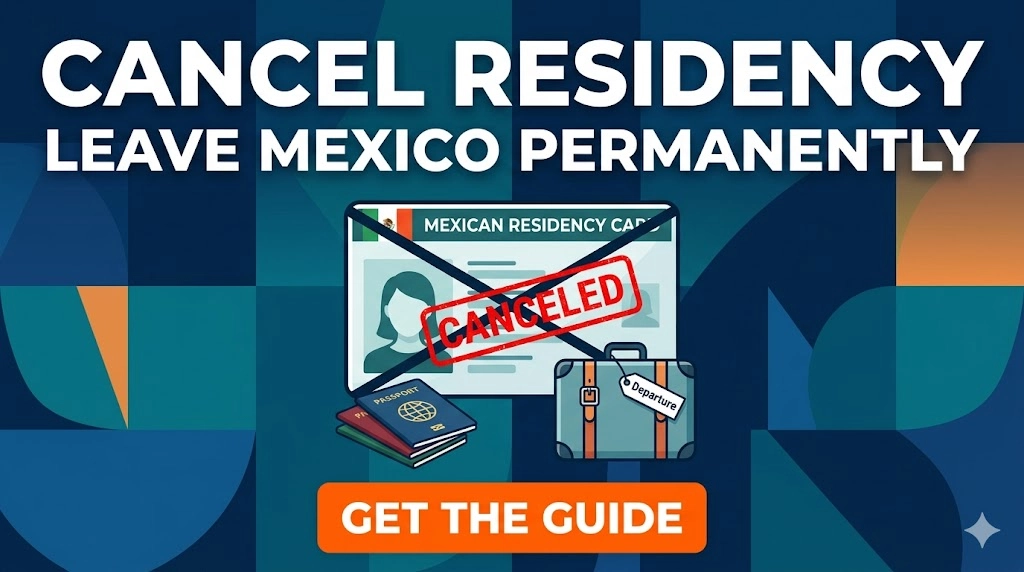
To close your immigration file, you must execute a formal procedure known as Cancelación de condición de estancia por salida definitiva (Cancellation of condition of stay due to definitive departure).
This is the legal process of voluntarily surrendering your Temporary or Permanent Residency status. You are telling the Mexican government: “I am leaving forever, and I relinquish my rights to live here.”
Step 1: The Formal Request Letter
You cannot simply hand your card to the agent at the airport gate. You must prepare a formal dossier. You must draft a Carta de Renuncia Voluntaria (Letter of Voluntary Surrender) addressed to the INM. In perfect, formal Spanish, this letter must include:
- Your full legal name, nationality, and passport number.
- Your exact residency card number (NUT and CURP).
- A clear, unambiguous statement that you are permanently leaving Mexico and voluntarily renouncing your residency status.
- The exact date of your departure flight.
The Golden Bureaucratic Rule: You must sign this letter strictly in blue ink. If you use black ink, the INM agent will reject it, assuming it is a photocopy.
Step 2: The Airport Surrender
This procedure is executed at the airport on the exact day of your departure. You cannot do it three weeks early.
- Arrive Early: You must arrive at the international airport at least 4 to 5 hours before your flight.
- Find the INM Office: Before you go through security, locate the main INM administrative office inside the terminal.
- The Hand-Off: Present your passport, your boarding pass, your signed blue-ink letter, and your physical plastic residency card.
- The Stamping: The INM officer will process your renunciation in the federal database. They will physically confiscate your residency card. They will then stamp your passport with a definitive exit stamp and provide you with a formalized document proving your residency has been officially canceled.
Do not lose this cancellation document. It is your absolute legal proof that you followed the law and surrendered your status cleanly.
3. The Tax Trap: Suspending Your RFC (SAT)
Surrendering your residency card to the INM only solves your immigration status. It does absolutely nothing to stop the Mexican tax clock. You must independently close your file with the Servicio de Administración Tributaria (SAT).
Depending on how you were registered, you must execute one of two specific procedures.
Procedure A: Aviso de Suspensión de Actividades
If you were registered with an active economic profile—meaning you were formally employed by a Mexican company, you were a freelancer issuing invoices (CFDIs), or you were operating under RESICO—you must file a “Notice of Suspension of Activities.”
- This tells the SAT: “I am no longer generating income in Mexico, so I am pausing my tax obligations.”
- You can do this entirely online through the SAT portal, provided you have an active, unexpired e.firma (electronic signature) and your private key (.key and .cer files).
Procedure B: Aviso de Cambio de Residencia Fiscal
If you are moving your entire life back to the United States, Canada, or Europe, you are legally changing your tax residency. You must file a “Notice of Change of Tax Residence.”
- This is a more definitive break. It formally notifies the Mexican government that another nation now has primary jurisdiction over your global income.
- This process is significantly more complex and often requires the assistance of a certified Mexican accountant (Contador Público) to ensure your final annual declaration is filed correctly and no outstanding debts remain.
The “e.firma” Emergency
If your e.firma has expired (they are only valid for 4 years), you cannot execute these cancellations online. You will be forced to book an in-person appointment at a local SAT office to renew your digital signature before you can suspend your RFC. Because SAT appointments are notoriously backlogged, you must start this process at least two months before your departure date.
Do not leave Mexico with an active RFC. To understand the gravity of the Mexican tax system, thoroughly review Taxes in Mexico for Expats: A Complete Guide to Income Tax and More.
4. Closing the Financial Loop: Banks and Utilities
Once you have scheduled your SAT and INM cancellations, you must dismantle the local infrastructure of your life. Leaving open bank accounts and utility contracts is a recipe for identity theft and accumulating debt.
Dismantling Mexican Bank Accounts
You cannot easily close a Mexican bank account (like BBVA, Santander, or Banorte) from abroad. Mexican banks require an in-person visit, your physical residency card, and a wet signature.
- Transfer Your Funds: Wire the bulk of your Mexican Pesos back to your home country via a service like Wise or a direct SWIFT transfer several weeks before you leave.
- Leave a Minimum Balance: Keep just enough in the account to pay your final utility bills and any last-minute moving expenses.
- The In-Person Closure: A few days before your flight (while you still possess your physical residency card), go to your bank branch. Withdraw the remaining cash and formally request the account closure.
- Demand the “Finiquito”: Do not simply walk away when the teller says the account is closed. Demand a physical letter of Finiquito or Constancia de Cancelación (Cancellation Certificate) stamped by the bank. This proves the account has a zero balance and is permanently closed, protecting you from future phantom maintenance fees.
Severing Utility Contracts
Do not assume your landlord will seamlessly take over your internet or electricity contracts.
- CFE (Electricity): If the CFE meter is in your name, you must go to a CFE office, pay your final balance, and request a Baja (cancellation) of the service, or execute a formal name transfer (Cambio de Titular) to the landlord.
- Telmex/Totalplay (Internet): Post-paid internet contracts in Mexico are notoriously difficult to cancel. You must usually return the physical modem to an authorized branch and pay any early termination fees. If you simply stop paying, the debt will be sent to a Mexican collection agency, which could impact your Mexican credit score (Buró de Crédito) if you ever return.
5. The TIP Dilemma: Exporting Your Foreign Vehicle
If you are an expat who drove a US or Canadian-plated vehicle into Mexico under a Temporary Import Permit (TIP), your departure logistics are incredibly strict.
When you entered Mexico, Aduana (Customs) recorded your vehicle’s VIN and took a credit card deposit (often $400 USD). Your TIP is legally tied to your Temporary Residency card.
The Mandatory Border Cancellation
You absolutely cannot sell your foreign-plated car to a Mexican citizen, nor can you leave it behind in a garage. If you leave the country permanently, the car must leave with you.
When you drive back across the northern border into the United States, you must stop at the Mexican Banjercito office before you cross the bridge. 1. An Aduana agent will inspect the vehicle to verify the VIN matches your permit. 2. They will scrape the TIP sticker off your windshield. 3. They will issue a formal cancellation receipt. 4. Your $400 USD deposit will be automatically refunded to your credit card within a few days.
The Catastrophic Consequence: If you drive across the US border without stopping to cancel the TIP, the Mexican government assumes the car was illegally sold in Mexico. You forfeit your deposit, and the vehicle’s VIN is permanently blacklisted. If you ever attempt to drive that car back into Mexico, it will be confiscated immediately. To fully grasp vehicle regulations, read Bringing Your Car vs Buying in Mexico: Pros and Cons for Expats.
6. Document Preparation for Your Next Chapter (Translations)
When you relocate from Mexico to a new country—whether you are returning to the US, moving to Spain, or heading to the UK—you are not arriving as a blank slate. You are bringing your Mexican history with you.
Your new home country’s government, your future employers, or your future landlords will demand proof of your life in Mexico. You will likely need to present:
- A Constancia de Antecedentes No Penales (Mexican Federal Police Clearance) to prove you did not commit crimes while living there.
- A Mexican Acta de Matrimonio (Marriage Certificate) if you met and married your spouse in Mexico.
- A Mexican Acta de Nacimiento (Birth Certificate) if you had a child during your residency.
- The formal INM Cancellation Letter to prove your previous visa status was resolved legally.
The Authentication and Translation Mandate
These documents are legally meaningless to the US government or a British immigration authority in their original Spanish form. Before you leave Mexico, you must run a bureaucratic gauntlet.
- The Mexican Apostille: While you are still physically in Mexico, you must take these original Mexican government documents to the Secretaría de Gobernación (SEGOB) or the respective state authority to obtain an international Apostille. (Getting a Mexican Apostille from abroad is incredibly difficult and expensive; do it before you leave).
- The Certified Translation: Once you have the apostilled Spanish documents, they must be flawlessly translated into English (or the language of your destination country).
You cannot use a web translator, and you cannot ask a bilingual friend to translate your police clearance. Immigration authorities explicitly require certified, sworn translations.
We strongly recommend utilizing RushTranslate for your entire exit dossier. They specialize in certified, sworn translations specifically formatted for complex global immigration and legal standards. By sending your apostilled Mexican police checks and vital records to RushTranslate, you ensure your documents are legally flawless and universally accepted by your new destination’s government. Do not risk a visa delay in your next country over a translation technicality.
7. The Healthcare Gap: Surviving the Transition
One of the most dangerous, overlooked vulnerabilities of permanently leaving Mexico is the sudden, terrifying gap in your healthcare coverage.
The Immediate Void
- Losing Mexican Coverage: The moment you surrender your residency card at the airport, your access to the Mexican public healthcare system (IMSS) is permanently terminated. If you hold a local Mexican private health insurance policy, it is geographically restricted; it will not cover you once you leave Latin America.
- The Home Country Delay: If you are returning to the United States, you cannot simply walk into a hospital the next day and expect coverage. Enrolling in the Affordable Care Act (ACA), securing employer-sponsored insurance, or reinstating Medicare parts can take 30 to 90 days to activate. If you are moving to the UK or Canada, you often face waiting periods before you can fully access the NHS or provincial health plans.
The Danger of the “Gap”
You are entering a 1-to-3-month transition period where you effectively have no health insurance. If you suffer a severe medical emergency while packing your house, while in transit at the airport, or during your first two weeks back in your home country, you face total financial ruin. Standard travel insurance policies will deny your claims, as you are executing a permanent relocation, not a temporary vacation.
The Expat Transition Solution
You must bridge this dangerous gap with robust, globally portable health coverage. We highly recommend securing a transition policy through Cigna Global.
Their elite international plans are explicitly designed for expatriates on the move. You can secure a policy that covers you during your final stressful weeks in Mexico, follows you onto the airplane, and provides comprehensive, VIP private medical coverage the moment you land in your new home country, completely bypassing local waiting periods.
This means that if a crisis strikes during your relocation, Cigna Global coordinates the bills directly, protecting your life savings from catastrophic out-of-pocket medical debt while you wait for your domestic insurance to activate. Securing this coverage ensures your international move is physically and financially protected from departure to arrival.
8. Menaje de Casa: Exporting Your Belongings
If you accumulated a house full of furniture, art, and appliances during your time in Mexico, you must decide what to do with it. Selling it locally is always the easiest logistical choice. But if you want to ship a container of your belongings back to your home country, you must navigate export customs.
The Export Process
Leaving Mexico with household goods is generally easier than bringing them in, but it still requires formal documentation.
- Hire an International Mover: You must hire an international logistics company (a Mudanza Internacional). Do not attempt to pack a U-Haul and drive it across the border yourself, as US and Mexican customs require specific, formal manifests.
- The Inventory List: You must create a meticulous, itemized inventory of everything in the container, in both English and Spanish, including serial numbers for electronics.
- Proof of Status: The moving company will require a copy of your passport and your formal INM cancellation letter to prove to Mexican customs that you are permanently exporting your life, which often exempts you from certain export tariffs.
Be aware that international shipping is exceptionally expensive. A 20-foot container moving from central Mexico to the central United States can easily cost $6,000 to $10,000 USD. Ensure the sentimental value of your items outweighs the massive logistical cost of exporting them.
9. What if You Change Your Mind Later?
Expatriate life is unpredictable. Sometimes, the grass isn’t greener back home. What happens if you execute this entire permanent cancellation process, fly back to London or Chicago, and six months later realize you made a terrible mistake and want to move back to Mexico?
You can absolutely return, but you must start from absolute zero.
Because you formally surrendered your residency card and filed your definitive exit with the INM, your previous immigration history is closed. You cannot “reactivate” your old card.
- You must book a new appointment at a Mexican consulate in your home country.
- You must prove your Economic Solvency all over again, meeting the newly inflated 2026 UMA income or savings thresholds.
- You must fly to Mexico with a new visa sticker and undergo the grueling 30-day Canje process to get a brand new “Year 1” Temporary Resident card.
This is why you must be absolutely certain that your departure is definitive before you surrender your card at the airport.
10. Summary Action Checklist for a Clean Exit
Relocating internationally is a logistical marathon. To ensure your departure from Mexico is legally flawless and does not leave a trail of financial liabilities behind you, use this rapid-fire exit checklist:
- [ ] Month 3 (Before Flight): Book an appointment at the SAT to renew your e.firma if it has expired. You need it to cancel your taxes.
- [ ] Month 2: Obtain Mexican Federal Police clearances and Apostilles for any local vital records. Send them to RushTranslate for certified English translation.
- [ ] Month 1: Log into the SAT portal with your e.firma and file your Aviso de suspensión de actividades or formal change of tax residency.
- [ ] Final days: Empty your Mexican bank accounts, request formal in-person closure, and demand your stamped Finiquito letter.
- [ ] Week 2: Cancel CFE, Telmex, and any post-paid cellular contracts to prevent debt accumulation.
- [ ] Week 1: Secure a globally portable Cigna Global health insurance policy to cover the dangerous medical gap between leaving Mexico and settling into your new country.
- [ ] Day of Flight: Arrive at the airport 5 hours early. Present your blue-ink Carta de Renuncia Voluntaria and physical residency card to the INM office. Obtain your definitive exit stamp.
- [ ] If Driving: Stop at the Banjercito office at the northern border to physically scrape off and cancel your vehicle’s TIP before crossing into the US.
Leaving Mexico is the end of a profound chapter in your life. By respecting the strict bureaucratic procedures, legally closing your tax and immigration files, and securing your health and documentation for the future, you ensure that the book closes cleanly. You eliminate the anxiety of unresolved foreign liabilities, allowing you to step onto your flight with total peace of mind, ready to embrace whatever adventure comes next.
References
Primary Sources (Official)
- Instituto Nacional de Migración (INM): The definitive federal portal detailing the exact procedural requirements, the blue pen rule, and the formal process for voluntarily surrendering your residency card at the airport. https://www.inm.gob.mx/mpublic/publico/inm-tramites.html
Other Helpful Sources
- Mexperience: A highly trusted expat portal providing simplified explanations of closing bank accounts, managing utility cancellations, and the realities of the INM exit protocol. https://www.mexperience.com/lifestyle/mexico-immigration-guide/
- ExpatDen Mexico: A detailed, firsthand resource offering granular breakdowns of navigating dual-country tax liabilities, exporting household goods, and securing private international healthcare during a relocation transition. https://www.expatden.com/mexico/
Disclaimer
The information provided in this comprehensive guide is for educational, logistical, and informational purposes only and does not constitute formal immigration, legal, tax, or medical advice. The successful cancellation of a residency card or the suspension of an RFC is granted at the absolute discretion of the INM or SAT officers processing your case. Always verify the most current requirements directly with the relevant federal authorities before booking non-refundable international travel. We strongly recommend consulting with a certified bilingual Mexican immigration attorney if you have complex, unresolved immigration issues prior to leaving, and a cross-border tax specialist (such as a US CPA and a Mexican Contador Público) to ensure you properly sever your tax residency and avoid future SAT audits.