Extending Your Student Visa in Mexico: What to Do After Graduation
Graduating from a Mexican university is a profound, life-altering achievement. You have mastered not only the rigorous academic curriculum of your chosen field but also the language, the vibrant workplace culture, and the beautiful, often bewildering complexities of daily life south of the border. This comprehensive, step-by-step guide is your definitive roadmap for life after graduation. We will break down exactly how to execute a Cambio de Condición de Estancia (Change of Condition of Stay), the distinct legal pathways available to you (Corporate Job Offer, Economic Solvency, or Family Unity), the strict 2026 UMA financial thresholds, and the critical tax and healthcare transitions you must make as you enter the Mexican professional world.
Disclosure: This post may contain affiliate links. We may earn a commission at no extra cost to you if you make a purchase through these links. Read full disclosure.
1. The Hard Truth: The Expiration of Your Student Visa
Before you start updating your LinkedIn profile or applying for jobs in Polanco or Guadalajara, you must deeply understand the exact legal limitations of your current immigration status.
When you originally arrived in Mexico, the National Institute of Migration (INM) granted you a student visa under the strict legal presumption that your sole, overriding purpose in the country was academic. This visa expressly prohibited lucrative activities (unless you had secured a specific, separate permission for an academically mandated internship).
The Ticking Clock and the Risk of Irregularity
Your Tarjeta de Residente Temporal Estudiante has an expiration date explicitly printed on the front. However, if your academic program officially ends—meaning you have completed your coursework and received your final transcripts or letter of completion—before that expiration date, your legal justification for being in the country technically ends with it.
If you allow your card to expire without initiating a formal status change with the INM, you will instantly fall into irregular (illegal) status. You will be forced to undergo a highly punitive regularization process, pay massive federal fines calculated in daily penalties, or potentially face a deportation order.
Furthermore, if your card expires by even a single day, you lose the greatest privilege you currently hold as a student: the legal right to change your visa status from inside Mexican territory.
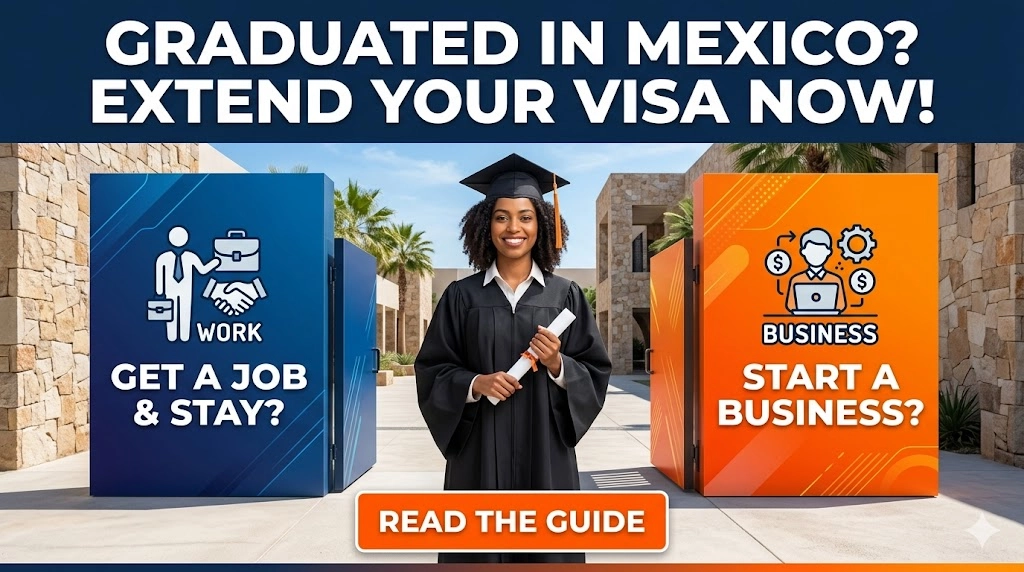
2. The Ultimate Privilege: The In-Country “Cambio de Condición”
For a standard tourist or a digital nomad sitting in Mexico City on a 180-day visitor stamp, obtaining residency requires them to physically leave the country, book an appointment at a Mexican consulate abroad (often waiting months for a slot), and apply entirely from scratch.
As an active, legal student resident, you are exempt from this exhausting hurdle. Under Article 43 of the INM guidelines, you are legally entitled to apply for a Cambio de Condición de Estancia (Change of Condition of Stay).
This administrative procedure allows you to seamlessly swap your student card for a standard, adult Temporary Resident card without ever crossing a border. You simply transition your federal file at your local INM office. However, the golden rule of Mexican immigration applies: You must apply for this Cambio before your current student card expires.
To successfully execute this change, you must fit perfectly into one of three specific legal pathways outlined by the Mexican government.
3. Pathway A: The Corporate Job Offer (The Most Common Route)
If your goal is to immediately enter the Mexican workforce, earn pesos, and build your career locally, you must transition from a Student to a Residente Temporal con Permiso para Trabajar (Temporary Resident with Permission to Work).
This pathway requires a legally registered Mexican corporation to formally sponsor you. You cannot simply freelance, consult on the side, or work for a cash-only business.
The Employer’s CIE Registry
Before a Mexican company can offer you a job that the INM will actually accept, the company must hold an active Constancia de Inscripción del Empleador (CIE). This is a federal corporate registry proving the company pays its taxes, has a physical operating address, and is legally authorized by the federal government to hire foreigners.
Your Critical Action Step: When interviewing for post-graduation roles, do not assume a company can hire you just because they like your resume. Your first question to the HR department must be: “¿La empresa cuenta con su Constancia de Inscripción del Empleador (CIE) vigente ante el INM?” If they do not hold an active CIE, they cannot legally hire you, and acquiring one takes weeks of corporate legal work.
The Job Offer Requirements
The company must provide you with a formal, highly specific job offer letter printed on their official corporate letterhead. This letter must explicitly state:
- Your full legal name (matching your passport).
- Your exact job title.
- Your monthly salary in Mexican Pesos (MXN).
- A detailed, bulleted description of your daily activities.
The Golden Rule of Alignment: The INM will heavily scrutinize this offer letter to ensure the job is directly, inextricably related to the degree you just earned. If you just graduated with a Master’s degree in Architecture, the INM will reject a work permit petition for you to manage a digital marketing team or work in hospitality. The job must justify your specialized Mexican education.
Proving Your Graduation
To prove you are ready to enter the workforce and possess the skills the company is hiring you for, the INM requires hard evidence that you actually completed your studies. You must submit your official university Título (Degree) or your Carta de Pasante / Kardex (Official Transcript and Letter of Completion) signed and stamped by your university’s academic director.
To understand the broader implications and the robust labor rights associated with entering the formal Mexican workforce, read our comprehensive guide on Getting a Work Permit in Mexico: Employer Sponsorship Explained.
4. Pathway B: Economic Solvency (The Remote Worker Route)
What if you do not want to work for a local Mexican company? What if you graduated, but you have a lucrative remote job offer from a tech firm in the United States, or you want to live off your accumulated savings or a trust fund while you build your own startup in Mexico?
You can execute a Cambio de Condición to a standard Residente Temporal (without local work permission) by proving Economic Solvency.
The 2026 In-Country UMA Thresholds
This is where many recent graduates get caught completely off guard. The financial thresholds required to prove solvency inside Mexico (for an in-country Cambio) are significantly higher than the thresholds required if you were applying fresh at a consulate in your home country.
The INM calculates these thresholds using the 2026 UMA (Unidad de Medida y Actualización), which is officially set at $117.31 MXN daily. You must prove EITHER consistent monthly income OR a massive liquid savings balance:
- Monthly Income (400 Days of UMA): You must prove you have a steady, foreign-sourced monthly income equivalent to 400 days of the current UMA over the last 6 consecutive months.
- The Exact Math: 400 x $117.31 = **$46,924 MXN per month**.
- The USD Estimate: Approximately $2,600 to $2,800 USD after taxes, hitting your bank account every single month.
- Liquid Savings (20,000 Days of UMA): If you do not have a monthly income, you must show an average monthly balance over the last 12 months equivalent to 20,000 days of UMA.
- The Exact Math: 20,000 x $117.31 = **$2,346,200 MXN**.
- The USD Estimate: Approximately $135,000 to $145,000 USD.
If you meet these elite financial thresholds (perhaps through a high-paying remote job or family wealth), you simply submit your original foreign bank statements to the INM, and you are granted standard Temporary Residency, allowing you to live in Mexico while earning money abroad.
5. Pathway C: Family Unity (Vínculo Familiar)
If you spent the last four years studying in Mexico, there is a very high probability you built deep, enduring personal relationships. If those relationships resulted in marriage or the birth of a child, you have access to the most privileged, fast-tracked immigration pathway in the country.
Under the constitutional principle of Vínculo Familiar (Family Unity), the Mexican government fiercely protects your right to remain with your Mexican family, entirely waiving the financial requirements that plague other applicants.
- Marriage to a Mexican Citizen or Resident: If you marry a Mexican national or a foreigner who already holds Permanent Residency, you can apply for a Cambio de Condición based purely on your marriage. The INM completely waives the economic solvency requirements. You simply present your Mexican marriage certificate (Acta de Matrimonio). You will be granted a Temporary Resident card, and after just two years, you can upgrade to Permanent Residency.
- Having a Mexican Child: If you had a child in Mexico during your studies, that child is a Mexican citizen by birthright under the law of Jus Soli. As the parent of a Mexican citizen, you bypass the Temporary Residency phase entirely. You are eligible to execute a Cambio de Condición directly to Residente Permanente (Permanent Residency) immediately upon the registration of your child’s birth.
For a deep dive into the nuances of spousal visas, the timeline for citizenship, and family unity, review Permanent Residency through Family Ties: Marrying a Mexican or Having Mexican Children.
6. The Step-by-Step “Cambio” Bureaucracy
Regardless of which pathway you choose (Job Offer, Solvency, or Family), the physical administrative process at the INM follows a strict, highly regulated sequence. You must execute this flawlessly.
Step 1: The Digital Formatting
You must log onto the INM Micrositio and generate the specific application for a Cambio de Condición de Estancia. You will select your exact pathway from the dropdown menus (e.g., “Estudiante a Residente Temporal por Oferta de Empleo”). You must fill out the digital Formato Básico with your biographical details, ensuring your address matches your current utility bills perfectly.
Step 2: The Formal Request Letter
You must draft a formal, respectful letter (in Spanish) addressed to the INM. This letter must state your full legal name, your current student card number, your exact address, and a formal request to change your status. You must detail your justification (e.g., naming your new employer and their CIE number, detailing your remote income, or naming your new Mexican spouse).
The Blue Pen Rule: You must sign this letter, and all accompanying INM forms, in blue ink. If you use black ink, the receiving agent will reject your entire dossier under the assumption that the signature might be a photocopy. This is a rigid, non-negotiable bureaucratic standard.
Step 3: The INM Visit and the Passport Lock
You must visit your local INM office early in the morning and submit your original passport, your physical student residency card, your request letter, your tamaño infantil photographs (white background, no smiling, ears visible), and all supporting documents.
If the agent accepts your file, they will issue you a tracking number (NUT). From this exact moment, your application is processing, and your passport is effectively locked. You cannot leave Mexico. If you exit the country while a Cambio is processing, the border systems alert the INM, your application is instantly canceled under the presumption of abandonment, and your residency is destroyed. You will have to start over at a consulate abroad.
Step 4: Paying the Federal Fees
The agent will give you a Formato para Pago de Derechos (payment document). You must take this to a local Mexican bank (like BBVA, Santander, or Banorte). In 2026, you will pay two distinct fees:
- The Reception and Study Fee: Approximately $1,800 MXN just for the INM to legally review your file.
- The Card Issuance Fee: Once your file is officially approved, you return to the bank to pay the fee for the physical Temporary Resident card (ranging from roughly $5,500 MXN for a one-year card, up to $12,000+ MXN for multiple years).
Step 5: Fingerprints and the New Card
After an anxious waiting period of 3 to 8 weeks, you will receive an email notification. You return to the INM, provide fresh digital fingerprints, surrender your old student card to be destroyed, and receive your new, adult Tarjeta de Residente Temporal.
To properly budget for these rising federal expenses, read Mexico Immigration Fees and Costs: Budgeting for Your Residency.
7. The Document Gauntlet and Certified Translations
If you are applying for your Cambio via the Economic Solvency route using foreign bank accounts, or if you married your Mexican spouse outside of Mexico before returning for your studies, you must overcome a severe administrative hurdle.
Foreign documents (like a Chase bank statement from the US, or a marriage certificate from Canada) are legally meaningless to the INM unless they are internationally authenticated via an Apostille from your home government.
Once apostilled, Mexican immigration law strictly mandates that any official foreign document must be accompanied by a certified Spanish translation.
You cannot use Google Translate. You cannot ask your bilingual university professor or your Mexican friends to translate them. The Mexican government explicitly requires translations performed by a recognized, sworn translator embedded within the Mexican legal system (a Perito Traductor).
We strongly recommend utilizing RushTranslate for your entire immigration dossier. They specialize in certified, sworn translations specifically formatted for complex Mexican INM procedures and corporate applications. By sending your apostilled foreign bank statements or vital records to RushTranslate prior to submitting your Cambio application, you ensure your documents are legally flawless, culturally compliant, and universally accepted by the INM. Do not risk a rejection, a lost job offer, and a potential deportation order over a translation technicality.
8. Healthcare Transition: Losing Your Campus Safety Net
As an international student, you likely relied on a basic, low-cost student health insurance policy mandated by your university for enrollment, or you utilized the convenient campus health clinics for your basic medical needs.
The absolute moment you graduate and transition into a working professional, that safety net vanishes. You must immediately secure your own adult healthcare strategy.
The IMSS Reality
If you accept a corporate job offer (Pathway A), your new Mexican employer is legally obligated to register you with the Instituto Mexicano del Seguro Social (IMSS). This grants you access to the public healthcare system. While IMSS is an excellent backup for routine medications and pre-existing conditions, it is chronically underfunded and severely backlogged. Waiting for a specialist appointment or non-emergency surgery can take months.
The Private Healthcare Imperative
Now that you are entering the professional world, you must protect your new income and your life savings. Mexico boasts world-class private hospitals (such as Hospital Ángeles, Star Médica, or Hospital San Javier). However, they are strict for-profit businesses. In a medical emergency, hospital administrators will demand a massive, upfront credit card deposit (often ranging from $3,000 to $10,000 USD) before admitting you to the ER or beginning stabilization.
Attempting to self-insure as a young professional is a massive financial risk. You must secure robust international health coverage to guarantee VIP access to these private facilities without facing financial ruin.
We highly recommend upgrading your basic student coverage to a comprehensive professional policy through Cigna Global. Their expat-focused international plans offer direct billing networks with top-tier Mexican private hospitals. This means the hospital coordinates the massive bills directly with Cigna Global, completely bypassing the need for you to drain your new salary or your savings during a medical emergency. Securing this coverage ensures your transition into the Mexican workforce is physically and financially protected.
9. Taxes, the SAT, and Your Professional Future
Graduating in Mexico means entering the formal adult ecosystem. You can no longer hide behind your student status. You must face the Mexican Tax Authority (SAT).
The Inescapable RFC
To legally live and work in Mexico as a non-student resident in 2026, you are legally required to possess an RFC (Registro Federal de Contribuyentes). This is the Mexican equivalent of a Social Security Number or Tax ID.
- If you take a corporate job: Your Mexican employer absolutely requires your RFC to process your payroll, issue your electronic paystubs (CFDIs), and withhold your income tax (ISR). You literally cannot be paid without it.
- If you work remotely (Solvency): Even if you don’t owe Mexican taxes on your foreign income, you still need an RFC to open a standard Mexican bank account, sign a formal, legally binding apartment lease, or buy a car from a dealership.
You must book an appointment at the SAT to register your biometric data (iris scans and fingerprints) and secure your RFC and your e.firma (electronic signature).
The 183-Day Tax Rule for Remote Workers
If you choose the remote work route (Pathway B), you must be hyper-aware of Mexican tax residency laws. If you spend more than 183 days a year physically present in Mexico, the SAT legally considers you a Mexican tax resident.
Even if your salary is paid in USD to an American bank by an American company, you may be legally liable to declare that global income in Mexico. Fortunately, Mexico holds robust double-taxation treaties with many nations (including the US, Canada, and the UK) to prevent you from being taxed twice on the same income, but federal compliance and reporting are mandatory. To understand your new adult tax liabilities, thoroughly read Taxes in Mexico for Expats: A Complete Guide to Income Tax and More.
10. The Resetting Clock: The Path to Permanent Residency
Finally, we must address the most frustrating, often misunderstood reality for graduating international students regarding their long-term future in Mexico.
Many students assume that because they just spent four consecutive years studying in Mexico on a Residente Temporal Estudiante visa, they are immediately eligible to upgrade to Permanent Residency upon graduation.
This is entirely false.
Under Mexican immigration law, time spent on a Student Visa does not count toward the four consecutive years required to earn Permanent Residency. The INM views your student years as a specialized, non-migratory learning period, not as true residency.
The Clock Starts at Zero
The exact moment the INM approves your Cambio de Condición and hands you your new, non-student Tarjeta de Residente Temporal (whether you secured it via a corporate job offer or through economic solvency), your four-year clock resets to Day 1.
You must now hold this new Temporary Resident card, and renew it successfully, for four consecutive years. Only after completing those four years as a working professional or a solvent expat will you be legally entitled to convert your status to Residente Permanente (Permanent Residency).
Once you finally achieve Permanent Residency, the bureaucratic chains loosen entirely. You possess the inherent, constitutional right to work anywhere in the economy without corporate sponsorship, your card never expires, and you are placed on the direct pathway to apply for full Mexican citizenship and a dual passport. To deeply understand this long-term, multi-year strategy, review Qualifying for Permanent Residency in Mexico: Paths and Requirements.
11. Summary Checklist for Graduating Students
If your graduation date is rapidly approaching, use this rapid-fire checklist to ensure your transition into Mexican society is seamless and legally unassailable:
- [ ] Check Your Expiration Date: Know exactly when your student card expires. You MUST initiate your Cambio at the INM before this date.
- [ ] Choose Your Pathway: Secure a corporate job offer (ensure the company has an active CIE), organize your remote financial solvency documents, or prepare your marriage certificates.
- [ ] Acquire Academic Proof: Obtain your official Título or Carta de Pasante signed and stamped by your university director.
- [ ] Translate Foreign Documents: Submit any foreign bank statements or vital records to RushTranslate for certified Spanish translation prior to your INM visit.
- [ ] File the INM Petition: Submit your Cambio de Condición dossier, ensuring you sign all documents in blue ink. Do not leave Mexico while it processes!
- [ ] Register with the SAT: Secure an appointment to obtain your adult RFC (Tax ID) and your e.firma.
- [ ] Upgrade Your Healthcare: Ditch the basic campus clinic plan and purchase a comprehensive Cigna Global private health insurance policy to protect your new income and your future.
Graduating from a Mexican university is not the end of your adventure; it is merely the prologue. By successfully navigating the strict Cambio de Condición process, transitioning into the formal tax system, and securing your professional healthcare safety net, you transform from a passing student into a fully integrated, legally protected, and thriving member of the Mexican economy. The vibrant, complex, and deeply rewarding reality of adult life in Mexico awaits you.
References
Primary Sources (Official)
- Instituto Nacional de Migración (INM): The definitive federal portal detailing the exact legal requirements, UMA solvency thresholds (400 days for income, 20,000 days for savings), and the specific procedures for students transitioning to standard residency. https://www.gob.mx/tramites/ficha/cambio-de-condicion-de-estancia-de-residente-temporal-estudiante-a-residente-temporal/INM823
- Secretaría de Relaciones Exteriores (SRE): The official portal outlining the initial consular guidelines and the restrictions placed on the student visa class. https://www.gob.mx/sre/acciones-y-programas/visas-para-extranjeros
Other Helpful Sources
- Mexperience: A highly trusted portal providing simplified explanations of the corporate sponsorship process (CIE) and the precise legal differences between student and standard temporary residency. https://www.mexperience.com/lifestyle/mexico-immigration-guide/
- ExpatDen Mexico: A detailed, firsthand resource offering granular breakdowns of Mexican corporate culture, navigating the SAT, and day-to-day logistics for young professionals entering the workforce. https://www.expatden.com/mexico/
Disclaimer
The information provided in this comprehensive guide is for educational, logistical, and informational purposes only and does not constitute formal immigration, legal, tax, labor, or medical advice. Requirements for Apostilles, UMA financial thresholds for in-country status changes, and federal fee structures fluctuate annually. Always verify the most current requirements directly with your prospective employer’s legal team, the INM, or the SAT. We strongly recommend consulting with a certified bilingual Mexican immigration attorney and a registered Mexican accountant (Contador Público) before signing employment contracts, navigating double taxation treaties, or initiating a Cambio de Condición.