Can You Work on a Temporary Resident Visa in Mexico? Rules Explained
The romanticized vision of moving to Mexico, opening a little beachside bar, or picking up freelance graphic design gigs for local businesses is often shattered by a strict, digitized bureaucratic reality. The Mexican government fiercely protects its local labor market. A standard Temporary Resident Visa does not grant you the automatic, blanket right to work in the Mexican economy. This comprehensive guide strips away the rumors and provides a granular, step-by-step roadmap for understanding the difference between lucrative and non-lucrative activities, how to legally work remotely, how to secure corporate sponsorship, and how to legally freelance in Mexico.
Disclosure: This post may contain affiliate links. We may earn a commission at no extra cost to you if you make a purchase through these links. Read full disclosure.
1. The Golden Rule: Lucrative vs. Non-Lucrative Activity
The entire Mexican immigration framework surrounding employment hinges on one critical, foundational distinction: Are your activities considered “Lucrative” or “Non-Lucrative”?
Before you accept a job, sign a contract, or sell a product, you must determine which category your economic activity falls into.
Non-Lucrative Activity (The Foreign Income Exemption)
If you live in Mexico but perform your work entirely for a company or clients located outside of Mexico, and your compensation is deposited directly into a foreign bank account, you are engaging in a “non-lucrative” activity in the eyes of the Mexican government.
From the INM’s perspective, you are not taking a job from a Mexican citizen, nor are you competing in the local market. Instead, you are bringing foreign capital into the country and spending it on local rent, food, and services. The Mexican government highly encourages this.
Lucrative Activity (The Local Market Rule)
If you intend to earn Mexican Pesos, provide services to clients physically located within Mexico, open a brick-and-mortar storefront, or sign a formal employment contract with a Mexican corporation, you are engaging in “lucrative” activity.
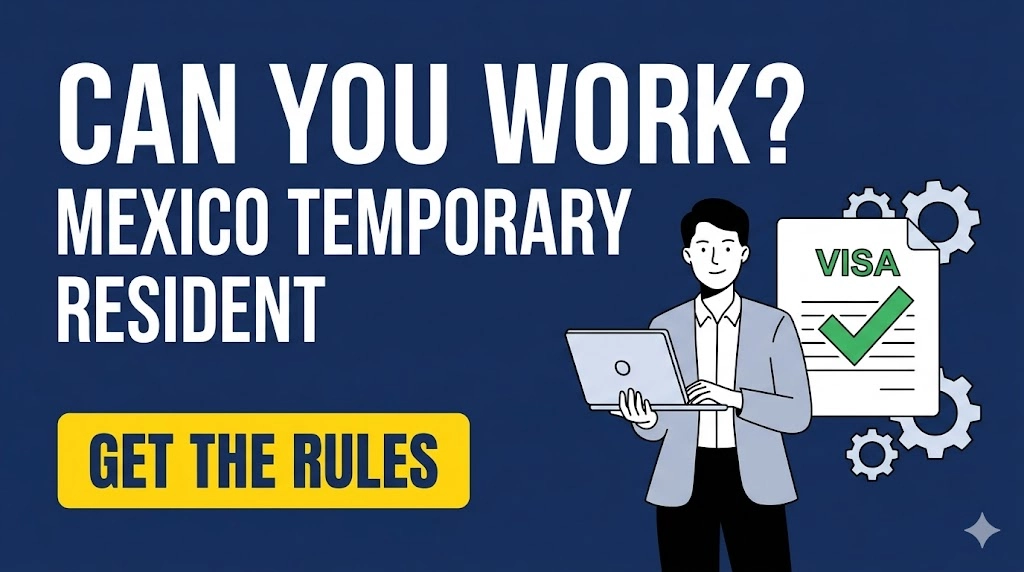
You are now entering the local labor pool. The moment you cross this line, your standard Temporary Resident Visa is no longer sufficient. You must obtain explicit, formalized Permission to Work (Permiso para realizar actividades remuneradas) from the INM, and you must register with the Mexican tax authority to pay income tax on those local earnings.
2. The Digital Nomad Reality (Non-Lucrative Work)
If you are a remote software engineer for a tech firm in Seattle, a freelance copywriter with clients in London, or a consultant being paid into a Canadian bank account, you fall under the non-lucrative category.
Do Remote Workers Need a Work Permit?
No. If you originally obtained your Temporary Resident Visa by proving “Economic Solvency” (showing sufficient monthly income or savings at a Mexican consulate abroad), you are legally allowed to continue earning that foreign income while physically residing in Mexico.
Your residency card will state No Inmigrante or simply Residente Temporal without specific work permissions on the back. This is perfectly legal for your situation.
The Tax Implications for Nomads in 2026
While the INM does not require you to hold a work permit, the Mexican Tax Authority (Servicio de Administración Tributaria, or SAT) has tightened its grip.
Under Mexican tax law, if you spend more than 183 days in Mexico during a 12-month period, or if Mexico becomes your primary “center of vital interests,” you are considered a Mexican tax resident. Even if your income is sourced abroad, you may be liable to report it to the SAT. Fortunately, Mexico holds double-taxation treaties with over 50 countries (including the US, Canada, and the UK) to prevent you from being taxed twice on the same income.
To optimize your remote setup, legally manage your cross-border liabilities, and understand the 183-day rule, please review our Digital Nomads in Mexico: Remote Work Guide.
3. Entering the Local Economy: The “Permiso para Trabajar”
What happens if you already hold a standard Temporary Resident Visa (based on economic solvency), but you suddenly receive a lucrative job offer from a Mexican company, or you decide you want to start selling your artisanal goods at a local market in Oaxaca?
You do not have to leave the country and start the visa process over from scratch. Because you are already a legal resident, you can apply directly to the INM to modify your current status. You must apply for a Permiso de Trabajo (Work Permit) to be added to your existing residency card.
You have two primary pathways to secure this permission: Corporate Sponsorship or Independent/Freelance Authorization.
4. Pathway A: Corporate Sponsorship (The Employee Route)
If you want to accept a formal, salaried W-2 style job with a Mexican company, the bureaucratic burden falls heavily on your prospective employer. You cannot simply update your visa on your own; your employer must formally sponsor you.
Step 1: The Employer’s CIE Registration
Before any Mexican company can legally hire a foreigner, the company itself must be registered with the INM and hold a valid Constancia de Inscripción del Empleador (CIE).
The CIE is the government’s way of verifying that the company is a legitimate, tax-paying corporate entity authorized to sponsor foreign workers. If a local startup or language school offers you a job but does not hold an active CIE, they cannot legally sponsor your work permit. Verifying the company’s CIE status should be your very first question during the interview process.
Step 2: The Formal Job Offer
The company must provide you with a formal job offer printed on their official letterhead. The offer must detail your exact position, your salary in Mexican Pesos, your work location, and it must be signed by the company’s legal representative.
Step 3: The INM Application (Inside Mexico)
Because you already hold a Temporary Resident card, your employer files a petition directly with the local INM office to add a work permit to your existing file.
- They must justify why they are hiring you (a foreigner) instead of a Mexican citizen.
- You will submit your current residency card, your passport, the job offer, and proof of your qualifications.
Step 4: Updating the Plastic Card
Once the INM approves the employer’s petition, you will be called into the immigration office. You will surrender your current Temporary Resident card and provide new fingerprints.
The INM will issue you a brand new physical card. On the back of the new card, under your personal details, there will be a specific notation indicating that you are now authorized to perform lucrative activities, explicitly tying your work permission to that specific employer.
Important Warning: If you quit that job or are fired, your permission to work ends. If you find a new job with a different Mexican company, that new company must file a fresh sponsorship petition with the INM before you can legally start working for them. To understand the broader costs and fees associated with these INM modifications, review Mexico Immigration Fees and Costs: Budgeting for Your Residency.
5. Pathway B: The Independent Professional (The Freelance Route)
Mexico is a land of entrepreneurs, and many expats eventually want to start their own local businesses, open cafes, or offer independent consulting services to Mexican clients.
If you do not have a corporate sponsor but want to earn Mexican Pesos independently, you must apply to the INM for an independent work permit. You are essentially sponsoring yourself. This is a highly scrutinized process.
Step 1: The SAT Registration (RFC)
The Mexican government will not grant you permission to work independently unless they are absolutely certain they can tax you. Before you even approach the INM, you must make an appointment with the SAT to obtain your RFC (Registro Federal de Contribuyentes)—your federal tax ID.
You must register under a specific tax regime that matches your intended business. For most independent freelancers and small business owners, this means registering under the Persona Física con Actividad Empresarial (Individual with Business Activity) regime, or the highly favorable Régimen Simplificado de Confianza (RESICO), which offers dramatically lower income tax rates for small earners.
Step 2: The Business Plan and Petition
Armed with your official SAT registration, you must file a petition with the INM for a work permit.
- You must draft a formal letter (in Spanish) detailing exactly what your independent lucrative activity will be, where it will take place, and who your target clients are.
- You must submit your SAT Constancia de Situación Fiscal proving you are legally registered to pay taxes on this specific activity.
Step 3: Approval and Scope
If the INM approves your independent business plan, they will issue you a new Temporary Resident card authorized for independent lucrative activities.
Crucial Note on Scope: This independent permit authorizes you to work for yourself. You cannot use this permit to accept a formal, salaried employment contract with a Mexican corporation. If you want to become a formal employee later, you must switch back to Pathway A (Corporate Sponsorship). To dive deeper into local taxation and the RESICO regime, read Taxes in Mexico for Expats: A Complete Guide to Income Tax and More.
6. The Bureaucratic Gauntlet: Document Preparation and Translation
Whether you are applying for corporate sponsorship or an independent work permit, the INM requires proof that you are qualified to perform the work you are requesting permission to do. This is where thousands of expats hit a devastating bureaucratic wall.
If you are applying for a job as an engineer, a teacher, or a specialized consultant, the INM will demand to see your university degrees, professional licenses, or technical certifications.
The Apostille Requirement
A foreign university degree or professional certificate is legally meaningless in Mexico unless it is authenticated. If your degree was issued in the US, UK, Australia, or Canada, it must bear an Apostille—an international certification attached by your home government verifying the document’s authenticity.
The Certified Translation Mandate
Once your degree is Apostilled, you face the language barrier. Mexican law strictly mandates that any official foreign document submitted for immigration or employment purposes must be accompanied by a certified Spanish translation.
You cannot use an automated web translator, nor can you ask your bilingual friend to translate your diploma. The INM explicitly requires translations performed by a recognized, sworn translator (known in Mexico as a Perito Traductor).
We strongly recommend utilizing RushTranslate for your entire professional dossier. They specialize in certified, sworn translations specifically formatted for complex Mexican immigration and employment cases. By sending your Apostilled degrees, professional licenses, and vital records to RushTranslate prior to your INM submission, you ensure your professional qualifications are legally unassailable and culturally compliant. Do not risk an INM rejection or a lost job offer over a translation technicality—get your credentials certified professionally.
7. The Inescapable RFC: Why Every Resident Needs One in 2026
Even if you never plan to earn a single Mexican Peso and intend to remain strictly non-lucrative, the administrative reality of living in Mexico has changed.
The era of living off the grid is over. The Mexican Tax Authority (SAT) now legally requires all Temporary and Permanent Residents to possess an RFC (Tax ID), regardless of their employment status.
Without an RFC, your life in Mexico will be severely paralyzed. Even if you are not working locally, you absolutely need an RFC to:
- Open a Mexican bank account.
- Buy a car from a dealership.
- Sign a formal, post-paid cellular or fiber-optic internet contract.
- Purchase or sell real estate (to avoid punitive withholding taxes).
If you are approved for a local work permit (lucrative activity), your RFC will simply be updated by your accountant to reflect your active tax-paying status. Securing an appointment at the SAT is notoriously difficult, so you should begin trying to book one online the exact day your physical residency card is issued.
8. Healthcare for the Working Expat: The IMSS vs. Private Divide
Entering the formal Mexican labor market fundamentally alters your healthcare situation. Understanding the dual medical system is critical to protecting your family and your finances.
The Public System: IMSS Registration
If you secure Corporate Sponsorship (Pathway A) and become a formal employee of a Mexican company, your employer is legally obligated to register you with the Instituto Mexicano del Seguro Social (IMSS).
A portion of your paycheck will be automatically deducted to fund this, and your employer will pay a matching contribution. This grants you full access to the Mexican public healthcare system. If you break your arm, need surgery, or require maternity care, you can receive treatment at an IMSS hospital at no point-of-service cost.
The Critical Need for Private Insurance
While having IMSS is an excellent legal safety net, the reality of utilizing the public system is complex. IMSS hospitals are chronically overcrowded, severely underfunded, and operate entirely in Spanish. Securing an appointment with a specialist can take months, and there are frequent shortages of specialized medications.
For expats accustomed to immediate, premium care, the public system is often insufficient. If you suffer a severe medical crisis, you will almost certainly want to utilize Mexico’s elite private hospital networks (such as Hospital Ángeles, Star Médica, or Hospital San Javier). These facilities offer world-class, bilingual care, but they operate strictly for-profit.
In an emergency, private hospital administrators will mercilessly demand a massive, upfront credit card deposit—often ranging from $3,000 to $10,000 USD—before they will admit you to the emergency room or begin stabilization.
Do not rely solely on your employer-provided IMSS registration for catastrophic events. You must secure a robust international health insurance policy to guarantee VIP access to private facilities. We highly recommend securing coverage through Cigna Global. Their expat-focused international plans offer direct billing with top-tier Mexican private hospitals. This means the hospital coordinates the massive bills directly with Cigna Global, completely bypassing the need for you to drain your life savings during a medical emergency. Securing this coverage ensures your time working in Mexico is physically and financially protected. For a comprehensive comparison, read Healthcare in Mexico: Complete Guide for Expats Public vs Private.
9. The Consequences of Working Illegally in Mexico
Some expats, deterred by the bureaucracy of the SAT and the INM, attempt to work “under the table” for cash, bartending in tourist towns or offering un-registered consulting services.
This is an incredibly dangerous gamble. The INM regularly conducts sweeps of popular expat businesses, construction sites, and language schools. If you are caught engaging in lucrative activities without explicit permission on your Temporary Resident card, the consequences are severe:
- Immediate Detention: You can be detained in an immigration holding facility (Estación Migratoria).
- Massive Fines: You will face punitive financial penalties calculated in days of UMA.
- Deportation: Your residency card will be immediately revoked, and you will be deported to your home country.
- The Ban: You will be placed on a federal blacklist, banning you from re-entering Mexico for anywhere from 1 to 5 years.
Do not jeopardize your life in Mexico to skip a few bureaucratic steps. The work permit system exists to protect both you and the local labor market. Follow the rules.
10. The Ultimate Goal: Transitioning to Permanent Residency
If dealing with work permits, corporate sponsorships, and CIE registrations sounds exhausting, there is a massive light at the end of the tunnel.
Your Temporary Resident Visa maxes out at exactly four years. Once you have completed four consecutive years as a Temporary Resident, you are legally entitled to convert your status to Permanent Residency (Residente Permanente).
The absolute best part of this conversion process? The right to work becomes automatic.
Permanent Residents possess the inherent, constitutional right to work in the Mexican economy. You no longer need to petition the INM for a specific work permit. You do not need a corporate sponsor. You can accept local jobs, start businesses, and operate as an independent contractor freely (provided you pay your SAT taxes). Earning your Permanent Residency liberates you from the INM employment bureaucracy for the rest of your life.
To understand how to successfully execute this final upgrade, review Upgrading from Temporary to Permanent Residency: What You Need to Know.
Summary Checklist for Working on a Temporary Visa
If you are planning to earn money while holding a Temporary Resident card, use this rapid-fire checklist to ensure your economic activities are legally sound:
- [ ] Define Your Revenue: Determine if your work is strictly Non-Lucrative (foreign remote work) or Lucrative (local Mexican clients/employer).
- [ ] Verify the Employer (If Lucrative): If accepting a local job, confirm the company holds a valid, active Constancia de Inscripción del Empleador (CIE).
- [ ] Prepare Credentials: Gather your university degrees, professional certificates, and birth certificates. Order fresh Apostilles from your home government.
- [ ] Translate Legally: Submit all foreign professional documents and vital records to RushTranslate for certified Spanish translation prior to submitting them to the INM.
- [ ] Register with the SAT: Secure an appointment to obtain your RFC (Tax ID) and register under the appropriate tax regime (such as RESICO).
- [ ] Secure Your Health Net: Purchase a comprehensive Cigna Global private health insurance policy so you aren’t solely reliant on the public IMSS system during an emergency.
- [ ] Wait for the Card: Never log a single hour of local, lucrative work until your new, updated physical residency card with the work permission notation is actually in your hand.
Working in Mexico—whether as a remote digital nomad leveraging the cost of living, or as an integrated local professional—offers an incredible opportunity for cultural immersion and professional growth in one of the world’s most dynamic emerging markets. While the INM regulations and SAT tax requirements demand meticulous attention to detail, successfully navigating this system transforms you from a passing visitor into a legally protected, deeply integrated member of the Mexican economy.
References
Primary Sources (Official)
- Instituto Nacional de Migración (INM): The definitive federal portal detailing the legal requirements, required forms, and tracking mechanisms for adding lucrative activity permissions to an existing residency card. https://www.inm.gob.mx/mpublic/publico/inm-tramites.html
Other Helpful Sources
- Mexperience: A highly trusted portal providing simplified explanations of the critical distinction between lucrative and non-lucrative activities, and the CIE corporate sponsorship requirements. https://www.mexperience.com/lifestyle/mexico-immigration-guide/
- ExpatDen Mexico: A detailed, firsthand resource offering granular breakdowns of Mexican corporate culture, salary expectations, and day-to-day logistics for working expats. https://www.expatden.com/mexico/
Disclaimer
The information provided in this comprehensive guide is for educational, logistical, and informational purposes only and does not constitute formal immigration, legal, tax, or labor advice. Requirements for Apostilles, corporate CIE registries, and tax regime eligibility fluctuate based on federal mandates. Always verify the most current requirements directly with your prospective employer, the INM, or the SAT. We strongly recommend consulting with a certified bilingual Mexican immigration attorney and a registered Mexican accountant before signing employment contracts, opening local businesses, or engaging in lucrative activities. Thoroughly verify your international health insurance coverage networks directly with your provider to ensure full protection in Mexico.