Mexico Immigration FAQs: Everything New Expats Need to Know
Relocating to a new country is an exhilarating dream, but the moment you start researching the actual logistics of moving to Mexico, that dream often collides with a wall of intense bureaucratic confusion. If you are feeling overwhelmed by conflicting Facebook group advice, outdated blogs from 2018, and confusing consulate websites, take a deep breath. You are in the right place. To help you navigate this new, highly regulated reality, I have compiled the definitive, up-to-date answers to the most frequently asked questions by expats looking to call Mexico home.
Disclosure: This post may contain affiliate links. We may earn a commission at no extra cost to you if you make a purchase through these links. Read full disclosure.
1. Can I just live in Mexico on a tourist visa by doing “border runs”?
The short, candid answer is absolutely not. That strategy is dead.
For decades, the foundation of expat life for many foreigners was the Forma Migratoria Múltiple (FMM), a paper slip handed out on airplanes that almost automatically granted visitors 180 days in the country. Expats would stay for six months, fly to Texas, Belize, or Guatemala for the weekend, and return for a fresh 180-day stamp.
Today, Mexico has fully transitioned to a digital immigration system at all major international airports (like Mexico City, Cancún, Guadalajara, and Los Cabos). The paper FMM has been largely eliminated. When you scan your passport at an automated e-gate or hand it to an immigration officer, your entry is recorded instantly in a centralized federal database.
The law states that tourists may be granted up to 180 days. It is a maximum limit, not a guaranteed right. Because officers can now see your entire travel history on their screens in real-time, they are actively cracking down on foreigners who appear to be living in Mexico without paying taxes or holding residency. If they see you have spent the majority of the last year in the country, they are highly likely to issue you a restricted entry stamp—often limiting your stay to just 7, 15, or 30 days.
If you overstay this digital limit, you face severe fines, potential detainment in an immigration holding facility, and a multi-year ban from re-entering the country. Furthermore, you cannot legally sign a long-term apartment lease, open a local bank account, or register a vehicle on a tourist stamp. If you plan to stay long-term, you must formalize your status immediately.

2. What is the difference between Temporary and Permanent Residency?
Choosing the right residency track depends entirely on your lifestyle goals, your financial situation, and whether or not you plan to bring your car across the border.
Temporary Residency (Residente Temporal)
This is the standard starting point for the vast majority of expats, digital nomads, and younger retirees.
- The Timeline: It is granted initially for exactly one year. Before it expires, you can renew it for one, two, or three additional years (for a maximum total of four consecutive years).
- The Four-Year Rule: After completing four consecutive years as a Temporary Resident, you are legally entitled to convert your status to Permanent Residency without having to prove your financial solvency all over again.
- The Vehicle Advantage: This is a massive, often-overlooked benefit. As a Temporary Resident, you are legally allowed to bring a foreign-plated (US or Canadian) vehicle into Mexico and keep it there for the duration of your residency under a Temporary Import Permit (TIP). To fully understand this logistical hurdle, review Bringing Your Car vs Buying in Mexico: Pros and Cons for Expats.
Permanent Residency (Residente Permanente)
Permanent Residency is the ultimate immigration goal. The card never expires, meaning you are permanently liberated from the anxiety of annual INM renewals.
- Direct Application: While most expats must wait four years to convert from Temporary status, retirees who meet exceptionally high financial thresholds can apply directly for Permanent Residency at a consulate abroad.
- Right to Work: Permanent Residents have the absolute, inherent right to work for Mexican companies and earn pesos locally without needing to apply for a separate work permit.
- The “Car Trap”: The biggest drawback for expats is that Permanent Residents are strictly forbidden by federal customs law from driving a foreign-plated car in Mexico. The moment your status changes to Permanent, your US or Canadian vehicle becomes illegal contraband. You must sell it, drive it back north, or undertake the highly complex, expensive process of nationalizing it.
3. How much money do I need to qualify for residency in 2026?
To secure residency, you must prove “Economic Solvency.” The government wants assurance that you have the means to support yourself and will not become a financial burden on their social systems.
The 2026 UMA Shift: In the past, these requirements were tied to Mexico’s Minimum Wage, which caused the USD requirements to skyrocket wildly as the minimum wage was artificially raised by over 20% annually. Thankfully, starting in late 2025 and fully enforced in 2026, Mexican consulates officially shifted to using the UMA (Unidad de Medida y Actualización) for these calculations. The UMA only rises with standard inflation (roughly 3% to 4% a year), which has stabilized the requirements. The 2026 UMA is set at 117.31 MXN.
You only need to prove either monthly income or savings. You do not need to prove both. (Note: The following USD figures are close approximations, as each consulate utilizes a slightly different exchange rate on the exact day of your interview).
Solvency for Temporary Residency (2026)
- Monthly Income: You must prove a consistent, after-tax monthly income (from pensions, remote work, or investments) over the last 6 months of roughly $4,400 USD.
- Savings/Investments: Alternatively, you can prove an average monthly balance in your liquid accounts over the last 12 months of roughly $74,000 USD.
Solvency for Direct Permanent Residency (Retirees Only – 2026)
- Monthly Income: You must prove a consistent monthly pension or retirement income over the last 6 months of roughly $7,400 USD.
- Savings/Investments: Alternatively, you must show an average monthly balance over the last 12 months of roughly $298,000 USD.
4. Do I really need to translate my English bank statements?
Yes. Absolutely and without exception.
Mexican consulates operate entirely in Spanish, and they are notoriously pedantic about paperwork. You cannot simply log into your US, UK, or Canadian banking app, print a screenshot in English, and hand it to the consular officer. Your bank statements must be official, showing your full name, the bank’s logo, and the exact daily or monthly balances on every single page.
Crucially, you cannot use an automated web translator or translate the documents yourself. You must use a certified, sworn translator recognized by the legal system (known in Mexico as a Perito Traductor).
We strongly recommend utilizing RushTranslate for your entire application dossier. They specialize in certified translations for complex immigration cases that are universally accepted by Mexican consulates globally. By sending your bank statements, marriage certificates, and birth certificates to RushTranslate, you ensure your financial proof is legally unassailable. A single translation error can result in an immediate rejection on the day of your interview, costing you months of waiting for a new appointment.
5. Do I need health insurance to live in Mexico?
While the Mexican government does not always rigidly demand proof of private health insurance during your initial consular interview, living in Mexico without it is an immense financial risk.
Mexico has a heavily tiered healthcare reality. Once you possess a residency card, you are legally permitted to buy into the Mexican public healthcare system (IMSS) for a few hundred dollars a year. However, the IMSS system is chronically underfunded, heavily backlogged, and operates almost exclusively in Spanish. If you need a sudden appendectomy, complex cardiac care, or cancer treatment, you do not want to be waiting in a crowded public hospital corridor.
Mexico boasts exceptional, world-class private hospitals (such as Hospital Ángeles in Mexico City, Hospital San Javier in Guadalajara, or Hospital Joya in Puerto Vallarta). However, these elite facilities operate as strict for-profit businesses. In the event of a severe emergency, hospital administrators will mercilessly demand a massive, upfront credit card deposit—often ranging from $3,000 to $10,000 USD—before they will even admit you to the emergency room or begin stabilization.
Attempting to self-insure against catastrophic trauma is a dangerous gamble. You must secure robust international health coverage to guarantee VIP access to these private hospitals without draining your life savings. We highly recommend securing an expat-tailored policy through Cigna Global. Their international plans offer direct billing networks with Mexico’s top private hospitals, meaning the hospital coordinates the massive bills directly with Cigna Global, not your personal credit card. For a comprehensive overview of how to navigate this dual medical system, read Healthcare in Mexico: Complete Guide for Expats Public vs Private.
6. Can I work remotely in Mexico on a resident visa?
Yes, provided your income originates entirely from outside of Mexico.
Mexican immigration law hinges on the strict legal distinction between “lucrative” and “non-lucrative” activities.
- Non-Lucrative: If you are a digital nomad, a remote software engineer, or a consultant earning your income from a company located entirely in the US, Canada, or Europe, and your salary is deposited into a foreign bank account, you are operating under a non-lucrative status. The Mexican government loves this setup; you are spending foreign capital in the local economy without taking a job from a Mexican citizen. You do not need any special work permits to do this on a standard Temporary Resident visa.
- To optimize your workspace, internet connectivity, and digital setup while operating remotely, review our Digital Nomads in Mexico: Remote Work Guide.
- Lucrative: However, if you intend to earn Mexican Pesos, provide services to clients located within Mexico, open a brick-and-mortar cafe, or sign an employment contract with a Mexican corporation, you are engaging in a lucrative activity. To do this legally as a Temporary Resident, you must apply to the INM for a specific Permiso para Trabajar (Permission to Work) to be attached to your residency card, and you must register with the tax authority to pay local taxes.
7. How exactly do I apply? Can I just do it in Mexico?
A common misconception is that you can simply fly to Puerto Vallarta, walk into the local immigration office, and ask for residency. You cannot. The application is a strict, two-step process that must begin outside of Mexican territory.
Step 1: The Consular Interview (Outside of Mexico)
You must initiate the process at a Mexican consulate, typically in your home country (though some expats use consulates in the US, Guatemala, or Colombia).
- The Appointment: You must book an appointment through the SRE’s digital portal, “MiConsulado.” These appointments book up months in advance, so you must plan ahead.
- The Interview: You present your passport, your original financial documents, your RushTranslate certified translations, and a visa application form. The consular officer will interview you to ensure your intentions match your visa category and that you truly possess the funds.
- The Visa Sticker: If approved, you will pay a fee (roughly $53 USD), and the officer will place a physical visa sticker inside your passport. This is not your residency card; it is a single-use entry permit valid for 180 days.
Step 2: The “Canje” Process (Inside Mexico)
The Canje (Exchange) is the process of trading your consular sticker for your actual physical plastic residency card.
- The Critical Entry: When you enter Mexico via flight or driving, you must explicitly inform the immigration officer that you are entering to process your residency (Canje). They must stamp your passport appropriately. If they mistakenly stamp you as a “Tourist,” your visa sticker is instantly voided, and you must start over.
- The 30-Day Clock: From the exact date stamped in your passport, you have a strict, unforgiving 30-day window to initiate the Canje process at your local INM office.
- The INM Visit: You will fill out paperwork (the Formato Básico), pay the federal residency fees at a local bank, and provide your fingerprints. Within 2 to 6 weeks, you will receive your official Tarjeta de Residente.
Note on 2026 Fees: Be prepared for sticker shock at the INM. In late 2025, the Mexican Congress passed a law that effectively doubled the cost of foreign residency cards for 2026. A standard one-year card now costs upwards of $5,500 MXN. To deeply understand the granular costs and fees associated with every step of this journey, you must review Mexico Immigration Fees and Costs: Budgeting for Your Residency.
8. Can I bring my spouse and children?
Yes, but they require additional financial proof. The Mexican system is built around the concept of a Primary Applicant (Titular) and their Dependents (Dependientes Económicos).
If you apply together at the consulate simultaneously, the Primary Applicant must prove the base financial solvency amount for themselves, plus an additional incremental amount for each dependent. In 2026, adding a spouse or a minor child requires proving an additional ~$1,400 USD per month in income, or an additional ~$25,000 USD in savings, per person.
The “Family Unity” Strategy: To avoid proving these massive combined financial thresholds at the consulate, many veteran expats use the “In-Country Family Unity” (Vínculo Familiar) strategy. The Primary Applicant applies alone at the consulate and secures their physical residency card in Mexico first. Later, the spouse and children enter Mexico as tourists. The Primary Applicant then goes to the local INM office and sponsors them directly from within Mexico. When you sponsor family from inside the country, the INM generally waives the financial solvency requirements for the dependents. You simply prove the legal family tie with apostilled, translated marriage and birth certificates.
9. What is an RFC and why do I need one?
The era of living in Mexico off the grid is over. The Mexican government has heavily digitized its financial tracking and tax enforcement systems.
As a legal resident (Temporary or Permanent), you are legally required to obtain your RFC (Registro Federal de Contribuyentes) from the Mexican tax authority (SAT). This is the Mexican equivalent of a Social Security Number or Tax ID.
Even if you are a retiree who owes zero Mexican taxes because your pension is taxed in your home country, you still must have an RFC. Without it, your life in Mexico will be paralyzed. You cannot:
- Open a local bank account.
- Legally purchase a car from a dealership.
- Sign a formal, post-paid cellular or internet contract.
- Buy or sell real estate without facing massive, punitive tax withholdings.
Securing an appointment at the SAT is notoriously difficult, so you should begin trying to book one online the moment your physical residency card is issued.
10. What happens if I forget to renew my residency card?
The INM does not send friendly reminder emails or text messages. It is entirely your responsibility to track the expiration date printed on the front of your Tarjeta de Residente.
You must initiate your renewal application within the 30 days prior to the expiration date. If you let your card expire by even a single day, your legal status in Mexico evaporates instantly. You will be considered in the country irregularly.
While the INM does offer a “regularization” process for expired cards, it involves paying massive financial penalties (fines calculated in days of UMA), writing formal letters of apology to immigration officials, and enduring months of legal limbo where you cannot leave the country. Set calendar alerts six months, three months, and one month before your card expires to ensure you never face this nightmare scenario.
11. Can I bring my pets with me when I move?
Yes, Mexico is a very pet-friendly country, but crossing the border with your dog or cat requires strict adherence to agricultural laws managed by SENASICA (National Service of Health, Food Safety, and Food Quality).
You do not need an import permit for dogs or cats, but you must present a Health Certificate issued by a licensed veterinarian. This certificate must be issued within 15 days of your travel date and explicitly state that your pet is clinically healthy, free of internal and external parasites, and up to date on their rabies vaccination (if over 3 months old).
When you arrive at the airport, you must take your pet to the OISA (Agricultural Health Inspection Office) desk before leaving the terminal. The inspector will physically check your pet to ensure they have no ticks or open wounds and will verify your paperwork. If you attempt to bring in prohibited pet food (like raw diets or unsealed kibble containing beef or lamb from certain regions), it will be confiscated and destroyed at the border. Ensure your pet’s documents are flawless to avoid the trauma of having your animal quarantined upon arrival.
12. Can residents actually buy property in Mexico?
Yes, foreign residents can absolutely own property in Mexico, but the legal structure depends heavily on where the property is located.
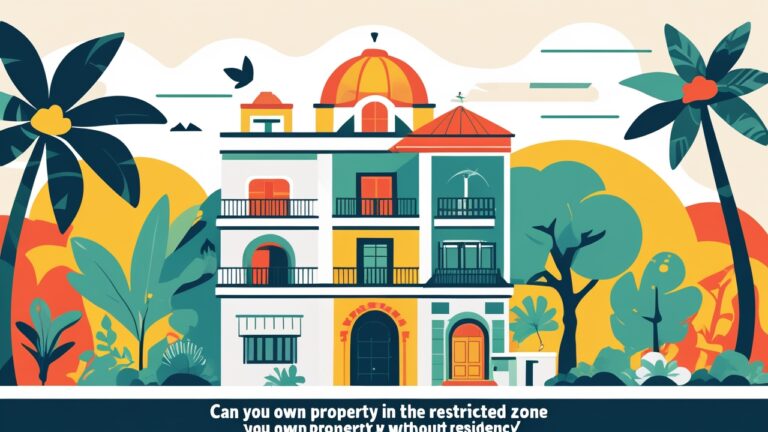
Article 27 of the Mexican Constitution prevents foreigners from holding direct title to residential land within the “Restricted Zone”—which is defined as land within 50 kilometers of the coast or 100 kilometers of any international border.
If you want to buy a beachfront condo in Playa del Carmen or a villa in Los Cabos, you must purchase the property through a Fideicomiso (a bank trust). You hold all the rights of ownership—you can sell it, rent it, remodel it, or pass it to your heirs—but a Mexican bank legally holds the deed in trust on your behalf. Setting up a Fideicomiso involves significant notary fees and annual bank maintenance fees.
However, if you buy property in the interior of the country (such as San Miguel de Allende, Lake Chapala, or Mexico City), you fall outside the Restricted Zone. In these areas, foreign residents can hold the direct deed (escritura) to the property in their own name, exactly like a Mexican citizen.
Conclusion
Navigating the Mexican immigration system is a profound test of patience and organization. The bureaucracy is undeniably heavy, but the reward is access to one of the most culturally profound, diverse, and welcoming nations on earth. By preparing your documents meticulously, respecting the strict federal deadlines, and securing your health safety net, you can transform the stress of the INM into the foundation of an extraordinary life abroad.
References
Primary Sources (Official)
- Instituto Nacional de Migración (INM): The definitive federal authority for processing residency cards (canje), tracking renewals, and enforcing immigration laws within Mexico. https://www.gob.mx/inm
- Secretaría de Relaciones Exteriores (SRE): The official portal for the Mexican Ministry of Foreign Affairs, detailing specific financial requirements and appointment scheduling for consulates globally. https://www.gob.mx/sre/acciones-y-programas/visas-para-extranjeros
Other Helpful Sources
- Mexperience: A trusted portal providing simplified explanations of Mexican bureaucracy, the UMA shift, and retiree-specific residency rules. https://www.mexperience.com/financial-criteria-for-residency-in-mexico/
- The Latinvestor: An insightful breakdown of the current financial realities and updated income metrics required to retire comfortably south of the border. https://thelatinvestor.com/blogs/news/mexico-money-retire
Disclaimer
The information provided in this comprehensive guide is for educational, logistical, and informational purposes only and does not constitute formal immigration, legal, tax, or medical advice. Mexican immigration laws, SRE consular requirements, the UMA valuation, real estate trust laws, and federal fee structures are subject to frequent and sudden legislative changes in 2026. Always verify the current requirements directly with your specific Mexican consulate, the INM, or consult a certified bilingual Mexican immigration attorney before submitting applications, purchasing real estate, or executing cross-border relocations.